
Font size
S
M
L
XL
 Worksheets
Ultimate Greece Review
Total questions: 45
Worksheet time: 23mins
Name
Class
Date
1.
What is the correct definition of the word "HELOT?"
a)
A slave in ancient Sparta.
b)
A ruler who illegally grabs power and often holds on to authority through cruelty or oppression.
c)
A person who uses ideas and reason to solve problems in society
d)
A lightly armored warrior in ancient Greece.
2.
ATHENS OR SPARTA? They were known for their military strength.
a)
ATHENS
b)
SPARTA
3.
ATHENS OR SPARTA? They were known for their art, architecture and culture.
a)
ATHENS
b)
SPARTA
4.
ATHENS OR SPARTA? They were known for creating dramas that were performed in outdoor theaters called amphitheaters. (ie. comedies and tragedies)
a)
ATHENS
b)
SPARTA
5.
ATHENS OR SPARTA? Men were required to serve as soldiers until they were 60 years old.
a)
ATHENS
b)
SPARTA
6.
ATHENS OR SPARTA? Men only had to serve in the army for 2 yrs.
a)
ATHENS
b)
SPARTA
7.
ATHENS OR SPARTA? Women had more freedoms and responsibilities.
a)
ATHENS
b)
SPARTA
8.
Ancient Greek civilization was made up of __________.
a)
one large empire controlled by a single ruler.
b)
many separate villages that all followed the same laws and customs.
c)
many separate city-states who developed independently and had unique customs.
d)
many colonies of the Egyptian and Babylonian empires.
9.
What role did geography play in the development of individual Greek city states?
a)
The gentle rolling hills and river valleys of Greece provided lots of food resources to give Greek city-states a surplus that could be traded.
b)
The large flat plains of Ancient Greece encouraged cultural diffusion between Greek city-states.
c)
The large sandy desert of Ancient Greece required Greek city-states to rely on each other for important resources.
d)
The many islands, peninsulas and mountains of Greece isolated Greeks from each other creating separate cultures and independent governments.
10.
What were the religious beliefs of the ancient Greeks?
a)
They were monotheistic and only believed in one god.
b)
They practiced Buddhism and followed the ideas of Siddhartha Gautama.
c)
The Greeks did not have any religious beliefs.
d)
They were polytheistic and believed in many gods/goddesses.
11.
The Olympic Games were created to honor the Greek God/Goddess ____________.
a)
Poseidon
b)
Zeus
c)
Athena
d)
Odysseus
12.
Which of the following people was NOT a Greek philosopher that contributed to Greek society?
a)
Socrates
b)
Confucius
c)
Aristotle
d)
Plato
13.
Which type of democracy did ancient Athens have?
a)
Direct Democracy
b)
Indirect Democracy
14.
TRUE OR FALSE? The United States has the same type of democracy as ancient Athens had in the past?
a)
TRUE
b)
FALSE
15.
Who fought in the Peloponnesian War?
a)
Athens and Persia
b)
Sparta and Persia
c)
Athens and Sparta
d)
Sparta and Macedonia
16.
What happened to Greek city-states after the Peloponnesian War?
a)
Greek city-states became the strongest they had ever been.
b)
Greek city-states weakened making it impossible for them to unite again.
c)
Greek city-states became part of the Persian Empire.
d)
Greek city-states agreed to have one government system, a monarchy.
17.
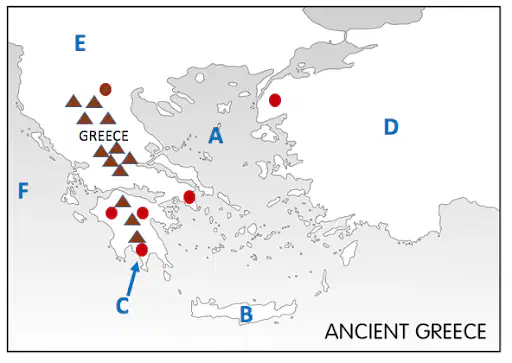
Which letter on the map represents the island of Crete?
a)
A
b)
B
c)
C
d)
D
18.
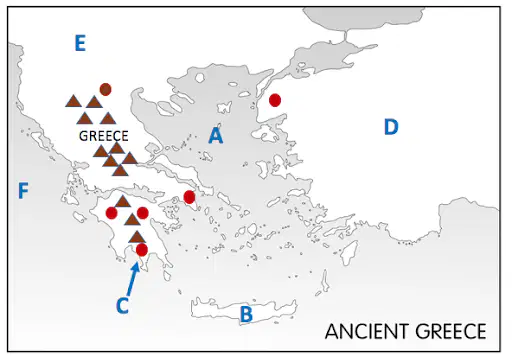
Which letter on the map represents the Aegean Sea?
a)
A
b)
C
c)
E
d)
F
19.
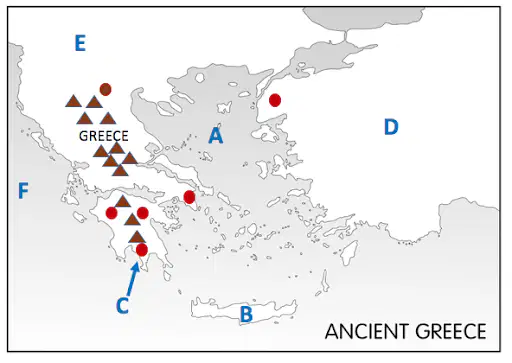
Which letter on the map represents the Ionian Sea?
a)
A
b)
B
c)
C
d)
F
20.
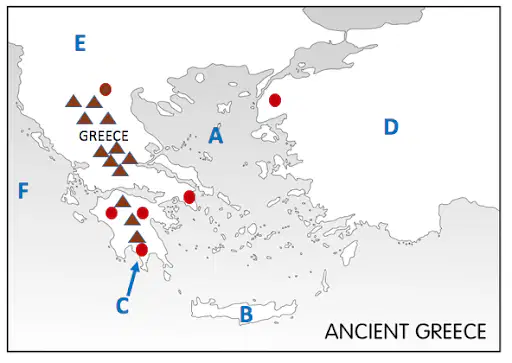
Which letter on the map represents where Sparta was located?
a)
E
b)
B
c)
C
d)
F
21.
What was a CAUSE of the wars between Persia and Greek city-states (The Persian Wars)?
a)
Athens wanted to conquer the Persian Empire.
b)
Persia wanted to expand their empire and control trade in the Aegean Sea.
c)
Spartans refused to fight in the battle of Marathon.
d)
The Greeks built a giant wooden horse and left it in Troy.
22.
Which type of government was practiced in Ancient Sparta?
a)
A monarchy led by a queen.
b)
A democracy led by all citizens
c)
A republic led by representatives of the citizens
d)
An oligarchy led by two kings and a council of elders
23.
Which of the following was Ancient Sparta known for?
a)
A school started by the philosopher Plato
b)
producing strong soldiers and a lifestyle that was focused on military strength
c)
hosting the Olympic games
d)
defeating the Persians at the battle of Marathon without the help of any other Greeks
24.
Which of the following was Ancient Athens known for?
a)
Culture that included art in the form of theater and sculpture, philosophy and the sciences.
b)
Creating the largest empire in the world at the time.
c)
Giving women more rights than any other civilization in the world.
d)
A perfect form of government that had no negative aspects
25.
Which of the following is a POSITIVE aspect of Democracy in Athens?
a)
Women were excluded from voting.
b)
All Athenian citizens had an equal voice and could propose and vote on laws.
c)
Men had to be born in Athens and have two Athenian parents to vote.
d)
Foreign-born men had no way to gain citizenship and no voting rights.
26.
In what way were Spartan women allowed more rights and responsibilities than women in Athens?
a)
Women in Sparta ran the government but women in Athens couldn't even vote
b)
Women in Sparta could get an education, received athletic training, and move about the city freely, but women in Athens could not.
c)
Women in Sparta could live a peaceful life at home but women in Athens were forced to train as warriors.
d)
Women in Sparta could raise their male children to adulthood but women in Athens were forced to give up their children at age seven.
27.
In ancient Athens, which of the following groups of people were allowed to participate in government as citizens?
a)
Greek adult women
b)
Greeks from other city-states
c)
Athenian adult men whose parents were from citizen families
d)
Athenian children
28.
Which of the following was a NEGATIVE aspect of Democracy in Athens that limited who was represented?
a)
The 500 council members of the Boule were chosen by lottery each year.
b)
Women, Slaves and Foreigners had no voting rights.
c)
Athenian citizens voted on all decisions.
d)
Term limits existed allowing no one person to get too powerful.
29.
What three major bodies of water is Greece surrounded by?
a)
Mediterranean Sea
b)
Ionian Sea
c)
Aegean Sea
d)
Red Sea
e)
Yellow Sea
30.
What made traveling in ancient Greece difficult, and caused them to develop into many separate city-states?
a)
Low flat plains covered in farmalnd
b)
Many islands and peninsulas covered in high mountains
c)
Sandy deserts covering high plateaus
31.
How did Greece get resources such as grain and metals?
a)
It had many productive farms and mines on its mainland
b)
By trading and conquering other areas to established colonies
32.
On which island did the Minoans live?
a)
Rhodes
b)
Sardinia
c)
Crete
d)
Cyprus
33.
With whom did Mycenae fight a war around 1200 BCE?
a)
Persia
b)
Troy
c)
Egypt
d)
Babylon
34.
What brought Persia into conflict with the Greek city-states?
a)
It sought to expand its power and take advantage of trade routes in the Aegean Sea
b)
It sought to dominate local politics and control trade in the Ionian Sea
c)
It sought to conquer Rome and dominate trade in the Tyrrhenian Sea
35.
A ruler who takes power away from a group.
a)
Tyrant
b)
Citizen
c)
Colony
d)
Democracy
e)
Monarchy
36.
A type of serious drama that usually ends in disaster for the main character.
a)
Tragedy
b)
Citizen
c)
Colony
d)
Democracy
e)
Monarchy
37.
An area of land almost completely surrounded by water and connected to the mainland by a narrow strip of land.
a)
Peninsula
b)
Citizen
c)
Colony
d)
Democracy
e)
Monarchy
38.
A form of government that has a single person known as a monarch as its head. (ex: King, Queen, Emperor, Empress,etc.)
a)
Monarchy
b)
Citizen
c)
Colony
d)
Democracy
e)
Oligarchy
39.
A group of people from one country who build a settlement in another territory, or land and maintain political and economic ties to their home country.
a)
Colony
b)
Citizen
c)
Democracy
d)
Monarchy
e)
Oligarchy
40.
A member of a nation or state.
a)
Citizen
b)
Colony
c)
Democracy
d)
Monarchy
e)
Oligarchy
41.
A form of government in which citizens govern themselves. (by voting)
a)
Democracy
b)
Citizen
c)
Colony
d)
Monarchy
e)
Oligarchy
42.
A form of government where most political power rests with a small group of people.
a)
Oligarchy
b)
Citizen
c)
Colony
d)
Democracy
e)
Monarchy
43.
A payment made in return for safety.
a)
Tribute
b)
Citizen
c)
Colony
d)
Democracy
e)
Monarchy
44.
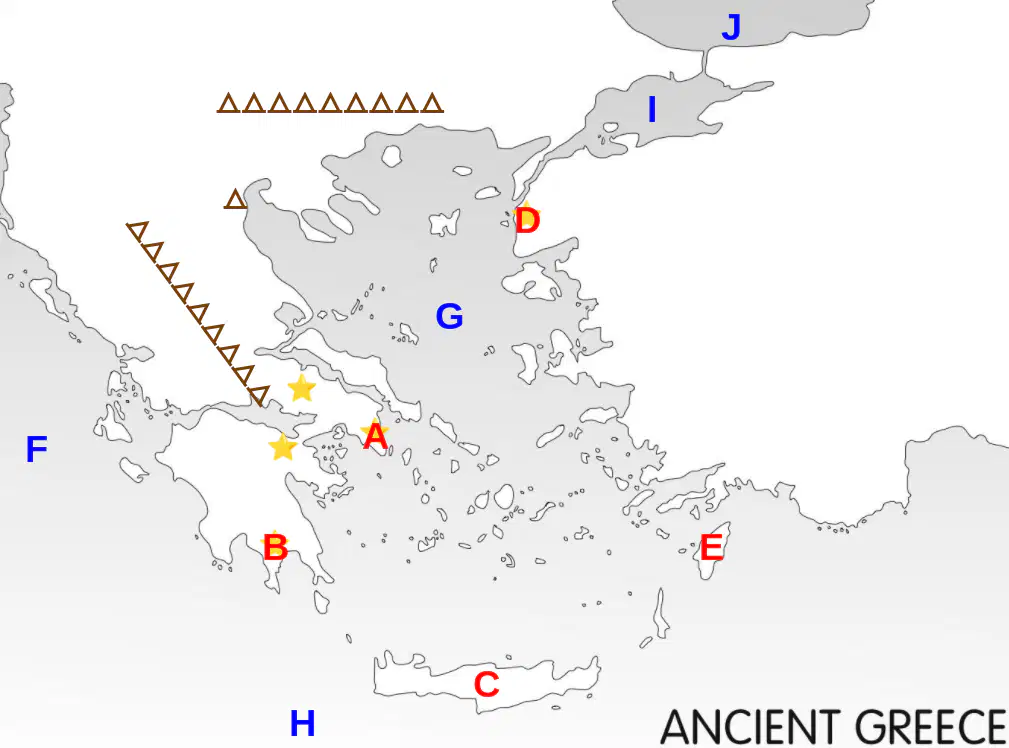
Mediterranean Sea
a)
H
b)
A
c)
B
d)
C
e)
D
45.
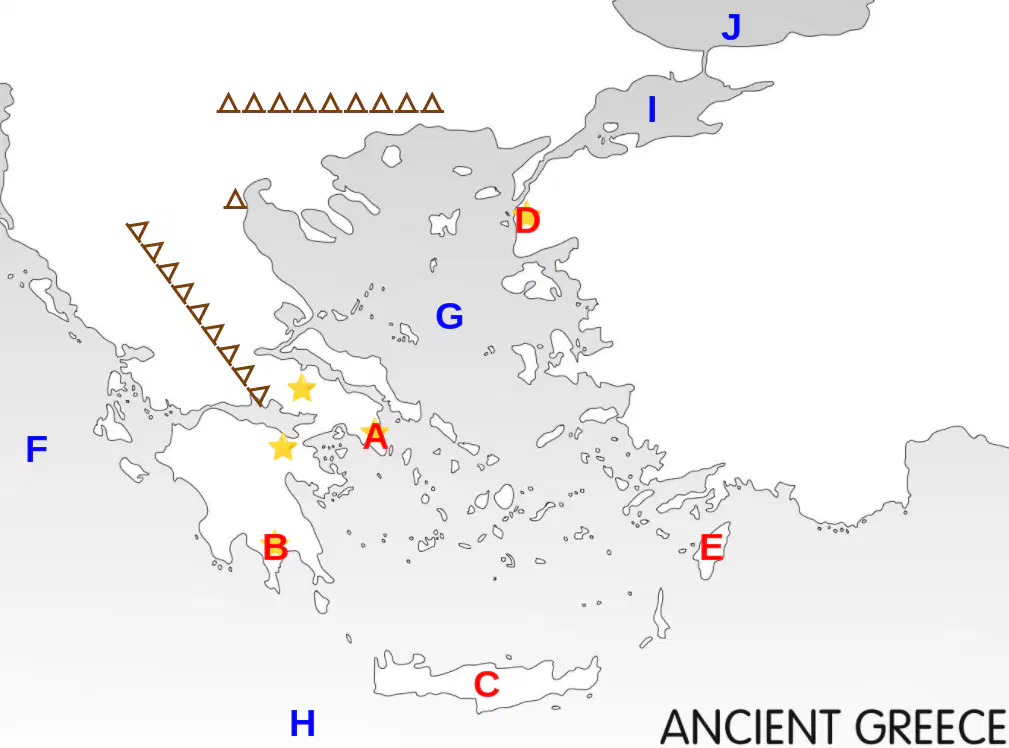
Athens
a)
A
b)
B
c)
C
d)
D
e)
E
Reset

