
 Worksheets
APWH Unit 7 - Global Conflict
Total questions: 20
Worksheet time: 20mins
His Majesty’s most loyal Muslim subjects should understand that His Majesty’s government is not fighting this war because of religion. The British navy and its military forces will not attack the holy places of Arabia or Jeddah unless the [Ottoman] Turks interfere with pilgrimages from India to the holy places and shrines in question. In that case, British military forces will intervene to keep the pilgrimage routes open. At the request of His Majesty’s government, the governments of France and Russia have given similar assurances.”
Source: Pamphlet published by the British Indian War Department, 1915. The pamphlet was translated and distributed in cities and towns in India.
Which of the following best explains why the British government felt the need to make the above statement?
British authorities were concerned that going to war against a Muslim country could fuel anti-imperialist protests among India’s large Muslim population.
Many people in Britain regarded the First World War as a religious conflict between Christian and Islamic states.
Religious tensions between India’s Muslim and Christian populations significantly increased before the outbreak of the First World War.
British passenger ships and shipping companies made significant profits by transporting Muslim pilgrims on the hajj from India to Mecca and Medina.

The picture shows Indian troops praying in Surrey, England in 1916.
The use of the soldiers pictured most directly relates to which causes of early 20th century global conflicts?
network of rival alliances
imperialist expansion for resources and markets
decline in global production and trade
emergence of revolutionary communism

“The integrity of what remains of the Ottoman Empire is one of the principles upon which the world’s balance of power is based. Therefore, I reject the idea that it is in our national interest to shatter one of the cornerstones of the international order. What if, after we have attacked Libya* and destabilized the Ottoman Empire, the Balkans begin to stir? And what if a Balkan war provokes a clash between the two power blocs and a European war? Italy must not be the country that bears the responsibility of putting a match to the powder keg.”
- Giovanni Giolitti, Prime Minister of Italy, speech before the Italian parliament, 1911
In addition to the potential destabilization of the Ottoman Empire, Giolitti’s argument regarding Italy’s ambitions in Libya is likely explained by the concern that any attempt by a European state to acquire colonies in Africa could:
lead African states to unite against colonial rule
greatly endanger the spread of Christianity and enable the spread of Islam
encourage the Chinese to take advantage an conquer Italian colonies in Africa
intensify rivalries between European states seeking territories and resources

The poster was featured at the 17th Congress of the Soviet Communist Party in 1934.
Which led directly to the establishment of the govt. that produced the poster?
redrawn national boundaries as a result of peace treaties ending WWI
increased ethnic violence in Russia due to imperial expansion in the 19th century
the collapse of the Russian Empire under the stress of WWI
the abolition of serfdom and other forms of coerced labor during the 19th century

There are those moralists who would sit and wait for the day when all wars would end. Yet in my opinion the Western nations are growing ever stronger in the skills of war. In recent years, these countries devise strange new weapons and day by day increase their standing armies. One can argue that that is truly useless, truly stupid. Yet if others are working on being stupid, then I must respond in kind.
If others are violent, then I too must become violent. International politics is the way of force rather than the way of virtue—and we should accept that.”
Yukichi Fukuzawa, Japanese intellectual, Commentary on the Current Problems, 1881
Ideas similar to those expressed by Fukuzawa would contribute to most directly to which of the following?
Japan's "economic miracle" in the 1950s and 60s
Japan's policy of demilitarization after WWII
Japanese imperialist policies in the first half of the 20th century
Japanese government attempts to mobilize public opinion in support of emperor worship in the 1930s & 40s
Which of the following most directly led to the start of the First World War?
nationalist rivalries for raw materials and markets
Japanese imperialist expansion into Korea and Vietnam
political tensions between democratic and totalitarian states
European powers meeting in Berlin to divide Africa into spheres of influence
"In our country [Russia] today, there are countless agitators…telling the peasant that he should demand a gratuitous share of somebody else’s land, or the worker that he should be getting hold of the entire capital and profits of the manufacturer. War with Germany will create exceptionally favorable conditions for such agitations.”
Source: Pyotr Durnovo, Russian Minister of the Interior, memorandum to Tsar Nicholas II, February 1914
Durnovo's argument regarding the effect of war between Russia & Germany would prove to be:
inaccurate in its prediction that war would lead to "social revolution"
accurate in its prediction that BOTH Germany & Russia would succumb to revolution
inaccurate in its prediction that revolution would break out first in the defeated country
accurate in its prediction that war with Germany would lead to a revolution in Russia
“At school the teachers say it is our patriotic duty to stop using foreign words. I didn’t know what they meant by
this at first, but now I see it—you must no longer say ‘adieu’ [‘farewell’] because that is French. It is in order to say
‘lebwohl’ [‘farewell’ in German] instead. We also have a little tin box in which we’ll put some small change in
every time we slip up and use a foreign word. The contents of this little war savings box will go towards buying
knitting wool. We must now knit woollen things for the soldiers.”
Source: Diary of a twelve-year old German girl, August 1914
The passage is an example of which process leading up to and during the First World War?
the increasingly authoritarian methods used by European school teachers
the strengthening of nationalist sentiment throughout Europe
the emergence of a pan - European (continent wide) antiwar movement
the key role women played in sustaining the war effort in European nations
The global economic downturn of the 1930s had which of the following effects on nations in Europe and North America?
International trade increased because nations lowered trade barriers.
Industrialized countries became more democratic as the public sought greater input in the making of economic policy.
Most imperial powers granted independence to their colonies because the costs of maintaining empires
became unsustainable.
Governments took a more active role in directing and regulating their economies to stimulate growth.
Although most Asiatic nations are fully peers of European nations, yet they are discriminated against because of the color of the skin. The root of this discrimination lies in the perverted feeling of racial superiority entertained by the whites. If the present situation
continues, there is every likelihood that the peace of the world will be endangered.” Q: Asian reactions to Western claims of racial and cultural superiority were also instrumental in the period 1918–1945 in the:
growing popularity of laissez-faire economic policies in Asian states
establishment of European immigrant enclaves in many parts of South and East Asia
intensification of anti-imperial resistance activities and independence movements
growing number of conversions to Christianity among Asian peoples
How did Nazi ideology differ from that of Communist ideology?
Communism often used science to justify its claims, Nazism did not
Nazis focused on a worldwide workers' revolution, while Communism focused on specific ethnicities
Communism allowed for free election, Nazism did not
Nazis focused on theories of race, while Communists focused on class struggle
How were Midway, Stalingrad and D-Day similar?
Each of these battles was staged to liberate a concentration camp in Nazi controlled Europe
They each represent turning point battles where the Allied forces prevailed and began pushing
back against Axis expansion
Each of these battles included the use of tactical nuclear weapons against Axis aggressors
They each represent turning point battles where the Axis forces prevailed and allowed for their
expansion into new territories
Which of the following was the most important factor behind Europeans’ readiness to embrace authoritarian political systems in the 1930s?
Dissatisfaction with the welfare state
The economic crisis caused by the Great Depression
Admiration for the economic achievement of the Soviet Union under Stalin
Resentment of United States mass culture and consumer society
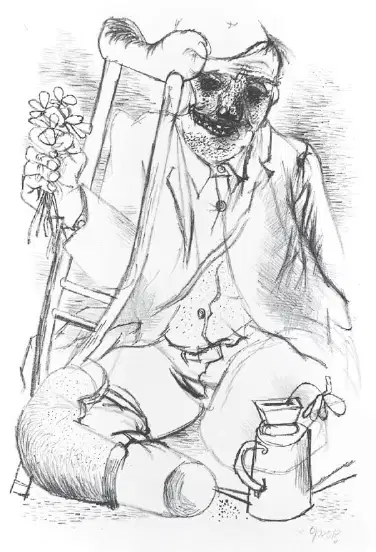
Which of the following best describes the 1936 lithograph by German artist George Grosz?
A propaganda poster prepared for the Nuremberg Rally by the Nazi Party
A representation of a Holocaust victim from Dachau
A protest poster against the atrocities of the atomic bomb
A post-First World War print expressing antiwar sentiment
His Majesty’s most loyal Muslim subjects should understand that His Majesty’s government is not fighting this war because of religion. The British navy and its military forces will not attack the holy places of Arabia or Jeddah unless the Turks interfere with pilgrimages from India to the holy places and shrines in question. In that case, British military forces will intervene to keep the pilgrimage routes open. At the request of His Majesty’s government, the governments of France and Russia have given similar assurances.”
- Pamphlet published by the British Indian War Department, 1915
Q: The treaties that settled the conflict referred to in the passage most directly changed the geopolitical structure of the Middle East in which of the following ways?
The state of Israel was created, which led to numerous wars.
Most states that were formerly under European colonial rule became independent.
Allied powers received territorial mandates from the League of Nations.
Religious fundamentalism increased, which led to attacks on Western states.
Which of the following developments most directly weakened European colonial states and contributed to the emergence of new nations in the 20th century?
The decline of European economies during the Great Depression
Japanese occupation of Southeast Asia during the Second World War
Competition between Great Britain and France
The conquest of Spanish imperial territories by the United States
Which of the following was a common characteristic of the major revolutions that occurred in Russia, China, and Mexico in the early twentieth century?
Nationalism and socialism helped shape all three revolutions.
Foreign powers played an important role in each revolution’s initial success.
The upper class of each society led the movement that resulted in revolution.
Each revolution failed after a short period of violent civil war.
“The way in which the nuclear weapons that we are now developing are first used will be of fateful importance. Our primary objective once the war is over should be to reach an international agreement on the total prevention of nuclear warfare. From this perspective, using nuclear weapons against Japan may easily destroy all our chances of success.
A demonstration of the new weapon might best be made, before the eyes of representatives of all nations, in a desert or on a barren island. Then America could argue, ‘We are ready to renounce the use of these weapons in the future if other nations join us in this renunciation and agree to the establishment of an efficient system of international control.’
-James Franck, German-born scientist developing nuclear weapons technology for the United States
Q: Which of the following arguments would a supporter of using nuclear weapons against Japan have most likely cited to explain the limitations of Franck’s arguments?
The United States use of nuclear weapons against Japan might provoke the Soviet Union into becoming Japan’s ally.
Japanese government propaganda instilled fierce, suicidal nationalism in the Japanese population, making Japan unlikely to surrender unconditionally without experiencing the effects of nuclear weapons.
The United States use of nuclear weapons against Japan would likely force the United States into a prolonged occupation of Japan in order to ensure the economic redevelopment of the country.
Japanese military actions in the Pacific, though often brutal, did not justify the use of nuclear weapons against Japanese cities with large civilian populations.
Which of the following best supports the contention that the First World War was the first total war?
All the major European powers were involved in the war.
Governments mobilized large segments of their populations and economies and targeted their opponents’ military and economic capabilities.
The militaries of all major powers used the most advanced weaponry available to them.
Many of the countries on the victorious side of the war were weakened politically by conflict.
This ‘peace’ offered to Germany is a mockery of President Wilson’s principles. Trusting in these, Germany surrendered and accepted peace. That confidence has been betrayed in such a manner that all Germans must now feel that they wish to shake off the heavy yoke imposed on them by the cajoling Entente. And we fear very much that they will soon find the opportunity to do so. Chained and enslaved, Germany will always remain a menace to Europe.”
Q: Which of the following accurately explains the historical significance of the harsh conditions imposed on Germany that the editorial describes?
They led to a successful communist revolution in Germany.
They triggered a massive wave of emigration from Germany.
They resulted in the virtual deindustrialization of Germany.
They encouraged the rise of political extremism in Germany.

