
 Worksheets
Lines And Angles
Total questions: 78
Worksheet time: 1hrs 10mins
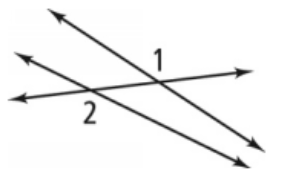
∠1 and ∠2 are __.
Alternate Interior Angles
Alternate Exterior Angles
Same-side Interior Angles
Corresponding Angles

∠8 and ∠6 are __.
Alternate Interior Angles
Alternate Exterior Angles
Same-side Interior Angles
Corresponding Angles
None of these
∠3 and ∠2 are ___.
Alternate Interior Angles
Alternate Exterior Angles
Same-side Interior Angles
Corresponding Angles
None of these
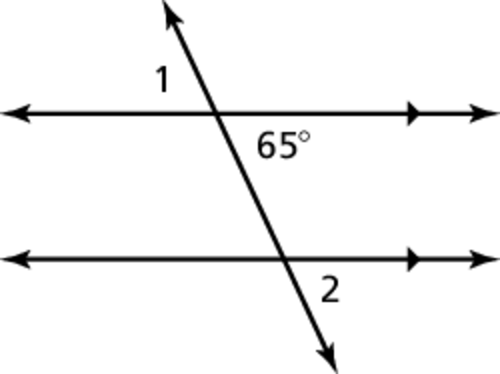
Find m∠2.
( NMMS 2010 )
65°
180°
115°
Find m∠1.
( NMMS 2010 )
180°
65°
115°
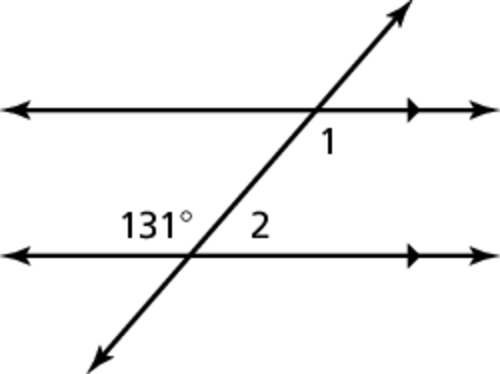
Find m∠1.
131°
180°
49°
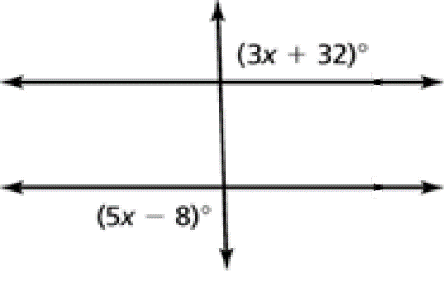
Which is the correct equation to solve for x?
40
20
-8
32

Given the two parallel lines cut by a transversal,
What is the measure of ∠4 if m∠8=76° ?
(a)
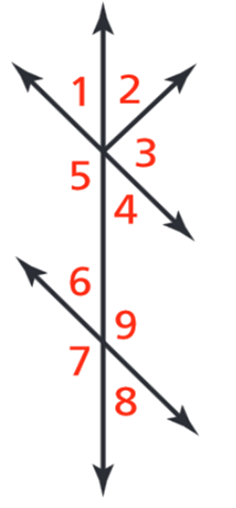
Which angle is a linear pair with ∠1 ?
∠2
∠3
∠4
∠5
∠6

Use the figure to determine which of the following angles has the greatest measure: ∠ 4, ∠ 8, ∠9
∠4
∠8
∠9
Not enough information
An angle which is complement of itself is___
90°
60°
45°
55°
Determine the measure of angle B.
59°
65°
115°
121°

Which lines are parallel?
p and r
q and s
p and s
q and r

If c∥d which statement is true?
∠1≅∠16
∠7≅∠10
m∠14+m∠15=180
m∠6+m∠10=180
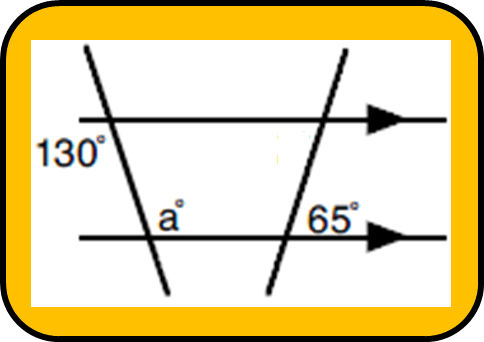
Calculate the missing angle.
130º
65º
50º
115º
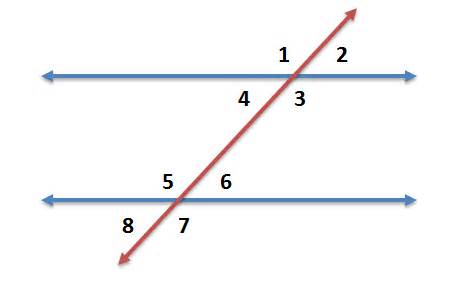


Two angles are complementary to each other and are equal. Find them ?
( NMMS 2012 )
500.500
450.450
900.900
300.300
The pair of ________ angles are complementary angles.
( NMMS 2011 )
obtuse
acute
reflex
right

The values of x, y and z in the adjacent diagram.
( NMMS 2019 )
x= 880, y = 670, z = 920
x= 920, y = 880, z = 670
x= 670, y = 920, z = 880
x= 880, y = 920, z = 670

From the figure, Find the value of
1160
1200
990
1180

Find the value of x.
35
140
175
75

Find the value of a.
58o
64o
116o
128o

Find the value of
∠PRQ45°
70°
65°
110°

Find the value of x.
130°
55°
30°
75°

Find
∠DCE if AB∥DE88°
53°
92°
35°

Find the value of x and y.
x=130°, y= 130°
x=50°, y= 130°
x=50°, y= 50°

Find the value of y.
7
6
5
8

Find the value of x.
30°
50°
45°
40°

Find the value of x if
l1∥l278°
35°
47°
57°

If AB∥CD Find the value of y.
126°
36°
54°
72°

Find the value of ∠BCE
75°
65°
140°
90°

If AB∥CD and BC∥DE, then find the value of x.
120°
140°
180°
40°
A triangle must have at least two acute angles


What is the value of x?
-5
5
8
11


Without using a protractor, find the measure of angle x.
214 degrees
6 degrees
186 degrees
180 degrees


Solve for x.
x = 10
x = 9
x = 2
x = 11
Determine the measure of angle B.
59°
65°
115°
121°

2. Line m represents a straight wire attached to 2 parallel telephone poles as shown above. Which statement is true?
∠5≅∠3
m∠3+m∠5=180°
m∠4+m∠6=180°
∠2≅∠3
∠5≅∠6
If c∥d which statement is true?
∠1≅∠16
∠7≅∠10
m∠14+m∠15=180
m∠6+m∠10=180

If the m∠6=55°, what is m∠12 and which rule did you use?
55°
125°
Alternate exterior angles are congruent.
Alternate exterior angles are supplementary.
You don't use alternate exterior angles, at all. I used a different rule.
If the m∠11=105°, what is m∠12 and which rule did you use?
105°
75°
Alternate exterior angles are supplementary.
Consecutive interior angles are supplementary.
Linear pairs are supplementary.
If the m∠8=50°, what is m∠10 and which rule did you use?
130°
50°
Alternate exterior angles are complementary.
Consecutive interior angles are supplementary.
Neither, I used a different rule.
If the m∠9=122°, what is m∠10 and which rule did you use?
122°
68°
58°
Consecutive interior angles are supplementary.
Consecutive exterior angles are supplementary.

Find x:
3
3.86
71
88.2
Other

If ∠9=4x and ∠10=6x−10, solve for ∠13 Hint: solve for x, first
5
19
160
104
76
If ∠6=18−3x and ∠12=10x+109, solve for ∠13 Hint: solve for x, first.
7
141
-7
39
Other
If ∠7=45x+120 and ∠13=135x+30, solve for ∠9 Hint: solve for x, first.
35
1
165
1/6
135

Which angles need to be congruent, for lines k and m to be parallel?
∠1 and ∠3
∠1 and ∠5
∠5 and ∠3
∠1 and ∠8
∠6 and ∠3

If AB || CD, which pair of angles are same side supplementary angles?
∠4≅∠5
∠3≅∠7
∠3≅∠5
∠1≅∠7
If AB || CD, which pair of angles are alternate exterior angles?
∠3≅∠6
∠1≅∠5
∠3≅∠5
∠2≅∠8


What is the value of X?
110°
120°
60°
90°

In this figure, lines m and n are l l . Name all of the angles that have the same measure as <1.
<3, <2 and <6
<3, <5 and <7
<2, <6 and <8
<3

Look at the figure. Which statement must be true in order to prove that lines b and c are parallel?
<1 is congruent to <7
<1 is congruent to <4
<3 is supplementary to <6
<1 is supplementary to <2

Which term best describes the relationship between <3 and <6?
Same-side exterior angles
Corresponding angles
Alternate Interior angles
Same-side Interior angles

Which angle is supplementary to <4?
<5
<3
<1
All of the above

Which theorem explains why <7 is congruent to <3?
Same Side Interior Angles Postulate
Alternate Interior Angles Theorem
Corresponding Angles Theorem
Vertical Angles Postulate

What is the length of AC?
6cm
3 cm
1.5 cm
9cm

Line I is the perpendicular bisector of AB. What is the length of AB?
6 cm
3 cm
12 cm
20 cm
A ______________ is a line that intersects other lines.
straight line
perpendicular
parallel line
transversal
Alternate interior angles lie on _____________ sides of the transversal and inside the intersected lines.
same side
upside down
opposite
similar

Name a pair of alternate interior angles.
<2 and <7
<1 and <6
<3 and <7
<7 and <4

Name a pair of same side interior angles.
<3 and <2
<6 and <7
<1 and <4
<5 and <1

Name a pair of alternate exterior angles.
<1 and <8
<6 and <7
<3 and <8
<4 and <5

What is the measurement of the angle labeled as "1"?
133°
180°
90°
47°

What is the measurement of angle 2?
119°
71°
63°

Find X
x = 8x - 34
x = 12
x = 5x

Determine if the angle relationship is enough to prove the line m l l line n. If so, Identify what theorem you used to prove the lines are parallel.
<3 + <6 = 180
No, Converse of different side exterior angles
Yes, converse of same side interior angles postulate
Yes, converse of corresponding angle
No, Can't prove
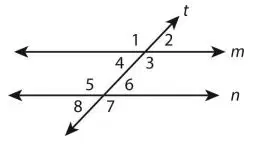
Determine if the angle relationship is enough to prove the line m l l line n. If so, Identify what theorem you used to prove the lines are parallel.
<4 is congruent to <6
Yes, converse of alternate interior angles theorem
No, can't prove
Yes, Congruent angle theorem
Yes, Alternate exterior angles postulate

