
 Worksheets
Chapter 11: Root Morphology
Total questions: 26
Worksheet time: 20mins
Root pain due to exposed dentin is caused by gingival recession. Exposed spots of dentin can stimulate pulpal nerves through the cementoenamel junction (CEJ).
Both statements are true.
The first statement is true, the second is false.
The first statement is false, the second is true.
Both statements are false.
Pressure and temperature responses are elicited by all of the following EXCEPT one. Which one is the EXCEPTION?
Bone
Periodontal ligament
Gingiva
Pulp tissue
Blood vessels traveling through the apical foramen support nerves and odontoblasts because the blood supply enables delivery of essential nutrients as well as removal of harmful products.
Both the statement and the reason are correct and related.
Both the statement and the reason are correct but are NOT related.
The statement is correct, but the reason is NOT correct.
The statement is NOT correct, but the reason is correct.
NEITHER the statement NOR the reason is correct.
Each of the following teeth frequently has two roots EXCEPT one. Which one is the EXCEPTION?
Maxillary first premolar
Maxillary second premolar
Mandibular first molar
Mandibular second molar
Maxillary molar root trifurcations are located on each of the following surfaces EXCEPT one. Which one is the EXCEPTION?
mesial
distal
lingual
buccal
Orthodontics requires a sustained pressure to move teeth to a new location. Osteoblasts respond to the new location by forming new bone.
Both statements are true.
The first statement is true; the second is false.
The first statement is false; the second is true.
Both statements are false.
Teeth with curved roots afford resistance to apical and distal forces but are vulnerable to occlusal forces. Roots with triangular cross section are particularly vulnerable to lateral displacement.
Both statements are true.
The first statement is true, the second is false.
The first statement is false, the second is true.
Both statements are false.
Root canal therapy in third molars is considered very unpredictable because the tooth is located so far distally in the mouth.
Both the statement and the reason are correct and related.
Both the statement and the reason are correct but are NOT related.
The statement is correct, but the reason is NOT correct.
The statement is NOT correct, but the reason is correct.
NEITHER the statement NOR the reason is correct.
Mandibular premolars typically have two pulp canals. Maxillary first premolars are more likely than maxillary second premolars to have two pulp canals.
Both statements are true.
The first statement is true, the second is false.
The first statement is false, the second is true.
Both statements are false.
During hypercementosis, excess cementum is deposited
Along the CEJ
Irregularly, throughout the root surface
At the dentinocemental junction
At the apex of the root
Cementum formed during hypercementosis is different from the cementum lining the root because this newly formed product can continue to grow and add on to itself.
Both the statement and the reason are correct and related.
Both the statement and the reason are correct but are NOT related.
The statement is correct, but the reason is NOT correct.
The statement is NOT correct, but the reason is correct.
NEITHER the statement NOR the reason is correct.
Each of the following root characteristics provides significant resistance to displacement from traumatic forces EXCEPT one. Which one is the EXCEPTION?
Root grooves
Root concavities
A short, smooth root
Multiple roots
A slight amount of mobility is not considered normal. Orthodontics can help with bone remodeling that can prevent even slight tooth mobility.
Both statements are true.
The first statement is true; the second is false.
The first statement is false; the second is true.
Both statements are false.
Each of the following is a characteristic of the periodontal ligament EXCEPT one. Which one is the EXCEPTION?
Capable of regeneration
Capable of compression
Provides tension
Provides support
A patient who has sensitivity in the mandibular anterior area due to abrasion is interested in having her teeth bleached. Which factor could contribute to her sensitivity?
Discolored teeth
Thin, uneven cementum
Root canal treatment on mandibular central incisors
Slight mobility
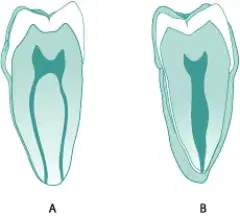
The figure below shows a mesial view (A) and a distal view (B) of a linguobuccal section. Identify the tooth.
Mandibular first premolar
Mandibular second premolar
Mandibular first molar
Mandibular second molar
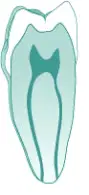
Which of the following best describes the root canal opening(s) in the figure below?
Accessory root canals
One main and one accessory root canal
Two apical root canals
An 11-year-old boy, Ronald, has an overjet and is being treated by an orthodontist. At a routine appointment, Ronald mentions that he feels some pressure in the area of his maxillary anterior incisors and asks if this is unusual. The orthodontist examines Ronald, makes some adjustments to his appliance, and reviews his radiographs. He informs Ronald that he is pleased with the movement of his teeth and that he may feel occasional pressure throughout treatment. In Ronald's case, each of the following radiographic findings is considered normal during orthodontic treatment EXCEPT one. Which one is the EXCEPTION?
Bone remodeling
Widening of the PDL
Bone resorption
Root resorption
An 11-year-old boy, Ronald, has an overjet and is being treated by an orthodontist. At a routine appointment, Ronald mentions that he feels some pressure in the area of his maxillary anterior incisors and asks if this is unusual. The orthodontist examines Ronald, makes some adjustments to his appliance, and reviews his radiographs. He informs Ronald that he is pleased with the movement of his teeth and that he may feel occasional pressure throughout treatment. Which factors contribute to forming new bone (select all that apply)?
PDL tension/compression
Sustained orthodontic force
Osteoclastic activity
Osteoblastic activity
Pain within the root (root pain) can be elicited by which of the following (select all that apply)?
Root decay
Root resorption
Secondary dentin
Dehydration
Reparative dentin
Which of the following travel through the apical foramen (select all that apply)?
Nerves
Enamel pearls
Blood vessels
Nutrients
Lymphatic vessels
Dentin tubules can carry a stimulus from the root surface to the nerves in the pulp canal.
True
False
The cementum covering the root is thick and smooth when first formed.
True
False
Root pain always means that dental caries is present.
True
False
If there are two pulp canals in a root, there could be one or two openings in the root.
True
False
Mandibular second molars often have two canals in each root.
True
False

