
NEW
Font size
S
M
L
XL
 Worksheets
QUIZ 1 FIRST QUARTER
Total questions: 15
Worksheet time: 8mins
Name
Class
Date
1.
Which of the following does not show a sequence?
a)
K to 12 Curriculum
b)
Months of a year
c)
Body temperature
d)
Counting numbers
2.
What are the next four terms of the sequence 2, 3, 5, 8, ....?
a)
12, 17, 23, 30
b)
12,20,33,54
c)
13,21,34,55
d)
13,18,23,28
3.
Which of the following is a finite sequence?
a)
negative even numbers
b)
even numbers below 100
c)
even numbers greater than 1
d)
even numbers between 10 and 50
4.
What is the 9th term in the sequence −1, 4, −9, 16, −25, ...?
a)
64
b)
-81
c)
-64
d)
81
5.
Find the first four terms of the sequence an = 5n − 1.
a)
5,10,15,20
b)
6,11,16,21
c)
4,9,14,19
d)
5,9,13,17
6.
What is the 20th term of the sequence 𝑎>𝑛 = (−1)^𝑛/𝑛^2 ?
a)
1/400
b)
-1/400
c)
20/400
d)
-20/400
e)
Option 5
7.
What rule will correctly describe the sequence: 2, 5, 10, 17, 26, 37, …?
a)
N + 1
b)
2N
c)
2n+1
d)
n2+1
8.
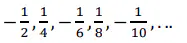
Find the nth term of the sequence
a)
Option 1
b)
Option 2
c)
Option 3
d)
Option 4
9.

Consider the figures below, what is the nth term of the sequence?
a)
Option 1
b)
Option 2
c)
Option 3
d)
Option 4
10.
Which numerical pattern follows the rule “the next term is obtained by alternately subtracting 2 and multiplying by 3”, when starting with 5?
a)
5,7,21,69
b)
5, 3, 6, 4, 12
c)
5, 9, 14, 36
d)
5, 3, 9, 7, 21
11.
Which is the next ordered pair in the pattern (1, 6), (3, 18), (5, 30)?
a)
(7, 49)
b)
(7, 42)
c)
(8, 56)
d)
(8, 64)
12.

a)
28/5
b)
-24/5
c)
30/5
d)
-26/5
13.

If x represents the number of terms, what is the rule for this pattern?
a)
4X
b)
X+4
c)
4X+28
d)
4X+32
14.
Which of the following patterns shows infinite sequence?
a)
6, 12, 18, 24, 30
b)
English Alphabets
c)
First 20 whole number
d)
100, 50, 25, 12.5, . ..
15.
Madison has the number pattern {5, 3, 8, 6, 11} for a homework problem. She says that the number pattern is alternately adding 5 and subtracting 2. Did Madison correctly describe the pattern?
a)
A) No, the pattern is alternately adding 5 and subtracting 2.
b)
B) No, the pattern is alternately subtracting 2 and adding 5.
c)
C) No, the pattern is alternately subtracting 3 and adding 4.
d)
D) Yes, Madison's description of the pattern is correct.
Reset

