
 Worksheets
Assessment| Chemistry Revision
Total questions: 100
Worksheet time: 1hrs 15mins
Which statement explains why ammonia gas, NH3, diffuses at a faster rate than
hydrogen chloride gas, HCl ?
Ammonia expands to occupy all of the space available.
Ammonia has a smaller relative molecular mass than hydrogen chloride.
Ammonia is an alkali and hydrogen chloride is an acid.
Ammonia molecules diffuse in all directions at the same time.
2.00 g of powdered calcium carbonate is added to 50.0 cm3 of hydrochloric acid.
Which apparatus is used to measure the calcium carbonate and the hydrochloric acid?
calcium carbonate- balance; hydrochloric acid-burette
calcium carbonate-balance; hydrochloric acid-thermometer
calcium carbonate-pipette; hydrochloric acid-burette
calcium carbonate-pipette; hydrochloric acid-thermometer

The measurements from a chromatography experiment using substance F are shown. The diagram is not drawn to scale.
What is the Rf value of F?
0.55
0.61
0.90
1.64
Which statement describes the structure of an ionic compound?
It is a giant lattice of oppositely charged ions.
It is a giant lattice of positive ions in a ‘sea’ of electrons.
It is a giant molecule of oppositely charged ions.
It is a simple molecule of oppositely charged ions.
Propane burns in oxygen.
C3H8 + xO2 → 3CO2 + yH2O
Which values of x and y balance the equation?
x:5, y:4
x:7, y:4
x:10, y:8
x:13, y:8
Magnesium reacts with sulfuric acid.
What are the formulae of the products formed in this reaction?
MgSO4 and H2
MgSO4 and H2O
Mg(SO4)2 and H2
Mg(SO4)2 and H2O
Which statement explains why graphite is used as a lubricant?
All bonds between the atoms are weak.
It conducts electricity.
It has a low melting point.
Layers in the structure can slide over each other.
Ethanol is used as a fuel.
ethanol + oxygen --> carbon dioxide + water
Which statements are correct?
1 The reaction is endothermic.
2 The products have more energy than the reactants.
3 The oxygen for this reaction comes from the air.
4 The temperature of the reaction mixture rises during this reaction.
1 and 2
1 and 3
2 and 4
3 and 4
Which metal has variable oxidation states?
aluminium
calcium
copper
sodium
What is the catalyst in the Haber process?
Fe
Ni
Pt
V2O5
Which calcium compound does not neutralise an acid soil?
calcium oxide
calcium sulfate
calcium hydroxide
calcium carbonate
Which type of linkage joins the amino acids in a protein?


In which molecule are all the outer shell electrons from each atom used to form covalent bonds?
CH4
Cl2
H2O
NH3

The diagram shows a section of an overhead power cable.
Which statement explains why a particular substance is used?
Aluminium has a low density and is a good conductor of electricity.
Ceramic is a good conductor of electricity.
Steel can rust in damp air.
Steel is more dense than aluminium.
Which row describes an endothermic reaction?


Some metal nitrates and carbonates decompose when heated strongly.
Metal Q has a nitrate that decomposes to give a salt and a colourless gas only.
The carbonate of metal Q does not decompose when heated with a Bunsen burner.
What is metal Q?
calcium
copper
sodium
zinc
Aluminium is extracted from its ore by electrolysis.
Which equation represents the reaction that occurs at the anode during the electrolysis?
Al3+ + 3e– ----> Al
Al3+ ---> Al + 3e–
2O2– ---> O2 + 4e–
2O2– + 2e– ---> O2

A
B
C
D

A
B
C
D

A
B
C
D

A
B
C
D

A
B
C
D

A
B
C
D

A
B
C
D

A
B
C
D

A
B
C
D

A
B
C
D

A
B
C
D

A
B
C
D

A
B
C
D

A
B
C
D

A
B
C
D

A
B
C
D

A
B
C
D

A
B
C
D

A
B
C
D

A
B
C
D

A
B
C
D

A
B
C
D

A
B
C
D

A
B
C
D

A
B
C
D

A
B
C
D

A
B
C
D

A
B
C
D

A
B
C
D

A
B
C
D

A
B
C
D

A
B
C
D

A
B
C
D

A
B
C
D

A
B
C
D
Smaller clumps allow for a _________ surface area to be exposed for the reaction.
the surface area of the reactants are smaller.
Na2S + 2 HCl → 2NaCl + H2S
What would happen if we increased the volume of the container where the reaction occurred?
More NaCl would be produced
Less H2S would would be produced
More reactions would occur
More HCl would be needed
(NH4)2SO4 + Ba(NO3)2 → 2NH4NO3 + BaSO4
What would happen if we increased the concentration of (NH4)2SO4?
More product would be produced
Less (NH4)2SO4 would participate in the reactions
There would be less collisions between
(NH4)2SO4 and Ba(NO3)2
There would be more Ba(NO3)2 particles to react

Which of the following would increase the number of collisions that occur? Choose all that appy.
Increase Surface Area
Decrease Concentration
Increase Temperature
Increase Volume
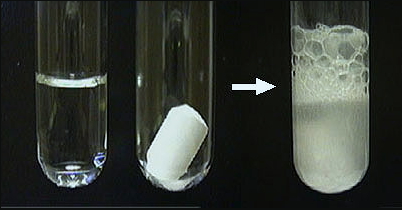
How could we make this reaction happen more quickly?
Decrease the concentration of the acid
crush the chalk to increase the surface area
Put the test tube in an ice bath
AgNO3 + NaCl → AgCl + NaNO3
What would you expect to happen if we decrease the temperature of this reaction container?
The energy of the reactants would decrease.
The would be more product produced.
The number of particles of
AgNO3 and NaCl would decrease.
The number of collisions in the reactants would increase.
More collisions (in the correct orientation) results in... (choose all that apply)
a slower reaction rate
an increased reaction rate
more product being produced
less volume of the reaction container

Which of the following is true?
The reaction rate of the diagram on the left would be greater because there are more collisions that will happen because of greater surface area.
The reaction rate of the diagram on the right would be greater because there are more collisions that will happen because of lesser surface area.
The reaction rate of the diagram on the right would be greater because there are more collisions that will happen because of greater surface area.
The reaction rate of the diagram on the left would be greater because there are more collisions that will happen because of lesser surface area.

In which container would you expect a higher reaction rate, and why? (Note: The number of particles is the same in both containers.)
The left would have a higher reaction rate because it has a greater volume and more collisions will happen.
The right would have a higher reaction rate because it has a greater volume and more collisions will happen.
The left would have a higher reaction rate because it has a lesser volume and more collisions will happen.
The right would have a higher reaction rate because it has a lesser volume and more collisions wil happen.
The average bond enthalpies for O-O and O=O are 146 and 496 kJ/mol respectively. What is the enthalpy change, in kJ, for the reaction below?
H-O-O-H(g) → H-O-H(g) + ½O=O(g)
-102
+102
+350
+394
When the solids Ba(OH)2 and NH4SCN are mixed, a solution is produced and the temperature drops. Which statement about the energetics of this reaction is correct?
The reaction is endothermic and ΔH is negative
The reaction is endothermic and ΔH is positive
The reaction is exothermic and ΔH is negative
The reaction is exothermic and ΔH is positive
The following equation shows the formation of magnesium oxide from magnesium metal. Which statement is correct for this reaction?
2Mg(s) + O2(g) → 2MgO(s) ΔH = -1204 kJ
1204 kJ of energy are released for every mole of magnesium reacted
602 kJ of energy are absorbed for every mole of magnesium oxide formed
602 kJ of energy are released for every mole of oxygen reacted
1204 kJ of energy are released for every two moles of magnesium oxide formed
For the reaction 2H2(g) + O2(g) → 2H2O(g) the bond enthalpies (in kJ/mol) are
H-H = x, O=O = y, O-H = z
Which calculation will give the value, in kJ/mol, of ΔH for the reaction?
2x + y - 2z
4z - 2x - y
2x + y - 4z
2z - 2x - y

Does breaking bonds require energy, release energy, or not involve energy at all?
requires energy to break
releases energy when broken
No energy involved
What kind of energy change happens in the photosynthesis reaction in plant leaves?
Endo
Exo
No change
Burning leaves and burning a fuel provide a(n) _______ change.
endothermic
exothermic
physical
When new chemical bonds form, energy ____________.
is taken into the system.
is released from the system.
stays the same in the system.
In a reaction old bonds _______ and new bonds _______.
form , break
break, form
stay, added
Is this equation endo- or exo-thermic?
PCl3 (s) + Cl2 (g) → PCl5 (s) + energy
endothermic
exothermic
Is this equation endo- or exo-thermic?
2KNO3 (s) + energy → 2KNO2 (s) + O2 (g)
endothermic
exothermic
Is this reaction endo- or exo-thermic?
NH4NO2 + energy → N2 (g) + 2H2O (g)
endothermic
exothermic






H
S
O
In the reaction 2Ca(s) + O2(g) → 2CaO(s), calcium is
Reduced
Synthesized
Oxidized
None of the above
In the reaction Zn + H2O → ZnO2 + H2 which element, if any, is oxidized?
Zinc
Hydrogen
Oxygen
None
What substance is oxidized in the following reaction?
4Fe + 3O2 → 2Fe2O3
Iron
Fluorine
Oxygen
Iron oxide

