
 Worksheets
ECOLOGY REVIEW
Total questions: 65
Worksheet time: 22mins
What is the branch of science that deals with the study of living things and their relationship with the environment?
Anthropology
Ecology
Ecosystems
An ecosystem thrives with biotic and abiotic components. An example of an abiotic part of an ecosystem is ______________.
Bacteria
Fungus
Water
Decaying plants
What is a community?
A habitat with abiotic factors
A very small habitat
All the abiotic factors in a specific area
All the different populations that live together in an area
Water, soil, minerals, nitrogen and energy are all essential ______ components of an ecosystem.
abiotic
Materials
Biotic
Environmental

All living things or organisms in an ecosystem are
None
biotic factors
abiotic factors
Which of the following are all abiotic?
Temperature, Light, Rain, Gravity, Heat
Water, Fish, Insects, Lily Plants
Dogs, Meat, Cats, Catnip
Lion, Pride Rock, Warthog, Meerkat
Which of the following are all biotic?
Temperature, Light, Rain, Gravity, Heat
Water, Fish, Insects, Lily Plants
Dogs, Meat, Cats, Catnip
Lion, Pride Rock, Warthog, Meerkat

Which level of organization is depicted in this image?
Population
Community
Ecosystem
Biome
Biosphere

Which level of organization is depicted in this image?
Population
Community
Ecosystem
Biome
Biosphere

Which of the following organism above are considered "Heterotrophic"?
Deer
Fern Plant
Apple Tree
Owl
Skunk
Which of the following organism above are considered "Autotrophic"?
Lemongrass
Fox
Apple Tree
Rose Plant
Sunlight
Which category of organism cannot make its own food?
Autotroph
Heterotroph
What type of organism makes its own food?
Autotroph
Heterotroph

What is a lion?
autotroph
heterotroph

What is asparagus?
autotroph
heterotroph


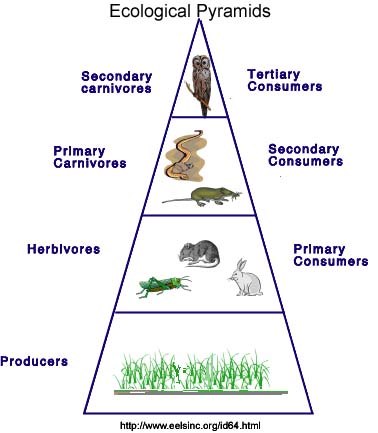

What amount of percentage does the energy decrease as it goes up the pyramid?
100%
1000%
10%
1%
How does the energy flow in an energy pyramids?
up the pyramid
down the pyramid
The German biologist ________ came up with the term “ecology”, as he viewed nature as a house with its own economy.
Galileo Galilei
Isaac Newton
Albert Einstein
Ernst Haeckel
Level of organization: Reorder the following from smallest to largest
Individual (Species)
Population
Community
Ecosystem
Biome
Species
a group of organisms that are genetically related and can breed to produce fertile young
Population
a group of organisms of one species that interbreed and live together within a defined area.
Communities
groups of populations comprised of many species that live together in a defined area.
ecosystem
a combination of the communities and the physical (non-living) environment.
Biome
large area that has a particular climate, and particular species of plants and animals that
Abiotic Factor
nonliving factors (soil, pollution, natural disasters, climate)
Biotics Factor
Living factors (plants and animals)
Habitat
is a place where a particular population lives (anthills, squirrel nests, beaver dams, etc)
What term do ecologists use to describe where an animal lives (an animal’s home)?
Ecosystem
Ecologist
Habitat
Population
Which of the following is NOT a nonliving thing? (which one is living?)
Sun
Rocks
Milk
Wood
What type of organism can make its own food?
A producer (an autotroph)
A consumer (a heterotroph)
A decomposer
All of the above
Organisms that can make their own food do so by the process of:
decomposition
respiration
photosynthesis
scavenging
What type of consumer eats plants?
Herbivore
Omnivore
Carnivore
Both herbivore and omnivore
What is a food chain?
A representation of an organism’s life cycle
A way to show the feeding relationships between organisms
The sequence of events that occurs during photosynthesis
A way to show how animals interact with nonliving parts of the environment
The first organism in a food chain is ALWAYS a:
producer
consumer
decomposer
Any of the above
How much energy is transferred between trophic levels?
25%
20%
10%
90%

What type of relationship is this?
parasitism
mutualism
commensalism
competition

symbiotic relationship in which both organisms benefit
competition
mutualism
predation
commensalism

symbiotic relationship in which one organisms benefits and the other organism is not affected
competition
mutualism
parasitism
commensalism


Sheep are herbivorous. What can you infer from this?
They are primary consumers.
They are producers.
They are secondary consumers
They are decomposers.
How is a food web different from a food chain?
Food webs contain only producers, not consumers.
. Food webs do not include decomposers
Food webs contain many different, linked food chains.
Food webs exist in aquatic environments; food chains exist in terrestrial environments.
What can you infer from the fact that the disappearance of just one species can disrupt an entire food chain?
Every food chain depends entirely on a single species.
Food chains are extremely fragile.
Food chains can regenerate on their own.
Food chains would not exist without humans.

This organism is most likely:
A primary consumer
A secondary consumer
A decomposer
A producer

