
 Worksheets
Magnets & Electricity Review
Total questions: 20
Worksheet time: 11mins
Adding a second battery to an electromagnet will _____.
decrease the resistance in the wire
decrease the magnetism in the wire
increase the current flowing through the wire
increase the amount of current needed to magnetize the wire
As the number of turns on an electromagnet is decreased, the pole strength of the electromagnet
Decreases
Increases
Remains the same
Two magnets move away from each other. What happens to the magnetic attraction between them as they become further apart?
It decreases
it increases
it becomes zero
it does not change
Lightning is an example of objects, clouds, becoming electrically charged due to induction. When the negative charges in the cloud jump to an object containing the opposite charge, we call the sudden flow of electrons ______________
electric generator
sonic boom
static discharge
static friction
Two negatively charged particles are 1 millimeter apart. The electric force between them is 20 Newtons. How will the amount of electric force between the particles change if the particles move closer together
force will increase
force will decrease
force will stay the same
force will disappear
If you cut a magnet in half you will have
Two magnets, one with a north pole only and one with a south pole only
One half will be a magnet and the other will no longer be a magnet
Two magnets, each with a north pole and a south pole
Two pieces but neither will be magnets anymore
When two neutral materials are rubbed together, there is a transfer of electrical charge from one material to the other. The total electrical charge for the system _________________
Increases as electrons are transferred
Increases as protons are transferred
Remains constant (unchanged) as protons are transferred
Remains constant (unchanged) as electrons are transferred
An inflated balloon which has been rubbed against a person's hair is touched to a neutral wall and remains attracted to it. Which diagram best represents the charge distribution on the balloon and wall?


What do you call a material in which releases its electrons easily?
conductor
insulator
glass
static
If a glass plate is placed over a magnet and iron filings are sprinkled over the glass, a pattern will be visible. What does this pattern indicate?
The magnetic field
The electrostatic field
The piezoelectric effect
The chemical reaction of the magnet and the filings

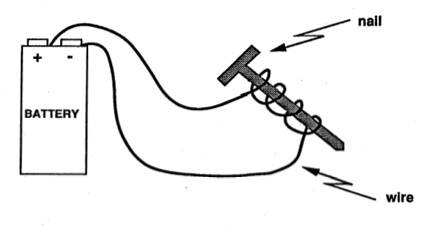
What is described as the flow of charged particles?
electric field
frictional force
electric current
gravitational force
Electricity is defined as the buildup or movement of ---
protons
energy
electrons
atoms
When you take your socks out of the dryer, sometimes they cling to other articles of clothing. This result is produced by the --
transfer of electric charges to clothes from faulty wiring in the dryer
formation of ionic bonds between the articles of clothing
build up of sticky residue on clothes from incomplete rinsing during the wash cycle
creation of static electric charges by friction as the clothes tumble inside the dryer
You can watch static electricity in action by rubbing an inflated balloon against your hair. Your hair will actually stand on its end! It does this because each hair becomes charged, and they all repel one another.
However, eventually, your hair will return to normal. Why is this?
The charge accumulated in your hair eventually just disappears.
The charge accumulated in your hair is eventually converted to neutral particles.
The charge accumulated in your hair is eventually broken down by the nuclear force.
The charge accumulated in your hair is eventually transferred to the surrounding environment.
There are three ways objects can become electrically charged. They are friction, induction and
conduction
Convection
radiation
polarization

