
 Worksheets
ORTHO ⏐ 𝙲𝙰 𝟸
Total questions: 12
Worksheet time: 12mins
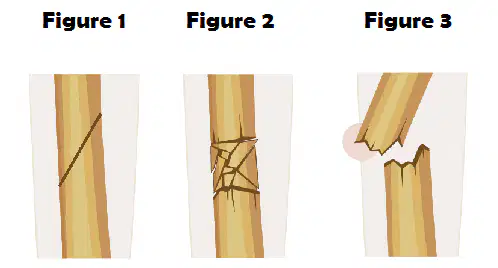
Figure 1 represents what type of bone fracture: This is a fracture that is slanted across the bone shaft.
Oblique Fracture
Transverse Fracture
Spiral Fracture
Compound Fracture
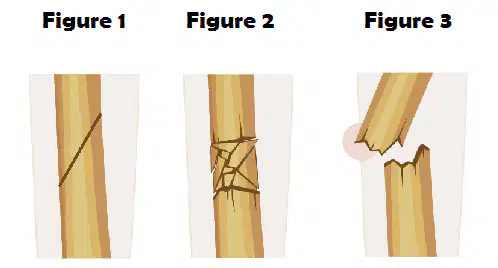
Figure 2 represents what type of bone fracture: The fractured bone is broken into many fragments (3 or more).
Comminuted Fracture
Open Fracture
Greenstick Fracture
Oblique Fracture
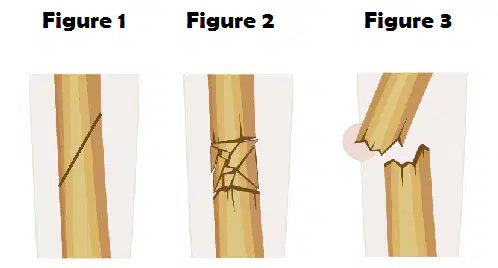
Figure 3 represents what type of bone fracture: This a fractured bone that breaks through the skin.
Compound Fracture
Closed Fracture
Greenstick Fracture
Transverse Fracture
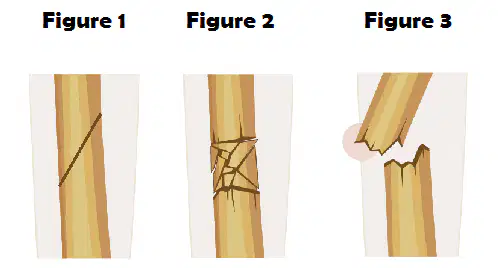
You’re caring for a patient who has experienced a fracture to the right arm that is represented in Figure 3. What nursing intervention will you take with this type of fracture?
Cover the fracture with a sterile dressing.
Place the arm below the heart level.
Attempt bone reduction by manually readjusting the bone.
Place a tight compression bandage over the fracture.
A 85 year old patient has an accidental fall while going to the bathroom without assistance. It appears the patient has sustained a bone fracture to the left leg. The leg’s shape is deformed and the patient is unable to move it. The patient is alert and oriented but in pain. What will you do FIRST after confirming the patient is safe and stable?
Immobilize the fracture with a splint.
Apply an ice pack covered with a towel to the site.
Administer pain medication.
Elevate the extremity above heart level.
Which statement by a patient, who just received a cast on the right arm for a fracture, requires you to notify the physician immediately?
“My pain is so severe that it hurts to stretch or elevate my arm.”
“It is really itchy inside my cast!”
“I can feel my fingers and move them.”
“I’ve been using ice packs to reduce swelling.””
What is a late sign of compartment syndrome?
Pulselessness
Paralysis
Pain
Paresthesia
Select all the signs and symptoms that will present in compartment syndrome?
(A.) Capillary refill less than 2 seconds.
(B.) Pallor.
(C.) Pain relief with medication.
(D.) Feeling of tingling in the extremity.
(E.) Affected extremity feels cooler to the touch than the unaffected extremity
B, D, 𝚊𝚗𝚍 E
A 𝚊𝚗𝚍 C
A, B, 𝚊𝚗𝚍 C
B and C
C, D, 𝚊𝚗𝚍 E
Your patient is 2 hours post-op from a cast placement on the right leg. The patient has family in the room. Which action by the significant other requires you to re-educate the patient and family about cast care?
Gently moving the cast with the fingertips of the hands every 2 hours to help with drying.
Positioning the cast at heart level with pillows.
Checking the color and temperature of the right foot.
Using a hair dryer on the cool setting to help with drying.
A patient sustained a fracture to the femur. The patient has suddenly become confused, restless, and has a respiratory rate of 30 breaths per minute. Based on the location of fracture and the presenting symptoms, this patient may be experiencing what type of complication?
Fat Embolism
Compartment Syndrome
Osteomyelitis
Hypovolemia
Which assessment finding found while assessing a patient with a fracture who has traction requires immediate intervention?
The weights are freely hanging on the floor.
Pin sites are free from drainage.
Patient uses the overhead trapeze bar to move around in the bed.
Patient’s extremities have a capillary refill of less than 2 seconds.
A 5 year old has a fracture of the right upper arm. The x-ray showed that one side of the bone is bent while the other is broken. This known as a __________ fracture?
Greenstick
Spiral
Oblique
Transverse

