
 Worksheets
DRAFTING
Total questions: 50
Worksheet time: 36mins
After a 2- dimensional drawings are done and all the shapes and sizes being laid-out, the
next step to be executed to complete the process is called_______.
A. Tolerancing
B. Specifications
C. Dimensioning
D. Drafting
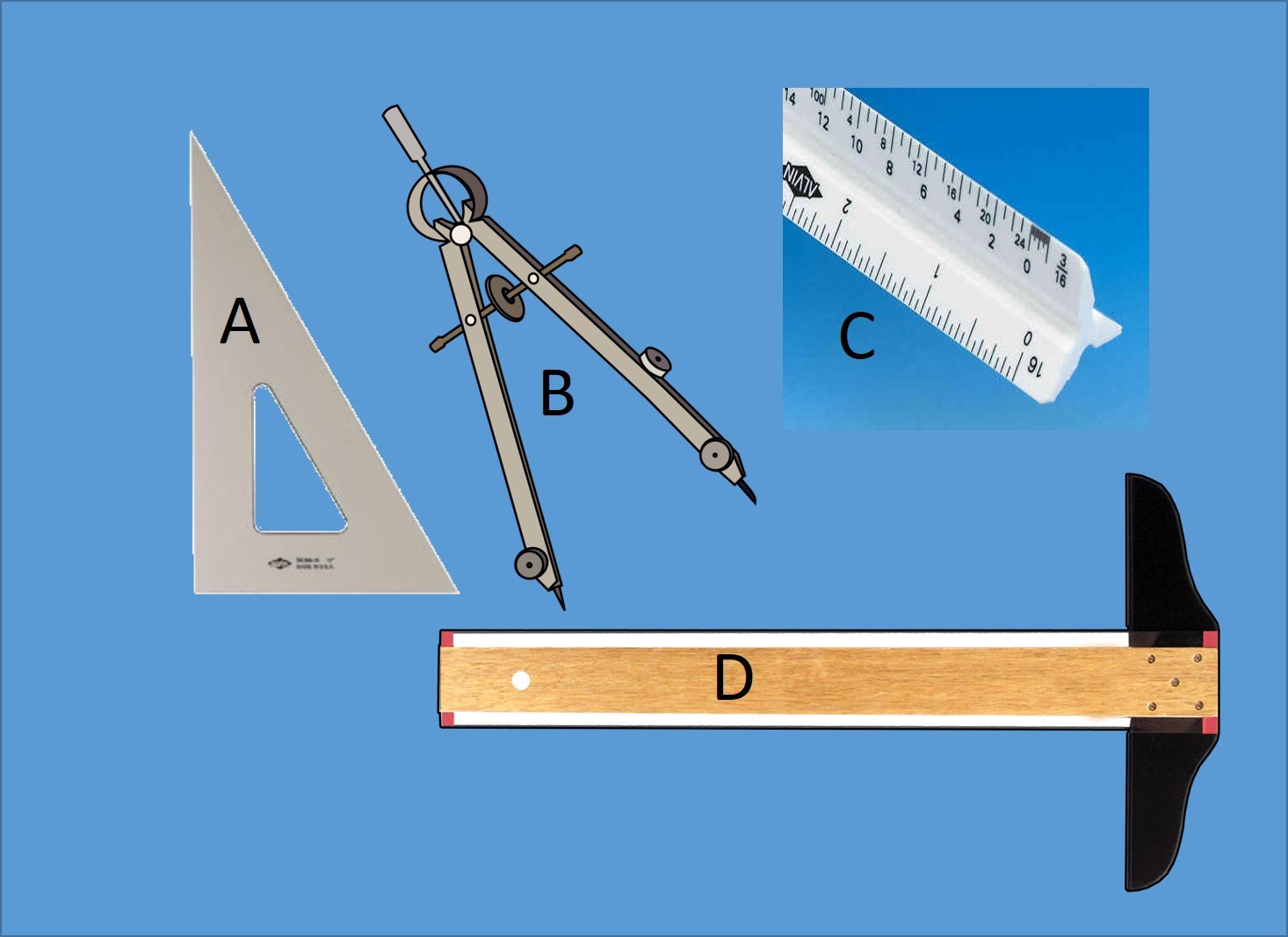
Which of the following is the 45x45 Triangle?


Where is the Divider tool primarily use in drafting?


The softest grade of pencil.
3B
4B
5B
6B

Identify the name of this drafting tool.
Triangle
Compass
T-Square
Divider
Which of the following is an example of Drawing Pencil commonly used in drafting?


Line segments intersecting at end points.
Polygon
Triangle
Quadrilatel
Circle

Identify the name of this drafting tool.
Template
Erasing Shield
Drawing Compass
Triangular Scale

Look closely, What is the name of this drafting tool?
Yard Stick
Meter Stick
Triangular Scale
Ruler
It is a drafting tool use for measuring angles, arcs and circles.
Triangular Scale
T-Square
Triangle
Protractor
A graphic language that uses pencil, eraser, and paper only; freedom and variety
Orthographic Projection
Mechanical Drawing
Freehand Drawing
Drawing

Which of the following is the Drawing Compass?


Basic form of expression for drafting beginners.
Sketching
Lettering
Drafting
Graphic Arts
The uppermost; for uppercase letters, also for letters with strokes that extend upward called ascender.
Capline
Waistline
Baseline
Dropline
A graphic language that uses pencil, eraser, and paper only; freedom and variety
Orthographic Projection
Mechanical Drawing
Freehand Drawing
Drawing
Basic form of expression for drafting beginners.
Sketching
Lettering
Drafting
Graphic Arts
It is an essential method of communication between designers and clients, architects and builders, engineers and production personnel between advertisers.
Drafting
Technical Drawing
Lettering
Sketching

T-Square is primarily used for drawing what kind of line?
Arc
Horizontal
Vertical
Curve
It indicates the shape and size of an object which helps in executing the drawing with less effort.
Technical Drawing
Orthographic Projection
Dimension
Lettering
It is a drafting tool use for measuring angles, arcs and circles.
Triangular Scale
T-Square
Triangle
Protractor

What is name of this Triangle tool?
30 x 60
45 x 45
60 x 90
30 x 45
The difference between a sketch and technical drawing is...
The use of tools
No difference
A sketch has a 3D perspective
The use of a pencil
Which tool allows vertical lines to be easily drawn?
Triangles
Protractor
Compass
Scale
Tossing or throwing items such as pencils, erasers, and paper is_____________________
OK as long as you are away from other students.
never permitted in the classroom
What is PPE?
paper, pencil, eraser
Personal Property Equipment
People Protect Equipment
Personal Protective Equipment
_________is an example of PPE.
baseball cap
Safety glasses
Sunglasses
music ear buds
Its main purpose is to reproduce, reduce or enlarge the dimension of size in the drawing
Tape Ruler
Triangle
Ruler
Scale
These are used for the purpose of measuring dimensions.
Cutting Tools
Measuring Tools
Lining Tools
Testing Tools
This drafting tool is used to protect the rest of the drawing when removing unnecessary lines.
Erasing Shield
Eraser
Masking Tape
Sharpener
The system of graphically representing an object by line drawing on a flat surface.
Pictorial Drawing
Isometric Drawing
Orthographic Projection
Dimetric Drawing
Angles of projection generally used for drafting purposes.
Ninety degrees and Forty Five degrees
First Angle and Third Angle
Thirty by sixty by ninety degrees
Thirty degrees and Sixty degrees
Degrees Standard projection used by many European countries (ISO standard)
Orthographic Projection
Third-angle Projection
Isometric Projection
First-angle Projection
The common views used in multi-view drawing are ___________.
front, top, and sides
front, rear, and sides
front, sides and rear
front, top and rear
The orthographic view drawn directly above the front view in an orthographic drawing is:
Auxiliary view
Top View
Right Side View
Front View
Standard of projection used by Americans, British and Canadians.
First-angle Projection
Orthographic Projection
Diametric Projection
Third- angle Projection
A line used to show the limits of a dimension.
Extension Line
Object Line
Dimension Line
Center Line
An oblique drawing in which the depth axis lines are in full size.
Cabinet Oblique
Cavalier Oblique
General Oblique
Perspective
This is the type of oblique pictorial view where the dimension of the receding features of the object is drawn half-scale.
Cabinet Projection
Cavalier Projection
Isometric Projection
Orthographic Projection
The point where the horizontal line in the perspective view seems to converge or meet.
Station Point
Vanishing Point
Center Point
Piercing Point
With the help of drawing instruments such as T-Square and triangles one produces quick and accurate dilineations for an intended project. The process is considered as _________.
Measuring
Pictorial Drawing
Graphing
Drafting
It is about placing units of measure to the height, weight, and length of an object to convey accurate instructions to produce that part. What is this process ?
Tolerancing
Dimensioning
Sectioning
Etching
As far as the appearance of the drawing is concerned, It is the most important part of the usefulness of the drawing and it can be ruined if it is done carelessly. Which is referred to?
Painting
Lettering
Measurement
Line
Four guidelines are accepted in the drafting field. Which one of them is laid-out to touch the capital letter C aside from the base line?
Base Line
Drop Line
Waist Line
Cap Line
In the field of drafting, each line has a specific meaning. This is to establish a uniform way when interpreting complex blueprints of objects and other mega projects. These lines are called _____?
Alphabet of lines
Alpha Numeric
Language of lines
Center Lines
There are six principal views of an object. Which of the views are accepted by the industry as standard multi-views according to the 3rd angle projection?
Front view, rear view, side view
Right side view, left side view, bottom view
Top view, front view, right side view
Top view, front view, rear view
In oblique drawing, the depth of the object is reduced to 1/2 in case of cabinet oblique while true of same measurement in ________oblique.
General
Isometric
Dimetric
Cavalier
When an observer stands in the middle of the street, the end of the street seems to narrow as far as his eyes can see. Then he tries to draw the buildings as it appears on his visual observations. The process is called _____.
Orthographic Projection
Perspective
Isometric
Pictorial

