
 Worksheets
March 8
Total questions: 10
Worksheet time: 10mins
A 25-year-old woman presents to the emergency department for a headache. She states it has been gradually worsening since she had a lumbar puncture 2 days ago and that it did not improve with rest, fluids, and naproxen. She describes it as a bilateral pressure that is intense. She reports no neurological symptoms. Her temperature is 98.0°F (36.7°C), blood pressure is 112/77 mm Hg, heart rate is 84/min, respirations are 14/min, and oxygen saturation is 99% on room air. Physical exam reveals no focal neurologic deficits with intact cranial nerves. Which of the following is the most appropriate next step in treating this patient?
Caffeine
Epidural blood patch
Ketorolac
Sumatriptan
In addition to a third generation cephalosporin and vancomycin, which additional empiric antibiotic should be considered in adult patients over 50 years of age who are suspected of having bacterial meningitis?
Ampicillin
Ciprofloxacin
Gentamycin
Rifampin
A patient presents to the emergency department with symptoms of right-sided weakness and aphasia which started 30 minutes prior to arrival. The National Institutes of Health Stroke Scale is 10. Which of the following is an absolute contraindication for intravenous thrombolytic therapy?
Age of 82 years
Ischemic stroke 4 months prior
Platelet count 95,000/mm3
Seizure at onset of symptoms with postictal residual neurologic deficits
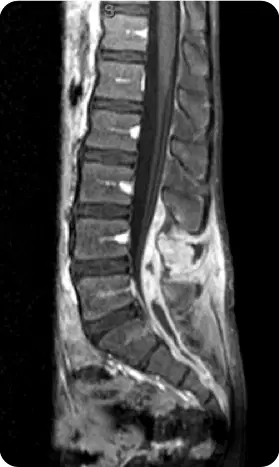
A 13-year-old boy on chemotherapy for acute lymphoblastic leukemia presents with progressive lower back pain for two weeks. Per the mother, he has had subjective fevers and a “bulge in his lower back” that is warm to touch. He is currently afebrile and has no focal neurologic deficits. An MRI is obtained, as seen in the image above. Which of the following regarding this patient’s condition is true?
An appropriate antibiotic regimen is cefepime and metronidazole
Direct extension of skin and soft tissue infections is the most common cause
Erythrocyte sedimentation rate is a sensitive screening tool
Most patients present with back pain, fever, and a focal neurologic deficit
A 6-month-old boy presents to the emergency department with sudden, brief, symmetric muscle contractions that were first noticed yesterday. These spasms last for < 2 seconds and occur several times per minute. They cause flexion of his neck, trunk, and arms and extension of the legs. They seem involuntary, are not associated with any heart rate change, and are followed by brief crying. Over the last 2 weeks, he has lost the ability to sit without support. A video electroencephalogram shows hypsarrhythmia. Which of the following is most likely to control this patient’s symptoms?
Corticotropin
Famotidine
Midazolam
Prednisone
A patient is diagnosed with Campylobacter jejuni enteritis, receives treatment, and recovers. He presents with weakness in his legs followed by weakness in his arms 2 weeks later. He reports no dyspnea but reports diplopia and dysphagia. Examination reveals a mild fever, extraocular muscle palsies, hyporeflexia, distal paresthesias, and intact proprioception. Laboratory testing is significant for a normal CBC and a PaO2 of 88 mmHg. Which of the following is the most appropriate intervention at this time?
Continuous positive airway pressure (CPAP)
Corticosteroids
Plasmapheresis
Vitamin B12
A 10-month-old boy presents to the emergency department with trouble breathing. His parents noticed he has seemed fatigued and weak lately. He has not been having bowel movements. Today, he seems to be very weak and is struggling to breathe. The patient has generally been healthy and sees a pediatrician regularly. His parents have tried introducing new foods recently. Physical exam is notable for a child with minimal muscle tone who is limp when picked up. Given his weak respiratory effort, he is intubated. Which of the following treatments is indicated for this patient?
Botulism antitoxin
Botulism immune globulin
Cefepime
Plasmapheresis
A 26-year-old woman with a history of dysmenorrhea and depression presents to the ED after having a seizure witnessed by her husband. He reports finding her on the bedroom floor with an empty pill bottle. Which of the following non-steroidal anti-inflammatory (NSAIDs) medications did she most likely ingest?
Celecoxib
Ibuprofen
Aspirin
Mefenamic acid
Rofecoxib
A 16-year-old girl presents to the ED reporting that she cannot walk up steps. She has been well recently except for an episode of gastroenteritis 2 weeks ago. On exam, she has decreased strength in her bilateral lower extremities with absent patellar and ankle jerk reflexes. What is the most important next test to perform?
Electromyography
Lumbar puncture
MRI lumbar spine
Vital capacity
Which of the following patients in the setting of a known subarachnoid hemorrhage has the worst prognosis?
A 39-year-old woman who is confused and has mild right lower extremity weakness
A 55-year-old man with a severe headache and oculomotor nerve palsy
A 65-year-old man with a mild headache, nausea, and an episode of vomiting
A 70-year-old woman with headache, neck stiffness, and an episode of vomiting

