wayground logo

Free Printable Worksheets

Font size

S
M
L
XL
Worksheets

Classification Review

Total questions: 50

Worksheet time: 47mins

Name
Class
Date
1.

Label steps of the lytic cycle.

2.

Label steps of the lytic cycle.

3.

Label steps of the lytic cycle.

4.

Label steps of the lytic cycle.

5.

Label steps of the lytic cycle.

6.

Which organism(s) have amniotic eggs but no hair?

7.

Which organism(s) have four limbs but no amniotic egg?
8.

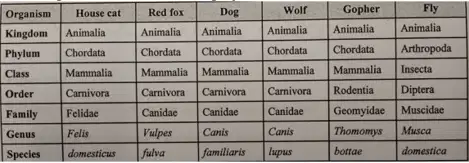
Which two animals are the most closely related?

(a)  

9.

​ (a)   : prokaryotes :: ​fungi : eukaryotes.

Choose from the below words
archaebacteria
animalia
protista
plantae
10.

Order taxa from most specific to most broad.

a)

Species

b)

Genus

c)

Order

d)

Phylum

e)

Domain

1)
2)
3)
4)
5)
11.
Scientific names are written using which two levels of classification?
a)
Kingdom phylum
b)
Kingdom class
c)
Species genus
d)
Genus species
12.

Which of the following is the least closely related animal: Gray Wolf: Canis lupus Aardwolf: Proteles cristatus Coyote: Canis latrans

a)

Coyote

b)

Aardwolf

c)

Gray Wolf

d)

Need more information on body characteristics

13.
Organisms that are unicellular, plant-like or animal-like or fungus-like, live in damp or wet places like ponds, rivers, or streams.
a)
Kingdom Fungi
b)
Kingdom Plantae
c)
Kingdom Animalia
d)
Kingdom Protista
14.
Organisms that are multicellular, photosynthetic autotrophs, reproduce sexually or asexually belong to this Kingdom:
a)
Animalia
b)
Fungi
c)
Monera
d)
Plantae
15.
Organisms that are eukaryotic, unicellular OR multicellular, decomposers or parasites belong to this Kingdom:
a)
Protista
b)
Fungi
c)
Plantae
d)
Archaebacteria
16.
Which of the six kingdoms correspond to the domain Eukarya?
a)
the kingdoms Eubacteria and Archaebacteria only
b)
the kingdoms Eubacteria, Archaebacteria, Protista, and Fungi only
c)
the kingdoms Plantae and Animalia only
d)
the kingdoms Protista, Fungi, Plantae, and Animalia only
17.
Fungi are different from plants primarily because they
a)
are nonmotile.
b)
contain chlorophyll.
c)
are heterotrophic.
d)
have cell walls.
18.
The table shows characteristics of several organisms. Based on the information given in the table, which two organisms would you think have the most recent common ancestor?
a)
Turtle and jawed fish
b)
Lamprey and jawed fish
c)
Turtle and frog
d)
Lamprey and frog
19.
An illustration and a dichotomous key are given. What is the correct classification for this organism?
a)
Class Insecta
b)
Order Amblygygi
c)
Order Araneae
d)
Order Scorpiones
20.

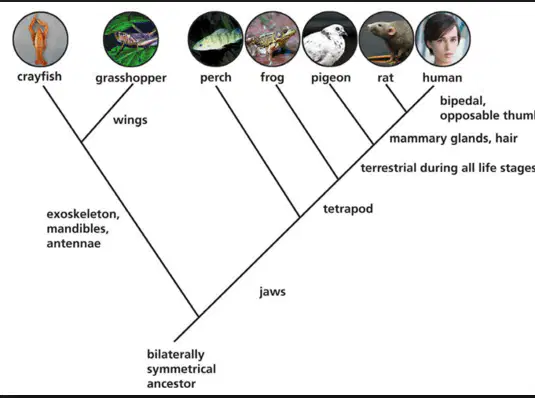
Which organism is most closely related to humans?
21.

Which trait do only humans have?

a)

bipedal

b)

hair

c)

mammary glands

d)

terrestrial during all life stages

22.

Which trait is shared only between humans and hares?

23.

Which is the common ancestor of frog and T. rex?
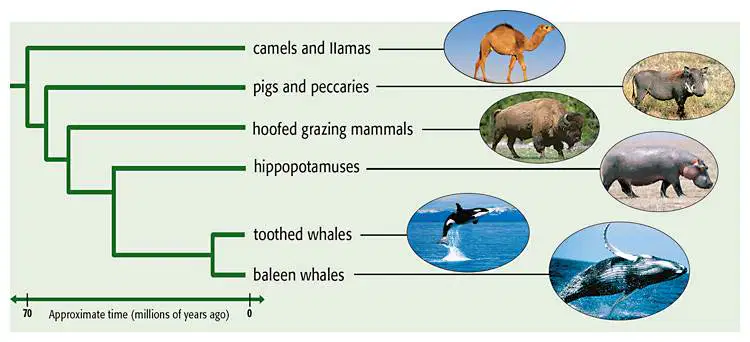
24.

​ ​​ (a)   are the most related to baleen whales.
Choose from the below words
hippopotamuses
hoofed grazing animals
pigs and peccaries
camels and llamas
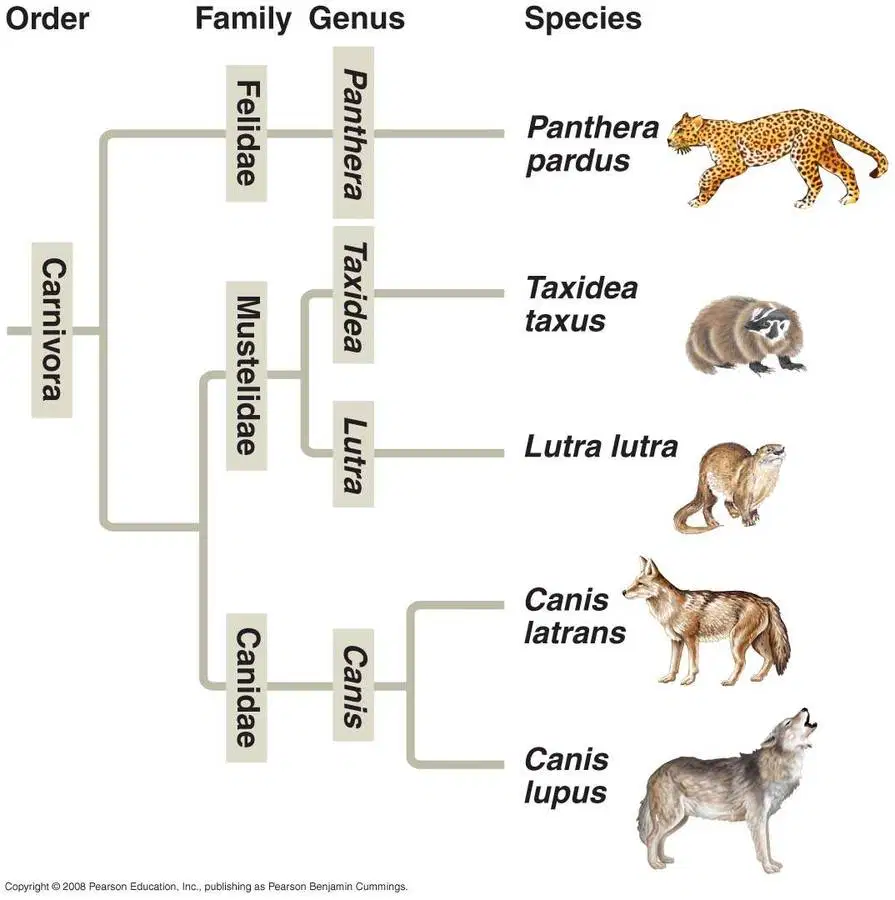
25.

Which is most related to Lutra lutra?

a)

Canis lupus

b)

Canis latrans

c)

Taxidea taxus

d)

Panthera pardus

26.

Which cycle is this showing?

a)

lytic

b)

lysogenic

27.

Which kingdom does this organism belong to?

(a)  

28.

Is this a living organism, yes or no?

(a)  

29.

Select the correct definition to the correct microbes

a)

Virus

1.

Contains DNA and a protein coat

b)

Bacteria

2.

No Nucleus and Unicellular

c)

Protist

3.

Has a nucleus, unicellular or multicellular, autotroph or heterotroph

d)

Fungi

4.

Has a nucleus, mainly multicellular, and heterotrophs

30.

Archaea live in ​ ​ (a)   environments

Choose from the below words
extreme
lonely
all
31.

Majority of bacterial infections can be treated with​ (a)  

Choose from the below words
antibiotics
vaccines
vitamins
32.

Bacteria reproduce asexually and result in offspring that are

a)

identical

b)

different

33.

Which of the following is a true statement about bacteria?

a)

Bacteria exist in only a few environments on earth

b)

Bacteria can grow to extremely large sizes

c)

Most bacteria are harmful to humans

d)

Bacteria can be both harmful and helpful to humans

34.
Reasons that viruses are considered to be nonliving is because
a)

They are not cellular

b)

They cannot reproduce on their own

c)

They cannot make energy

d)

all of the above

35.
What do viruses need to reproduce?
a)
they need genetic material
b)
They need a host cell
c)
They need  bacteria
d)
They need insulin
36.
Viruses are cells. 
a)
True 
b)
False
37.

A virus contains ______, the genetic material it uses to invade a living thing.

a)

DNA

b)

RNA

c)

Both DNA or RNA

d)

ATP

38.

A virus can be prevented by taking a ​ (a)  

Choose from the below words
vaccine
antibiotic
39.

What part of a virus is the protein capsule that houses the genetic material (DNA/RNA)?

a)

tail

b)

capsid

c)

glycoprotein

d)

nucleus

40.

Which viral life cycle allows viral genetic material to lay dormant while the host cell reproduces?

a)

lytic

b)

S phase

c)

lysogenic

d)

meiosis

41.

What do viruses have in common with living cells? They both...

a)

store genetic information

b)

have nuclei

c)

use glucose for cellular respiration

d)

have ribosomes

42.

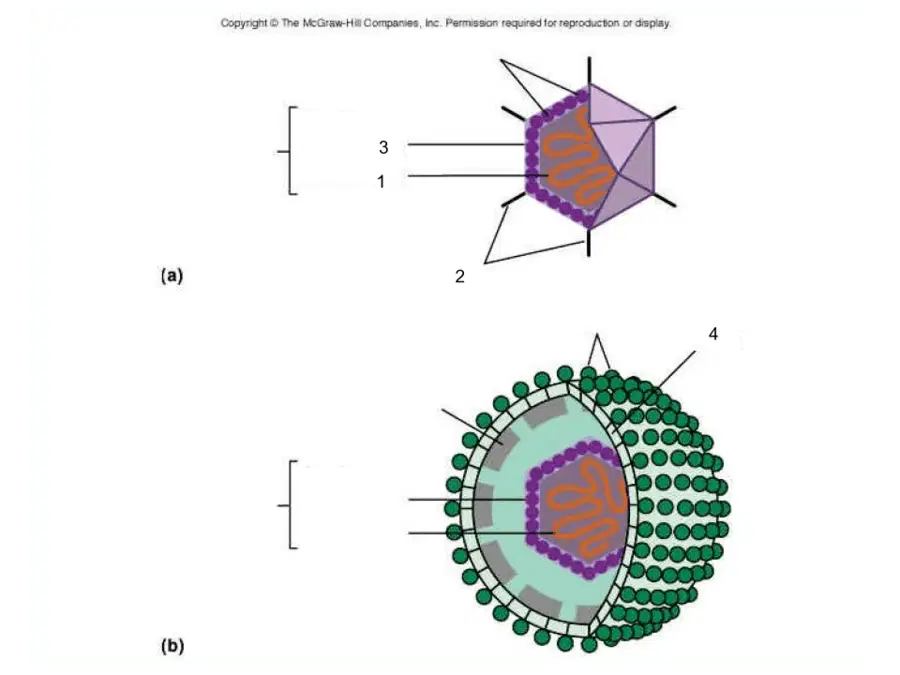
What part of the virus is number 2?

a)

Capsid

b)

Surface markers

c)

DNA

d)

envelope

43.
This kingdom is eukaryotic, uni and multicellular, heterotrophic, and has a cell wall made of chitin.
a)
Plant
b)
Fungi
c)
Animal
d)
Eubacteria
44.
This kingdom is multicellular, autotrophic, and has a cell wall made of cellulose.
a)
Fungi
b)
Plant
c)
Animals
d)
Eubacteria
45.
Escherichia coli is the scientific name of a bacterium.  What category of classification is Escherichia?
a)
Species
b)
Order
c)
Phylum
d)
Genus
46.
What species is bird C?
a)
Dunliin
b)
Osprey
c)
Bald Eagle
d)
Baird's Sparrow
47.
Do salamanders have claws?
a)
Yes
b)
No
c)
Maybe
48.
Which types of cells have a cell membrane?
a)
Eukaryotes
b)
Prokaryotes
c)
Both
49.
Which types of organisms have a nucleus
a)
Eukaryote
b)
Prokaryote
c)
Both
50.
Which of the following is the key difference between kingdom Protista and Bacteria?
a)
Unicellular
b)
Autotrophic and Heterotrophic
c)
Asexual
d)
Protista has a nucleus