
 Worksheets
WIS Ecology Benchmark #1 Review
Total questions: 24
Worksheet time: 14mins
Use the model to answer the following question: Which is the best explanation of the change in energy shown in the model?
New energy is produced by plants during photosynthesis.
Large amounts of energy are released into the environment during photosynthesis.
Energy from sunlight is destroyed as it powers photosynthesis.
Energy input from the environment is stored in food molecules during photosynthesis.
In recent decades, average global temperatures have increased significantly. Scientists agree that the widespread destruction of the Amazon rain forest contributes to climate change. Which mechanism might be used to support that hypothesis?
Deforestation causes water on the ground to reflect sunlight.
Deforestation reduces the number of plants able to absorb carbon dioxide.
Photosynthesis produces energy, which gives off heat.
Plants use up energy during cellular respiration.
A disease that destroys all the chloroplasts in a plant has been found in a plant population near your school. What would be the effect of this disease?
Nothing would happen. The plants would be fine.
The plant couldn't absorb light energy or conduct photosynthesis. Without photosynthesis, the plant would die.
Without chloroplasts the plant would be able to increase it's rate of growth by double
True or False: Chloroplasts are the location of photosynthesis.
True
False
True or False: Sucrose (sugar) molecules break down during cellular respiration.
True
False
True or false: Water is a product of cellular respiration.
True
False
Cellular respiration is the process in which organisms break down food to release _____.
energy
nutrients
sugar
oxygen
Where does cellular respiration occur?
Chloroplasts
Stems
Leaves
Mitochondria
Stoma
Which organisms use cellular respiration as a way to convert energy into usable form?
seedless plants only
only photosynthetic organisms
only mammals
all organisms
Photosynthesis is the process in which plants use energy from light to produce _____.
new cells
organelles
food
none of these answers
Photosynthesis uses all of the following except _______ to make food.
carbon dioxide
chemical energy
light energy
water
Carbon dioxide is used by plants for
(a)
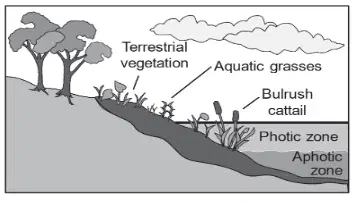
The diagram illustrates plants and two different zones of a deep lake.
In the upper part of the photic zone, organisms carry out both photosynthesis and cellular respiration. Deep in the aphotic zone, only cellular respiration occurs.
Which statement is the most likely reason photosynthesis does not occur in the deepest aphotic zone?
Sunlight for photosynthesis does not reach the deepest aphotic zone.
Water pressure limits the survival of animals in the deepest aphotic zone.
Not enough soil is present to support plant growth in the deepest aphotic zone.
Not as much dissolved oxygen from the surface reaches the deepest aphotic zone.
There are two options for what a plant can do with the sugar it creates. Choose TWO options.
It can be used immediately
It can be shared with other plants
It can be stored
It is released into the atmosphere
Plants need _______ from ______ to make their own food.
soil, Earth
water, ponds
energy, sunlight
weeding, from weeds
________ cells make up the upper and lower layers of the leaf.
vascular tissue
chlorophyl
stomata
epidermal
What are the two basic steps of photosynthesis? Choose TWO.
purifying water
capturing light energy
using that energy to make sugars
growing fruits and flowers
What is a pigment?
chemicals that can absorb and reflect light
My teacher's favorite band
a stage in photosynthesis
an organelle in a cell
Most plants appear green in color because _______ reflects green light.
betaphyl
stems
leaves
chlorophyl
Choose the THREE stages that occur during photosynthesis.
Water molecules are split apart.
Hydrogen atoms from the water molecules are used to make sugars.
Oxygen from the water molecules is released through the stomata into the atmosphere.
Pigments are created from capturing sunlight.
Roots absorb oxygen from the atmosphere.
In chloroplasts, ____ ______ from air is converted into sugars by using the energy stored and trapped by chlorophyll.
oxygen oxide
carbon monoxide
carbon dioxide
sun energy
Energy is in the __________ bonds of food molecules.
chemical
solid
liquide
gas
__________ __________ converts energy in food molecules into a usable form, called ATP.
Photosynthesis
Cellular respiration
Chlorophyll trapping
Sunlight energy
What are the TWO steps of cellular respiration? Choose TWO.
Sun energy is used to turn the plant green.
the smaller molecules made during glycolysis are broken down and ATP is produced.
Water and carbon dioxide are absorbed.
glycolysis (sugar is broken down into smaller molecules)

