
 Worksheets
Enzyme
Total questions: 12
Worksheet time: 6mins
Are most chemical reactions in living cells at equilibrium?
Yes
No
only the exergonic reactions
all reactions except those powered by ATP hydrolysis
Choose the pair of terms that correctly completes this sentence: Catabolism is to anabolism as is to .
exergonic; spontaneous
exergonic; endergonic
free energy; entropy
work; energy
A reaction has a ∆G of –5.6 kcal/mol. Which of the following would most likely be true?
The reaction could be coupled to power an endergonic reaction with a ∆G of +8.8 kcal/mol
The reaction is nonspontaneous.
To take place, the reaction would need to couple to ATP hydrolysis.
The reaction would result in products with a greater free-energy content than in the initial reactants
The reaction would proceed by itself but might be very slow
The oxidation of glucose to CO2 and H2O is highly exergonic: ∆G = –636 kcal/mole. This is spontaneous, but why is it very slow?
Few glucose and oxygen molecules have the activation energy at room temperature.
There is too much CO2 in the air.
CO2 has higher energy than glucose.
The formation of six CO2 molecules from one glucose molecule decreases entropy.
A friend is designing an industrial process around an endergonic biological reaction. You recommend finding a way to provide
ATP
minerals
a lower pH
a plasma membrane
mitochondria
Which of the following statements about enzymes is incorrect?
Enzymes can be used to accelerate both anabolic and catabolic reactions
An enzyme lowers the activation energy of a chemical reaction
An enzyme is very specific in terms of the substrate to which it binds
An enzyme is consumed during the reaction it catalyzes
Most enzymes are proteins
When a substrate molecule binds to an enzyme, it binds to a particular location known as the …………
active site
regulatory site
allosteric site
binding site
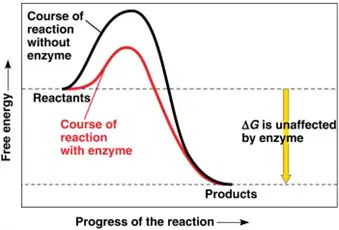
In the energy diagram, what is the difference between the red and black curves?
A. The red curve is for a
reaction powered by
ATP hydrolysis.
B. The black curve occurs
at higher temperature
C. The red curve is
catalyzed by an
enzyme
D. The black curve has a
higher activation energy
Both C and D
Enzymes increase the rate of an enzyme catalyzed reaction by
Increasing the activation energy barrier
Decreasing the activation energy barrier.
Increasing the free energy of the reactant.
Increasing the free energy of the product
Decreasing the free energy of the reactant
Which of the following statements about enzymes is/are true?
Enzymes increase the rate of a reaction by raising the activation energy for reactions
Enzymes speed up the rate of the reaction without changing the DG for the reaction
The more heat that is added to a reaction, the faster the enzymes will function
Enzymes react with their substrate (form chemical bonds), forming an enzyme-substrate complex, which irreversibly alters the enzyme
All of the listed responses are correct
If an enzyme is added to a solution where its substrate and product are in equilibrium, what will occur?
Additional product will be formed
Additional substrate will be formed
The reaction will change from endergonic to exergonic
The free energy of the system will change
Nothing; the reaction will stay at equilibrium
Amylase is an enzyme, found in saliva, which breaks down starch. It works best at a pH of 8. Why amylase does not function in the stomach where the pH is approximately 3 ?
The secondary structure of amylase is changed
Starch cannot bind to amylase to form an an enzyme-substrate complex
The enzyme is denatured and the active site is affected
The structure of starch changes at pH 3 so it cannot bind to active site of amylase

