wayground logo

Free Printable Worksheets

NEW

Font size

S
M
L
XL
Worksheets

Evolution Part 2- the theory of evolution

Total questions: 42

Worksheet time: 45mins
Name
Class
Date
1.
Structures with the same parts have different functions; suggests that organisms share a common ancestry
a)
vestigial structures
b)
homologous structures
c)
adaptive radiation
d)
fossil
2.
Study of embryos of various organisms to show a common ancestor because of similarities in development
a)
natural selection
b)
embryology
c)
speciation
d)
evolution
3.
Some organisms that share a common ancestor have features that have different functions, but similar structures.  These are known as
a)
vestigial structures
b)
analogous structures
c)
homologous structures
d)
fossil structures
4.
How do fossils provide evidence that evolution has happened on Earth?
a)
Fossils show how the sizes of certain animals has changed drastically over millions of years
b)
Fossils show that some species have gone extinct
c)
Fossils show how life forms present today are different than those from the past
d)
Different sedimentary rock layers provide evidence for how the environment has changed over time
5.
Humans, birds, whales, and lizards all have similar arm bones. What is the reason for this?
a)
The function of these bones is the same in all animals
b)
They live in similar environments
c)
They have a common ancestor
d)
All organisms resemble humans
6.

Vestigial structures

a)

structures that perform a similar function but are not similar in origin

b)

remnants of once-important structures that have slowly lost all or most of their function

c)

features found in different organisms that share structural similarities but may have very different functions

d)

preserved remains of an organism

7.
Which layer is the youngest
a)
1
b)
2
c)
3
d)
4
8.
The changes of species over time
a)
Embryonic 
b)
Natural selection 
c)
Mimicry 
d)
Evolution 
9.

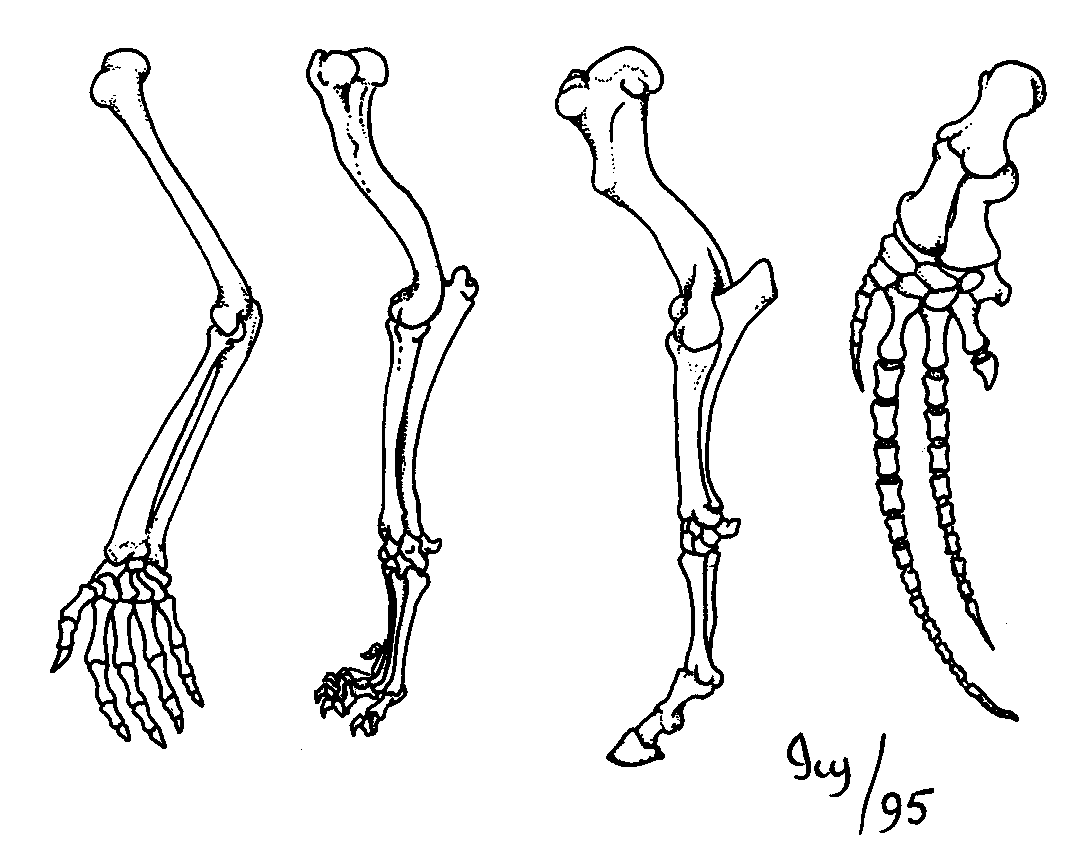
The picture shows a/an ___________

a)

homologous structure

b)

vestigial structure

10.

What is this an example of?

a)

Homologous structure

b)

Analogous structure

c)

Vestigial organs

d)

Functional adaption

11.
Study of embryos of various organisms to show a common ancestor because of similarities in development
a)
natural selection
b)
embryology
c)
speciation
d)
evolution
12.
How do fossils provide evidence that evolution has happened on Earth?
a)
Fossils show how the sizes of certain animals has changed drastically over millions of years
b)
Fossils show that some species have gone extinct
c)
Fossils show how life forms present today are different than those from the past
d)
Different sedimentary rock layers provide evidence for how the environment has changed over time
13.
The diagram illustrates an embryonic stage of two organisms.

Which of the following can be determined by observing the embryos shown in the diagram
a)
The organisms share a common ancestry.
b)
The organisms belong to the same genus.
c)
The organisms are native to the same geographic areas.
d)
The organisms will grow into anatomically similar adults.
14.

What best describes the hind leg bones seen in the whale?

a)

The bones are analogous structures to the fins of living fish.

b)

The bones are vestigial structures that had a function in an ancestor.

c)

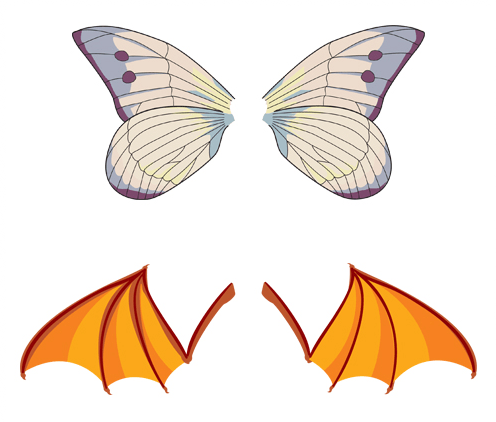
The bones are homologous structures to the wings of butterflies.

d)

The bones are fossil structures from an extinct ancestor.
15.
Which layer is the youngest
a)
1
b)
2
c)
3
d)
4
16.
If two organisms have similar traits of DNA they are probably
a)
share a common ancestor
b)
share a common environment
c)
share a common population
d)
speciation
17.
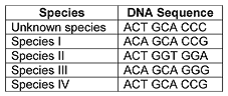
According to this data, the unknown bacterial species is most closely related to: 
a)
Species I
b)
Species II
c)
Species III
d)
Species IV
18.
You look at two species and see very similar DNA. What does this likely tell you?
a)
These are the same animal.
b)
These animals have a common ancestor.
c)
These animals are not likely related.
d)
These animals are likely becoming one species.
19.
____ is when members of a species that are best suited for their environment survive and reproduce at a higher rate than other members of the species
a)
natural selection
b)
artificial selection
c)
speciation
d)
adaptation
20.
An adaptation is
a)
how animals change over time.
b)
a characteristic that helps an organism survive and reproduce
c)
a theory of how organisms change.
d)
the genes in an organism that determine how an organism is going to look.
21.
The differences among a species, like different bird beaks, are called
a)
genes.
b)
variations.
c)
advantages.
d)
theories.
22.
Which two organisms are the most closely related according to their DNA sequence?
Critter A--> ATG CTT AAC CCG TTA
Critter B--> ATC CTT TTC CCG TAA
Critter C--> ATG CTA TAG GCG TAA
a)
Critter A and B
b)
Critter A and C
c)
Critter B and C
d)
They are all equally related
23.
Organisms with the most beneficial traits will survive and reproduce.  This is commonly known as
a)
DNA
b)
variations.
c)
survival of the fittest.
d)
ecosystems.
24.

Which of the following is considered a behavioral adaptation?

a)

Wolves hunting in packs

b)

Long trunks of elephants

c)

Birds wings that allow them to fly

d)

The white underbelly of a shark

25.
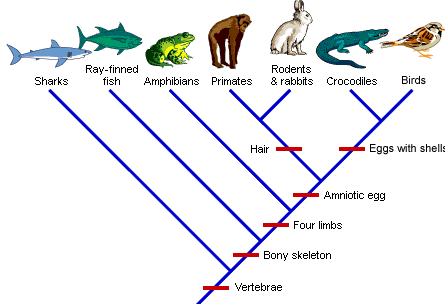
According to this cladogram, sharks are MOST closely related to which organism? 
a)
Amphibians
b)
Ray finned fish
c)
Crocodiles
d)
Birds
26.
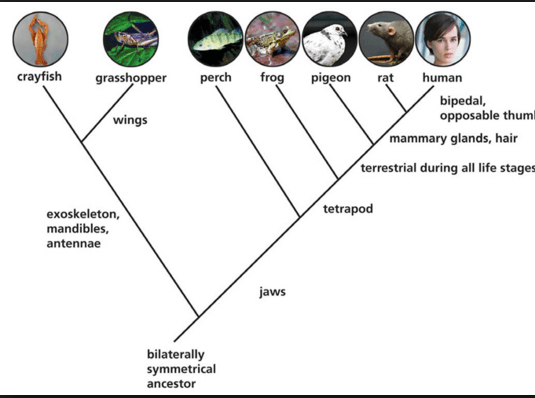
According to the cladogram, which organism is most distantly related to the human?
a)
crayfish
b)
grasshopper
c)
perch
d)
frog
27.

What are fossils?

a)

Are the remains or evidence of once-living organisms

b)

Is the change over time in populations of related organisms

c)

A chart that divides Earth’s history into different time units

d)

Occurs when the last individual organism of a species dies

28.

The solidified remain or imprint of a once living thing are called:

a)

Fossils

b)

Homologous Structures

c)

Vestigial Structures

d)

DNA

29.
The diagram shows fossils in different rock layers. Which of these statements about the age of these fossils is most likely correct?
a)
Fossil A and C are the same age
b)
Fossil B is older than fossil C
c)
Fossils A is older than fossil B
d)
Fossil D is older than fossil C
30.

Which of the following is true regarding the evidence of evolution

a)

Vestigial structures are not real evidence of evolution.

b)

Homologous structures and fossils are the most dependable forms of evidence.

c)

Comparing DNA is the most definitive and accurate method to show evolutionary relationships.

d)

Embryology and Homologous structures do not support the theory of evolution.

31.

Scientists have collected millions of fossils of different organisms, and have developed a timeline of life on Earth. What do we call this?

a)

Mutation

b)

Natural Selection

c)

The theory of evolution

d)

Fossil Record

32.

Scientific evidence proves that:

( choose only 1)

a)

Evolution is happening now and will happen in the future but did not happen in the past.

b)

Evolution happened in the past , but is not happening in the present or future

c)

Evolution happened in the past, is happening now and will happen in the future

d)

Evolution is happening now but did not happen in the past.

33.
In layers of sedimentary rock, the _________ layer is usually at the bottom. Each higher layer is _________ than the layers below it.
a)
oldest, younger
b)
youngest, older
c)
youngest, younger
d)
oldest, older
34.
Which layer is the oldest
a)
B
b)
A
c)
E
d)
C
35.

Which part of an organism's body typically fossilizes?

a)

Cartilage

b)

Skin and muscles

c)

Teeth and bones

d)

Hair and organs

36.
The theory of natural selection was a hypothesis first proposed by
a)
Gregor Mendel
b)
James Waston and Francis Crick
c)
Charles Darwin
d)
Robert Hooke
37.
1000 red and 1000 white ground beetles are placed in a cage on red clay containing beetle eating birds.  The beetles are counted after 2 days. What is expected? 
a)
Equal number of red and white beetles are left
b)
More red beetles are left
c)
More white beetles are left. 
d)
All the beetles are gone.
38.
Darwin's studies of finches on the Galapagos Island suggests that the finches' differences in beak structure were most directly due to:
a)
acquired characteristics in the parent finches
b)
the size of the island where the finches live.
c)
mating behaviors of the different finch species
d)
geographic isolation and adaptations of the finches to different environments 
39.
Characteristics of a species that make its members better able to live and reproduce in their environment are known as
a)
abiotic factors
b)
biotic factors
c)
homologous structures
d)
favorable adaptations. 
40.
Using the information from the chart, which two organisms are the closest in evolutionary distance from a common ancestor?
a)
horse-zebra
b)
human-gorilla
c)
human-chimpanzee
d)
horse-chimpanzee 
41.
A large population of bluejays living in the mountains is separated by the formation of a desert.  After millions of years, the populations of bluejays would most likely...
a)
become exstinct
b)
diverge into two new species 
c)
evolve into cats
d)
become two very small populations of the same species. 
42.
The diagram shows undisturbed sedimentary strata at the bottom of the ocean.  The fossils found in layer B resemble the fossils found in layer A.  This similarity suggests that. 
a)
modern forms of life lay have evolved from earlier forms of life
b)
vertebrate fossils are only found in sediments 
c)
the fossils in layer A must be more complex than those in layer B
d)
the fossils in layers B were formed before the fossils in layer A