
 Worksheets
LewLew Midterm Physics 1st
Total questions: 59
Worksheet time: 1hrs 28mins
Positive and Positive
Positive and Neutral
Negative and Neutral
Positive and Negative
negative (-)
positive (+)
neutral or no charge (0)
negative (-)
positive (+)
neutral or no charge (0)
A positive charge.
A negative charge.
A neutral charge
No charge at all

Closed
Open
What is an electric current?
a build up of electrons
the difference in charge between 2 points
the flow of electrons over a circuit
the opposition to flow of electrons
The wattage value for any resistor is equal to ____.
I X R
E/R
I X E
I/R
Total series circuit wattage is equal to source voltage ____.
multiplied by the voltage value going through any resistor
multiplied by the current value going through any resistor
divided by the current value going through any resistor
divided by the voltage applied to the circuit and the total resistance of the circuit

Using the circuit shown solve for total power dissipated in this circuit.
20 watts
30 watts
1.8 Kilowatts
180 watts
When a resistor in a series circuit is replaced by another resistor with an increased resistance value, the total circuit current will __________.
stay the same
decrease
increase
double in value
What happens to total current in a series circuit when the total voltage stays the same, circuit resistance decreases, current will ____________.
increase
Stay the same
Decrease
volts.
watts.
coulombs.

1V
2V
3V
6V

V1
V2
V3

What is this symbol?
Cell
Switch
Bulb
Resistor

This switch is open.
True
False

Wire
Battery
Buzzer
Fuse

Closed switch
Push switch
Trap door
AC Power supply

What is a conductor?
Material that does NOT transfer energy.
Materials that are connected to circuits.
Materials that transfer energy.
Materials that
Transfers thermal and electrical energy
Transfers electrical energy and slows thermal energy
Slows electrical energy and allows thermal energy to pass
Slows thermal and electrical energy from transfering
wood
plastic
metal
cloth

A battery
a peice of yarn
an insulator
a conductor
They are conductors of heat.
They are fuzzy.
They are conductors of electrical energy.
They are insulators.

Provide a conductor for electrical energy to flow.
Provide an insulator so that electrical energy will not pass outside of the wires.
Provide a conductor so that electrical energy can NOT flow.
Provide an insulator so that electrical energy can flow.
Ω (Ohms)
V (Volts)
A (Amps)
W (Watts)
Ω (Ohms)
V (Volts)
A (Amps)
W (Watts)
Current X Resistance
Resistance ÷ Current
Current ÷ Resistance
Measure it with a ruler
10V
2.5V
7V
0.4V
5V
0.2V
20V
200V
If the current through a resistor is 2A and the voltage across it is 12V, what is the resistance
12Ω
6Ω
24Ω
0.167Ω
What effect do electrons flowing through a resistor have on the resistor.
make it glow
reduce it's resistance
increase it's resistance
heat it up

in which circuit is the lamp brightest
1
2
3
All the same
As the length of a wire increases, the resistance of the wire will
increase
decrease
stay the same
As the diameter of a wire increases, the resistance of the wire will
increase
decrease
stay the same

Which resistor has the biggest voltage across it?
2 Ω
3 Ω
4 Ω
all have the same
What is the resistance of a lightbulb that experiences 9 Volts and 3 amps of current?
1/3 ohms
3 ohms
27 ohms
9 ohms
What is the voltage of a circuit with 4 ohms of resistance and 3 amps of current?
12 V
21 V
4/3 V
3/4 V
What is the formula for ohms law?
1+2=3
R X E = I
V =I x R
E= MC squared

not moving
positive constant velocity
negative constant velocity
changing velocity

not moving
positive constant velocity
negative constant velocity
changing velocity

not moving
velocity is increasing
velocity is decreasing
constant velocity
What does the slope of a position-time graph represent?
Distance
Displacement
Velocity
Acceleration

Which dot diagram shown is consistent with the position-time data?


During which stage is the object moving toward its starting point?
A
B
C
D
E

Which of the following lines (1-6) represent motion diagram B?
Graph Line 1
Graph Line 2
Graph Line 3
Graph Line 5
Graph Line 6
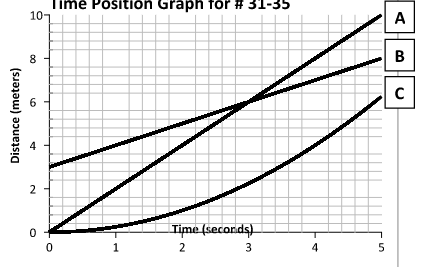
A
B
C
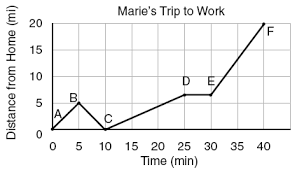
How does her speed at 3 minutes compare with her speed at 7 minutes?
She is driving faster at 3 minutes.
She is driving faster at 7 minutes
She is driving forward at 3 minutes and back at 7.
She is moving up at 3 minutes and down at 7 minutes

A position-time graph of an athlete winning the 100-m run is shown. What was the instantaneous position of the athlete at 2.5 s?
15 m
20 m
25 m
30 m

From the following position-time graph of two brothers running a 100-m run, analyze at what time do both brothers have the same position. The smaller brother started the race from the 20-m mark.
2 s
4 s
6 s
8 s

average speed
constant speed
instantaneous speed
acceleration

What is the speed of a cheetah that travels 112.0 m in 4.0 s?
0.0357 m/s
30 m/s
0.036 m/s
28.0 m/s
Turning a corner on a motorcycle is always an example of ____.
Speed
Velocity
A change in speed
A change in velocity

An old lady rolls down a hill at 3 meters/second. The hill is 36 meters long. How many seconds does it take the old lady to reach the bottom of the hill?
39 seconds
12 seconds
15 seconds
33 seconds

direction
speed
velocity
magnitude

Car A- distance: 4 meters, time: 2 sec
Car B- distance: 2 meters, time: 2 sec
Car C- distance: 8 meters, time: 2 sec
Car A= 1 Car B= 2 Car C = 3
Car A = 2 Car B= 1 Car C= 3
Car A= 3 Car B= 1 Car C = 2
Car A = 3 Car B= 2 Car C= 1

Explain the motion from 0-1s
Stationary
Constant speed
Constant acceleration
Non-constant acceleration
Explain the motion from 8s onwards. The blue line runs along the x-axis. Hint: What is the velocity from 8s onwards.
Stationary
Constant speed
Constant acceleration
Constant deceleration
time
velocity
size
motion
55km
32km
43km
32miles

