
 Worksheets
Unit 3 Review Case (Standards 8.21-8.28) The New Nation
Total questions: 96
Worksheet time: 2hrs 24mins
Which three of the following best identify the significant precedents set by Washington as the nation's first president?
Judicial Review
Neutrality in foreign policy
Two term limit
Abolished slavery
Cabinet of advisors
What was the main focus of the founders when trying to form America's first government?
To make taxes as low as possible
To keep the nation secure
To avoid an overly powerful government
To make state governments very powerful
What is a confederation?
A group of states bound by a powerful central government
A military alliance of independent countries
A group of countries all ruled by the same monarch
A group of mostly independent states bound by a weak central government
"I have already intimated to you the danger of parties in the State, with particular reference to the founding of them on geographical discriminations. Let me now take a more comprehensive view, and warn you in the most solemn manner against the baneful effects of the spirit of party generally...Without looking forward to an extremity of this kind (which nevertheless ought to not to be entirely out of sight), the common and continual mischiefs of the spirit of party are sufficient to make it the interest and duty of a wise people to discourage and restrain it."
Which of the following best identifies the issue in which Washington warns in the passage above?
Dangers of political factions (parties)
Dangers of involvement in foreign affairs/alliances
Dangers of geographic sectionalism in the young republic
Dangers of an uneducated public
What was America's first constitution called?
The Articles of Confederation
The Constitution of the United States
The Founding Principles of the United States
The Articles of American Constitution
What was the major problem with the Articles of Confederation?
The central government was too powerful and controlling
The state governments were too weak to solve problems
The central government was too weak to solve issues facing the country
The president was given too much power.
Which of the following best describes the significance of the Whiskey Rebellion?
Demonstrated the weakness of the federal government and calls for change
Leads to an undeclared and limited conflict with France in the Caribbean Sea
Demonstrated the power and energy of the new federal government
Leads to the establishment of judicial review by the supreme court
How many states had to agree before an Article could be amended or changed?
9 out of 13 states had to agree
All 13 states had to agree
A majority of states had to agree
10 out of 13 states had to agree
ARTICLES OF CONFEDERATION ARTICLE VII:
When land forces are raised by any State for the common defense, all officers of or under the rank of colonel, shall be appointed by the legislature of each State respectively, by whom such forces shall be raised, or in such manner as such State shall direct, and all vacancies shall be filled up by the State which first made the appointment.
ACCORDING TO ARTICLE VII, WHAT GROUP PROVIDES SOLDIERS OF AND BELOW THE RANK OF COLONEL?
STATES
FEDERAL GOVERNMENT
VIII.
All charges of war, and all other expenses that shall be incurred for the common defense or general welfare, and allowed by the United States in Congress assembled, shall be defrayed out of a common treasury, which shall be supplied by the several States in proportion to the value of all land within each State, granted or surveyed for any person, as such land and the buildings and improvements thereon shall be estimated according to such mode as the United States in Congress assembled, shall from time to time direct and appoint.
The taxes for paying that proportion shall be laid and levied by the authority and direction of the legislatures of the several States within the time agreed upon by the United States in Congress assembled.
ACCORDING TO THIS ARTICLE, WHAT LEVEL OF GOVERNMENT HAS THE POWER TO TAX?
FEDERAL
STATE
ACCORDING TO THE ARTICLES OF CONFEDERATION, WHICH OF THE CHOICES BELOW IS NOT A POWER GRANTED TO THE FEDERAL GOVERNMENT?
DECLARE WAR
TAX
MAKE TREATIES WITH FOREIGN POWERS
GUARANTEED THE RIGHTS OF CITIZENS TRAVELING FROM STATE TO STATE
ARE THE TOPICS LISTED BELOW STRENGTHS OR WEAKNESSES OF THE ARTICLES OF CONFEDERATION?
NO EXECUTIVE/LEADER AT THE NATIONAL LEVEL
CANNOT CREATE AN ARMY WITHOUT THE PERMISSION OF THE STATES
CONGRESS CAN MAKE LAWS BUT CANNOT FORCE STATES TO FOLLOW THEM
NO POWER TO TAX
EACH STATE HAD ONE VOTE
CONGRESS CANNOT MAKE LAWS ABOUT TRADE
STATES HAD MORE POWER THAN CONGRESS
WEAKNESSES
STRENGTHS
SHAYS' REBELLION TOOK PLACE BECAUSE...
THERE WAS NO MONEY TO PAY WAR VETERANS
VETERANS WHO WERE FARMERS WERE LOSING THEIR FARMS BECAUSE THEY HAD NO MONEY
FARMERS WERE GOING TO JAIL BECAUSE THEY COULDN'T PAY THEIR DEBTS
ONLY A AND C
A, B, AND C
Choose the 2 options below that correctly reflect the ideas of strict and loose interpretation of the Constitution.
Favored by Jefferson, strict interpretation ensures that the three branches of government have separate but equal powers.
Favored by Jefferson, loose interpretation supported the creation of tariffs on goods imported to the U.S.
Favored by Hamilton, loose interpretation allowed for the government's powers to change if necessary and proper to reflect the current conditions of the country
Favored by Hamilton, strict interpretation protects the rights and powers of the states
Favored by Jefferson, strict interpretation keeps the national government from using powers that are not expressly granted to it by the Constitution
CONGRESS DID NOT ADMIT THE STATE OF FRANKLIN TO THE UNION SO FOR A PERIOD OF TIME, THE STATE OF FRANKLIN ACTED AS ITS OWN NATION WITH...
A CONSTITUTION
WROTE TREATIES WITH THE INDIANS
USED A BARTERING SYSTEM INSTEAD OF MONEY
A AND B
A, B AND C
TWO REASONS WHY THE STATE OF FRANKLIN FAILED:
CONFLICT WITHIN THE NATION
PROBLEMS WITH AMERICAN INDIANS
VOTER REGISTRATION PROBLEMS
LITERACY ISSUES
Which of the following describes James Madison's role during the Constitutional Convention?
He developed the social contract theory
He was the main contributor of ideas that helped shape the Constitution
He was responsible for drafting the Virginia Plan
He was in favor of each state getting one vote in legislative matters
The system that ensures that all of the branches maintain equal power by giving each of them a check against one another
Separation of Powers
Checks and Balances
Counted a percentage of the slave population toward government representation
The Virginia Plan
3/5 Compromise
The New Jersey Plan
The Albany Plan
Makes the laws
Executive
Judicial
Legislative
"We the People of the United States, in Order to form a more perfect union..."
Which historical document is this from?
The Albany Plan of Union
The Declaration of
Independence
The Articles of Confederation
The Constitution
Interprets Laws
Executive
Judicial
Legislative
What did the Great Compromise do? (pick two)
It established one house
It established two houses
The number in each house would de determined by population and the Senate will get two senators no matter the size
Each state got equal representation and senators were based off of population
Unlike Hamilton, why was Thomas Jefferson against the bill that established the First National Bank?
He thought that Alexander Hamilton gave too much power to the states to run the bank.
He thought it would hurt the economy since it did not have enough power to provide the services needed.
He thought that the government should be providing economic services rather than a bank.
He thought it would expand the powers of the national government beyond the limits outlined in the Constitution
The idea that government should be divided into three branches
Separation of Powers
Checks and Balances
What brought the Founding Fathers to the Constitutional Convention?
They wanted to revise the issues with the Articles of Confederation
They were concerned with the western borders of the United States
Met in response to violent protests that were growing in number and popularity
Met to discuss breaking away from Great Britain
What was the role of George Washington at the Constitutional Convention? (pick two)
Sent as a delegate from Virginia
Was a main writer of the Constitution
Argued for the rights of the enslaved
Chosen to lead the Convention
By stating "establish justice" in the Preamble of the Constitution, what did the framers mean?
Establish a standing army
To fix the issues created by the Articles of the Confederation
Set up courts
Establish tranquility
The support of government--the support of troops for the common defense--the payment of the public debt, are the true final causes for raising money. The disposition and regulation of it, when raised, are the steps by which it is applied to the ends for which it was raised,...Hence, therefore, the money to be raised by taxes, as well as any other personal property, must be supposed to come within the meaning, as they certainly do within the letter, of authority to make all needful rules and regulations concerning the property of the United States...
In the excerpt above, Alexander Hamilton contends that the creation of a national bank...
Falls within the intent of the Constitution and is necessary and proper
is not supported by the Constitution and thus cannot be done
Is specifically stated in the Constitution and thus is permitted
Violates the Constitution because it is not written in the Constitution
The relationship between the federal and state government is called?
Separation of Powers
Federalism
Checks and Balances
Federalist
Enforces Laws
Executive
Judicial
Legislative
the power of government comes from the people is called...
Anti-Federalism
Popular Sovereignty
Federalism
Separation of Powers
“An American delegation sent to Paris to negotiate a trade treaty was pressed to offer bribes to facilitate negotiations”
What crisis during John Adams’ administration is described above?
The Barbary Conflict
The Alien and Sedition Acts
Negotiation for the Louisiana Purchase
The XYZ Affair
Protected small states and wanted equal votes in Congress
New Jersey Plan
Virginia Plan
Protected large states and wanted representation based off of population
New Jersey Plan
Virginia Plan
Protect the citizens on home soil
Promote the general welfare
Establish justice
Insure domestic tranquility
Secure the blessings of liberty
"If after such Reconsideration two thirds of that House shall agree to pass the Bill, it shall be sent, together with the Objections, to the other House, by which it shall likewise be reconsidered, and if approved by two thirds of that House, it shall become a Law"
Which principle is stated above?
Checks and balances
Popular Sovereignty
State's Rights
Anti-Federalism
The Executive Branch has the responsibility of enforcing the laws.
What is this an example of?
Federalism
Separation of Powers
Anti-Federalism
Checks and Balances
Each branch of government has designated powers to ensure that no single branch has more power than the other two branches
Checks and Balances
Separation of Powers
The 85 essays written to help ratify the Constitution were also known as...
The Constitution Papers
The Federalist Papers
The Albany Papers
The Gettysburg Address
* Worried that the federal government would have too much power
* Were primarily farmers
Anti-Federalists
Federalists
Change to the US Constitution
Precedent
Ratify
Amendment
Which of the BEST describes the purpose of the Alien and Sedition Acts?
They prevented people from becoming citizens of the United States
They were aimed at people who were criticizing President Adams's foreign policy
They provided a means to safely protect the country from French invasion
They were meant to punish the Federalists who supported the National Bank
Guarantees the fundamental rights and freedoms that the Constitution did not explicitly state
The Articles of Confederation
The Bill of Rights
The Declaration of Independence
The Olive Branch Petition
Lived mainly on the coast in cities
Worked mainly in trade and commerce
Wanted stronger foreign trade relations
Wanted a strong central government to lead the country
Federalist
Anti-Federalist
Lived mainly in rural areas
Were primarily farmers
Worried that the federal government would have too much power
Wanted more power to be given to the states and wanted a bill of rights to be included
Federalist
Anti-Federalist
Wanted a strong central government
Federalist
Anti-Federalist
Worried over the individual rights of the citizens
Federalists
Anti-Federalists
Freedom of Religion, Press, Speech, Assembly, Petition
1st Amendment
2nd Amendment
4th Amendment
8th Amendment
Right to Bear Arms
1st Amendment
2nd Amendment
4th Amendment
8th Amendment
Right to be free from un-reasonable searches and seizures
1st Amendment
2nd Amendment
4th Amendment
8th Amendment
Freedom from excessive bail and cruel and unusual punishment
1st Amendment
8th Amendment
4th Amendment
6th Amendment
Washington's first real test of his authority when thousands of Americans refuse to pay their taxes
Boston Tea Party
Shays' Rebellion
Stono Rebellion
Whiskey Rebellion
Who urged a Bill of Rights be added to the Constitution?
Federalists
Anti-Federalists
Washington served ___ terms as President
1
2
3
4
Washington's Farewell Address warned the US about (pick two)
Alliances with foreign nations
Creation of the national deficit
Uneven distribution of wealth
Division caused by political parties
Which of the following best describes the purpose of the Bill of Rights?
Power from the people
Each Branch has a check on the other
Each branch has specified powers
Citizens are secured in their life, liberty, etc.
"His Britannick Majesty and the United States of America"... is from which treaty signed in 1794?
Pinckney's Treaty
Treaty of Versailles
Jay's Treaty
Treaty of Paris
Prohibits the quartering of soldiers in homes in peacetime.
3rd Amendment
4th Amendment
7th Amendment
9th Amendment
Whiskey Rebellion set a precedent of the president calling on the militia for federal purposes
True
False
The Democratic-Republicans believed in strong state governments and...
a rule by wealthy class.
a national bank
a strong federal government
rule by the people
Which party feared that a strong central government would endanger people's liberties?
Democratic
Anti-Federalist
Federalist
Democratic-Republican
Who expressed their concern that political parties were a threat to the ability of people in government to work together?
Thomas Jefferson
George Washington
Alexander Hamilton
John Adams
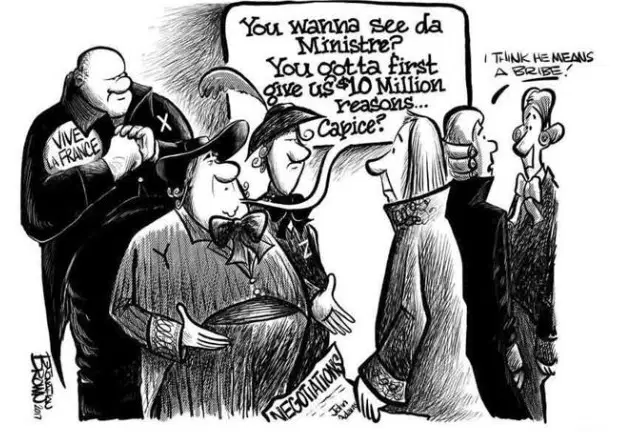
Which of the following events during the Adam's administration would the above image depict?
Sedition Act
XYZ Affair
War with the Barbary Pirates
Alien Act
To help build a strong national economy, what did Hamilton ask Congress to create?
Washington, D.C.
national bank
trade tariffs
the stock market
What did George Washington consider a grave danger to the new nation?
growth of political parties
France's influence
national taxes
settlers moving west
Which political party stood for a strong federal government?
Anti-Federalist
Democratic-Republican
Federalist
Democratic
The Federalists and the Democratic-Republicans had very different views about Britain and France. The Democratic-Republicans favored France, who had supported the colonies during the American Revolution. The Federalists often favored Britain because they...
wanted to maintain trade with the British.
wanted to avoid repaying debts from the Revolution
feared the growing strength of the French.
hoped for aid in defending against Native Americans.
One of the issues facing the early nation was how to interpret the Constitution. Alexander Hamilton said that the Constitution gave Congress the power "to make all laws necessary and proper." Which statement best describes Hamilton's views on how the Constitution should be interpreted?
He favored an inconsistent interpretation of the Constitution.
He favored a partisan interpretation of the Constitution.
He favored a strict interpretation of the Constitution.
He favored a broad interpretation of the Constitution.
While Alexander Hamilton supported merchants, Thomas Jefferson was more sympathetic toward the needs of...
financiers.
shopkeepers.
farmers.
aristocrats.
What barred French and British warships from American ports?
Treaty of Paris
Declaration of War
Proclamation of Neutrality
Treaty of Britain
How did the development of the Wilderness Road and the Warrior's Path lead Tennessee to statehood?
These trails encouraged western expansion in to the area that became Tennessee
These trails marked natural boundaries for the frontier states
Owners of these trails required pioneers to pay high tolls to use them, allowing the growth of Tennessee's population
These trails reduced the value of the Southwest Territory to North Carolina
What was the United States reaction to the French agents' demand for a loan and a bribe?
United States strengthened military
United States declared war to France
United States established new negotiations with France
United States declared war to France

Why did President Adams send negotiators to France?
United States and France were involved in a not declared war
to say French that United States was strengthening the military
French had begun capturing American ships
French agents demanded for a loan and bribe
John Adams pushed for the passage of the Alien and Sedition Acts in 1798. According to historians, one consequence of the Alien and Sedition Acts was that
immigrants became naturalized citizens faster.
citizens staged boycotts to protest the laws.
John Adams failed to win reelection.
John Adams deported thousands of immigrants.
The Alien and Sedition Acts were...
passed to strengthen the nation's military
strongly supported by the Republican party
strongly supported the Federalist party
passed to increase immigration
Who was the second president of the United States?
Aaron Burr
Thomas Jefferson
John Adams
Charles Pinckney
What did the Virginia and Kentucky Resolutions claim?
Pinckney's Treaty was biased in favor of wealthy landowners
Settlers had the right to settle in the Northwest Territories
The Alien and Sedition Acts violated the Constitution
Jay's Treaty violated the Constitution
What divided the Federalists and hurt John Adam's chance for re-election?
states' rights
war with France
Neutrality Act
treaty with France
What was the United States' reaction to the French agents' demand for a loan and a bribe?
United States strengthened military
United States declared war to France
United States began capturing french ships
Unites States established new negotiations with France
The Federalist party used the XYZ Affair to...
start a war with France.
try to impeach John Adams.
create a national agreement on new immigration laws.
build support for expanding the national army.
In January 1796, 55 delegates met at Knoxville to draft a constitution for Tennessee. This document was required for Tennessee to...
become a state.
accept government money.
become a territory.
accept permanent settlers.

Which of the choices below best complete the diagram?
A territorial census shows a population large enough for statehood.
Knoxville is established as the first state capital.
The Southwest Territory is created by the United States.
More people move to the Cumberland settlements in the late 1700s.
The Tennessee Constitution is comparable to the Bill of Rights in that both protect...
Protects the right to freedom of speech, assembly, and press.
Protects against unreasonable search and seizure.
Protects the right to a fair trial and religious freedom
Protects against alienable rights.
Protects voting rights for women.
A series of four laws passed by the U.S. Congress in 1798 amid widespread fear that war with France was imminent. The four laws–which remain controversial to this day–restricted the activities of foreign residents in the country and limited freedom of speech and of the press.
The Alien and Addition Acts
The Alien and UFO Acts
The Alien and Sedition Acts
The Alien and Planet Acts
The act where Congress increased residency requirements for U.S. citizenship to 14 years from five. (Many recent immigrants and new citizens favored the Republicans.)
Alien Enemies Act
Naturalization Act
Sedition Act
Alien Friends Act
The act permitted the government to arrest and deport all male citizens of an enemy nation in the event of war
Alien Enemies Act
Naturalization Act
Sedition Act
Alien Friends Act
The act allowed the president to deport any non-citizen suspected of plotting against the government, even in peacetime.
Alien Enemies Act
Naturalization Act
Sedition Act
Alien Friends Act
The act took direct aim at those who spoke out against Adams or the Federalist-dominated government. The new law outlawed any “false, scandalous and malicious writing” against Congress or the president, and made it illegal to conspire “to oppose any measure or measures of the government.”
Alien Enemies Act
Naturalization Act
Sedition Act
Alien Friends Act
Westward expansion into the territory that will become Tennessee encourages settlers to...
Enforce the Treaty of Paris
Sign the Treaty of Holston
Move North for industrial jobs
Apply for statehood
The Sedition Act infringed on the which amendment of the constitution.
The First Amendment
The Second Amendment
The Third Amendment
The Fourth Amendment
Which rights did the Sedition Act go against in the First Amendment?
Freedom of Speech
Freedom of Religion
Freedom of the Press
Freedom of Assembly
The Alien Enemies Act allowed the government to arrest and deport whom from the country?
All male citizens of an enemy nation in the event of war
All citizens of an enemy nation in the event of war
All female citizens of an enemy nation in the event of war
All child citizens of an enemy nation in the event of war
The Alien Friends Act allowed the president to deport non-citizens of the country only in wartime...
True
False
How long did you have to live in the U.S. before you could become a citizen under the Naturalization Act?
12 years
14 months
14 years
12 months
Which of the following describes the importance of Tennessee's first state constitution? Choose all that apply.
It contained a declaration of rights similar to the Bill of Rights.
It declared Tennessee as part of the Southwest Territory.
It was a necessary step for Tennessee statehood.
Thomas Jefferson declared that the constitution was unfit to be accepted.

