
 Worksheets
G7 Topic 6 Weather Review
Total questions: 40
Worksheet time: 20mins
What gas makes up 21% of the atmosphere?
Nitrogen
Oxygen
Argon
Carbon Dioxide
What gas makes up 78% of the atmosphere?
Nitrogen
Oxygen
Argon
Carbon Dioxide
The _____ is the layer of the atmosphere that is the closest to the ground.
Thermosphere
Stratosphere
Mesosphere
Troposphere
The _____ is the hottest layer of the atmosphere.
Thermosphere
Stratosphere
Mesosphere
Troposphere
What causes global winds?
movement of air from areas of low pressure to areas of high pressure
conduction currents caused by cool and warm air
radiation currents caused by absorbing the sun’s heat
unequal heating of Earth’s surfaces over large areas
Why is it hard to breathe at high altitudes?
Decreased air pressure causes the density of air to increase at higher altitudes.
Decreased air pressure causes the density of air to decrease at higher altitudes.
Increased air pressure causes the density of air to increase at higher altitudes.
Increased air pressure causes the density of air to decrease at higher altitudes.
Which step in the water cycle would explain why a puddle would disappear as the day goes on?
precipitation
evaporation
condensation
crystalization
Which step in the water cycle would explain why clouds begin to form?
precipitation
evaporation
condensation
crystalization
What does the amount of humidity describe?
The amount of moisture in the air
The amount of air pressure
The temperature of the air
The amount of oxygen in the air
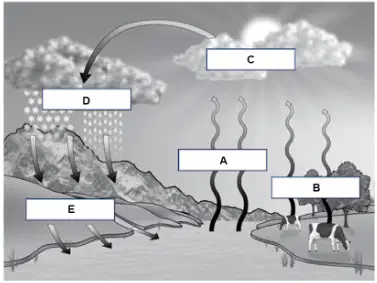
What stage of the water cycle is shown at position A?
Evaporation
Condensation
Precipitation
Respiration
What stage of the water cycle is shown at position B?
Evaporation
Condensation
Precipitation
Respiration
What stage of the water cycle is shown at position C?
Runoff
Condensation
Precipitation
Respiration
What stage of the water cycle is shown at position D?
Runoff
Condensation
Precipitation
Respiration
What stage of the water cycle is shown at position E?
Runoff
Condensation
Precipitation
Respiration
What are the sources of energy that drive the water cycle?
Gravity and the Earth's Core
Gravity and the Sun
The sun and the Earth's Core
The Earth's Core & Nuclear Energy
Which of the following cause the movement of the ar masses in North America?
changing humidity & changing temperature
Changing humidity & jet streams
jet streams & prevailing westerlies
prevailing westerlies & changing temperature
When a warm air mass is caught between two cold fronts, the result is a(n) ______________ front.
Warm
Cold
Occluded
Stationary
When a cold air mass runs into a warm air mass, the result is a(n) _____________ front.
Warm
Cold
Occluded
Stationary
When a fast-moving warm air mass overtakes a slower-moving cold air mass, the result is a(n) _____________ front.
Warm
Cold
Occluded
Stationary
When a warm air mass runs into a cold air mass but neither one can move the other, the result is a(n) _____________ front.
Warm
Cold
Occluded
Stationary
What kind of air mass brings hot & dry weather?
maritime tropical
maritime polar
continental tropical
continental polar
What kind of air mass brings hot & humid weather?
maritime tropical
maritime polar
continental tropical
continental polar
Which of the following is NOT a responsibility of a meteorologist?
collect and analyze data
make predictions about the weather
guess what the weather will be and report it on television
use observations and technology to determine how global patterns affect weather
A decrease in air pressure is a sign that _____ weather is on the way.
hot
stormy
calm
sunny
An increase in air pressure is a sign that _____ weather is on the way.
hot
stormy
calm
sunny
What can cause a storm to change its path?
an increase in temperature
an increase in speed
loss of moisture over the ocean
a changing wind direction
As wind speeds ______ a hurricane will become _____.
increase / weaker
increase / wider
decrease / weaker
decrease / faster
During a ____________________ you should go to a safe area and stay away from windows and doors in a house
Thunderstorm
Hurricane
Tornado
Winter Storm
During a ____________________ you should stay inside and have water and food ready in case the power goes out.
Thunderstorm
Hurricane
Tornado
Winter Storm
If you are outdoors during a ____________________ you should keep away from trees, poles, and high places.
Thunderstorm
Hurricane
Tornado
Winter Storm
During a ______________________ you should have water and food on hand or be ready to evacuate.
Thunderstorm
Hurricane
Tornado
Winter Storm
Lake effect snow forms when ___________.
a warm, moist air mass moving southeast across warmer lakes where the air mass drops the moisture on the nearby land
a cold, dry air mass moving southeast across warmer lakes where the air mass picks up water vapor and heat
a cold, moist air mass moving northwest across warmer lakes where the air mass picks up speed and heat
a warm, dry air mass moving northwest across warmer lakes where the air mass picks up speed and drops precipitation
What happens to hurricanes soon after they reach land away from the ocean?
Hurricanes stop.
Hurricanes speed up.
Hurricanes lose energy.
Hurricanes gain energy.
What causes more clouds to form as the day gets warmer?
precipitation increased
evaporation increased
condensation in creased
transpiration increased
What do trace gasses do in Earth’s atmosphere?
create the greenhouse effect by adding additional carbon dioxide
allow water vapor to remain in the atmosphere
trap solar energy before it escapes to help insulate Earth
suspend smoke and small particles in the atmosphere
A _____ front brings a drop in temperature & heavy rain.
Cold
Warm
Occluded
Stationary
A _____ front brings several days of rain.
Cold
Warm
Occluded
Stationary
Which of the following will happen when the temperature reaches the dew point?
Evaporation
Condensation
Precipitation
Transpiration
_________ tend to have clear skies and cool temperatures.
High pressure systems
Low pressure systems
Stationary fronts
Cold fronts
_________ tend to have cloudy skies and warm temperatures.
High pressure systems
Low pressure systems
Stationary fronts
Cold fronts

