
Font size
 Worksheets
Earth's History (Short Review)
Total questions: 10
Worksheet time: 6mins
The spontaneous breakdown of radioactive nuclei into a stable form releases energy. This is known as _____.
isotopes
radioactive decay
half-life
absolute dating
Which of the following is NOT a characteristics of index fossils?
spread over a wide geographical area
lived for a short period of time
distinctive and easily identifiable
exist in small numbers
(a) is determining the actual (b) of an event or object in years. While (c) is the (d) of determining if one rock or (e) is older or younger than another, without knowing their specific ages like how many years ago the object was formed.
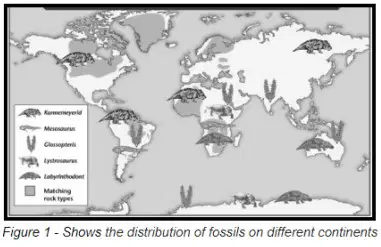
After reading a scientific paper in 1911, that listed identical plant and animal fossils on opposite
sides of the Atlantic Ocean. Alfred Wegener, a meteorologist and explorer, hypothesized that
the continents were once a large landmass. He then set out to search for other cases of
identical fossils on opposite sides of oceans. Wegener published his findings in 1915 (as seen
in Figure 1). How does Figure 1 provide evidence to explain how the Earth has evolved over geologic time?
All fossils contain the same DNA, showing a common ancestor among them.
All fossils change the area they lived in, showing their rapid changes over time.
Fossils of the same type of organism can be found on continents that are not connected,
showing that all continents were once together.
Fossils of the same type of organism can be found only on the same continent, showing
that the continents have always been separated.
A fossil sample is analyzed using carbon dating methods. Of the original 300g sample, only 75g remain. If the half-life of carbon-14 is 5730, how old is the fossil?
5730 years
2,865 years
429,750 years
11,460 years
What is an unconformity?
a correlation of rock layers in different regions using fossils
an erosional surface in the rock that represents a gap in time.
the lowest layer in a rock outcrop that contains an intrusion
the measurement of the ratio of parent and daughter isotopes in a rock sample
Which of the following best describes the principle of Original Horizontality?
Layers of sediment are deposited horizontally.
A fault or intrusion of magma is younger than the layers it crosses.
The oldest rocks are on the bottom in undisturbed layers.
Processes that occur today also occurred in the past.
A fossil sample is analyzed using carbon dating methods. Of the original 300g of carbon-14, only 75g remain. How much of the sample is stable nitrogen-14?
75g
375g
150g
125g
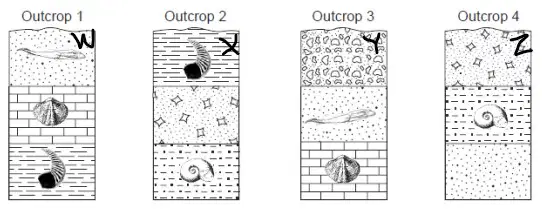
Four rock outcrops, labeled 1, 2, 3, and 4, found within the same plateau, are represented below. Index fossils found in some of the rock layers are shown. The rock layers have not been overturned. Which rock layer is the youngest?
Layer W in Outcrop 1
Layer X in Outcrop 2
Layer Y in Outcrop 3
Layer Z in Outcrop 4

