
 Worksheets
Organic molecules
Total questions: 25
Worksheet time: 14mins

Which best describes the importance of lipids to organisms?
They provide keratin in hair and outer layers of the skin.
They keep cellular organelles hydrated within an organism.
They provide storage for cellular waste within an organism.
They serve as cellular membrane components and as concentrated energy sources.

Which characteristic best explains why carbon is relevant to living organisms?
Carbon is the most common element on Earth.
Carbon can form a wide variety of molecules.
Many carbon isotopes are radioactive.
Many carbon allotropes occur in nature.
Which food items can be broken down mostly into amino acids?
noodles
steak
apple slices
pears
Food provides calories needed by the body for energy. However, the body must use energy between meals when food is not consumed.
What is the most likely response of the body when more energy is used than the calories consumed
provide?
to increase blood flow to the limbs for energy production
to release energy from lipids stored throughout the body
to transform stored proteins into carbohydrates for energy
to contract muscles to create heat energy for the body
Which organic molecule would a long-distance runner most likely choose to eat before a race?
A protein, because it builds muscle mass.
A carbohydrate, because it gives quick energy.
A lipid, because it stores and releases energy.
A protein, because it transports oxygen in the blood stream.
Which of the following foods is highest in polysaccharides?
broccoli
potatoes
cheese
fish
Which subunits make up the structure of all proteins?
glucose
amino acids
carbohydrates
phospholipids

The diagram shows the structural formula for starch.
Which of the following explains why starch is a polymer?
repetitive combination of simple subunits
organic compound molecule
high mobility as a result of its long length
contains carbon-based functional groups

What are the components of each nucleotide?
glucose, water, and cellulose
adenine, thymine, and cytosine
a phosphate group, a sugar molecule, and a nitrogen base
a phosphate group, a five-carbon sugar, and an amino acid
Why are proteins among the most diverse molecules?
They create nucleic acids.
They form muscle in animals.
Amino acids can link up in different combinations.
Amino acids are made up of more than 20 different proteins.
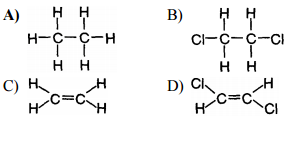
Which of the following is NOT one of the four major organic molecules?
Lipids
Nucleic Acids
Amino Acids
Carbohydrates
Which of the following is a necessary component of an organic molecule?
Phosphate
Carbon
Nitrogen
Sulfur
Which source of energy does our body use first?
Lipids
Carbohydrates
Proteins
A ___ is a subunit of an organic molecule.
Monomer
Polymer
Which of the following is the polymer for proteins?
Polysaccharide
Amino Acid
Polypeptide
Triglyceride
Which of the following has the most energy (calorie) per gram?
Lipids
Carbohydrates
Nucleic Acids
Protein
Energy is stored in chemical (a) .
___ stores short-term energy; ___ stores long-term energy.
Carbohydrates; Lipids
Lipids; Carbohydrates
Carbohydrates; Nucleic Acids
Nucleic Acids; Lipids
Sugar and cellulose are examples of..
Lipids
Carbohydrates
Nucleic Acids
Proteins
Fats, oils, and waxes are...
Lipids
Carbohydrates
Proteins
Nucleic Acids
Functions include contraction of the muscles, transporting substances in the body, and speeding up chemical reactions (enzymes).
Carbohydrate
Lipid
Nucleic Acid
Protein
Transmits genetic information (DNA and RNA)
Carbohydrates
Lipids
Nucleic Acids
Protein
Which of the following is not part of a nucleotide?
Phosphate
Sugar
Nitrogenous base
Fatty Acid

