
 Worksheets
Sculpture
Total questions: 18
Worksheet time: 9mins
What is a sculpture?
form that as height, width and depth made from clay, stone, metal, wood or other various materials
shape made from clay, stone, metal, wood or other various materials
form that has height and width made from clay, stone metal, wood or other various materials
shape with depth made from clay, stone, metal, wood or other various materials
What two elements of art are needed to create an in the round sculpture?
shape
unity
balance
form
To reproduce an object, such as a piece of sculpture, by means of a mould taken from it usually plaster.
subtractive sculpture
cast
additive sculpture
mould
Casting is which type of sculpture process?
additive
organic
subtractive
geometric
What is the armature's job for the sculpture?
it is the top of the sculpture that keeps it held together
to decide how the sculpture will be transported
it is the skeleton or framework used to support the sculpture
to tell the artist where to place the sculpture
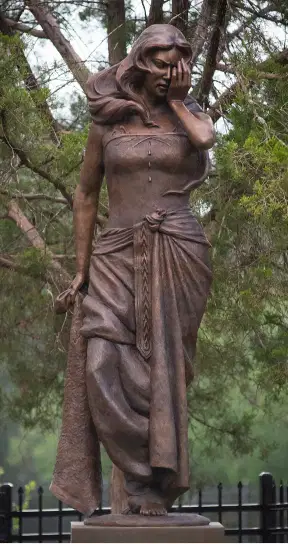
Who is the artist that sculpted, molded and casted this sculpture below titled "Rachel Weeping?"
Louise Bourgeois
Tracy H Sugg
Andrea Riccio
Alberto Giacometti
What is a sculpture technique that involves heating and hammering metal into shape?
Carving
Modeling
Forging
Casting
In sculpture, what is the technique called where material is added to build up the form?
Carving
Modeling
Casting
Forging
Which of the following is NOT a technique used in sculpture?
Carving
Modeling
Glazing
Casting
What is the term for art made by assembling different materials onto a backing?
Mosaic
Collage
Fresco
Graffiti
What is the name of the technique that creates the illusion of depth on a flat surface?
Sculpting
Perspective
Collage
Stippling
Which principle of art is involved in arranging elements to create a sense of motion or direction in a sculpture?
Balance
Movement
Harmony
Proportion
In sculptural art, what does the principle of balance refer to?
The distribution of visual weight
The harmony of colors
The symmetry of shapes
The contrast between textures
Which of the following materials is commonly used for casting in sculpture?
Wood
Stone
Bronze
Clay
Which element of art is primarily concerned with the surface quality of a sculpture?
Color
Form
Texture
Space
What element of art does a sculptor manipulate to create a 3D effect in a sculpture?
Line
Shape
Form
Color
Which principle of art is involved in arranging elements to create a sense of motion or direction in a sculpture?
Balance
Movement
Harmony
Proportion
In sculptural art, what does the principle of balance refer to?
The distribution of visual weight
The harmony of colors
The symmetry of shapes
The contrast between textures

