
 Worksheets
Unit 6 Review
Total questions: 187
Worksheet time: 2hrs 34mins
According to the kinetic molecular theory, a gas consists of molecules in constant fixed motion.
True
False
According to kinetic molecular theory-Gas molecules influence each other only by collision; they exert no other forces on each other.
True
False
According to the kinetic molecular theory, all collisions between gas molecules are inelastic; all kinetic energy is lost.
True
False
According to the kinetic molecular theory, the volume actually occupied by the molecules of a gas is negligibly small; the vast majority of the volume of the gas is empty space through which the gas molecules are moving.
True
False
In the KMT, pressure is the force exerted against the wall of a container by the continual collision of molecules against it.
True
False
The total kinetic energy of a collection of gas molecules is inversely proportional to the absolute temperature of the gas.
True
False
Ideal gases (best conditions) are light molecules such as hydrogen and helium. Heavier gases do not follow this rule.
True
False
Real gases have attraction to other gas molecules which is opposite of the kinetic molecular theory. This way they can have a chemical reaction with each other.
True
False
The first postulate of the KMT is that all matter is made up of
tiny particles
molecules
cells
mass
According the KMT, the particles are in
different states
organized patterns
constant motion
various containers
According to the KMT, increasing the temperature of particles will
give off energy
increase motion
decrease volume
increase pressure
According to the KMT, the particles of the different states of matter differ in what two key aspects?
volume and mass
density and extention of interactions
temperature and freedom of motion
freedom of motion and extent of interactions
In a solid, what keeps each particle trapped in the same small volume and with the same surrounding particles.
strong attractions between particles
ionic bonds
lack of particle motion
low temperatures
What does increasing the temperatureof a solid lead to?
increased mass of particles
decreased space between particles
decreased velocity of particles
increased velocity of particles
What is happening when a solid is becoming a liquid?
The particles decrease in motion, collapsing the organized structure.
The increased movement of particles pushes them completely out of position, collapsing the organized structure.
The particles increase in motion, causing the organized structure to flatten into a smaller shape.
A particle party!
How doe the particles in a liquid behave?
Neatly organized without any movement.
Move around trapped in a small volume and with the same surrounding particles.
Move fast enough to break attractions and pushing other particles out of the way.
Move freely in a straight line until they collide with another particle.
How doe the particles in a gas behave?
Neatly organized without any movement.
Move around trapped in a small volume and with the same surrounding particles.
Move fast enough to break attractions and pushing other particles out of the way.
Move freely in a straight line until they collide with another particle.
If the particles are moving fast enough to complete break the attraction pulling it back towards other particles, what process is occuring?
sublimation
melting
freezing
evaporation
When particles in a gas collide, they change
direction and velocity
velocity and temperature
direction and volume
volume and temperature
In which state of matter are the particles the farthest apart?
gas
liquid
solid


The melting point of the sample is
-60 ºC
-100 ºC
60 ºC
100 ºC

Given the heating curve of a solid being heated at a constant rate, what is the boiling point of this substance?
20°C
50°C
110°C
170°C

Given the heating curve for water, during which line segment could I find water in both the solid and liquid phase at the same time?
AB
BC
CD
DE
EF

This curve indicates what about the heat energy?
Heat energy is being added or absorbed
Heat energy is being released
What is the freezing point of the substance?
0oC
60oC
120oC
180oC

Where on the graph are phase changes taking place?
1
2
3
4
5

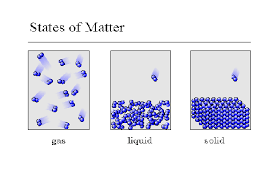

What state of matter is pictured?
Solid
Liquid
Gas
Plasma

At Point A, the beginning of observations, the substance exists in a solid state. Material in this phase has a ____________ volume and ___________ shape.
(a)

At POINT B, the temperature is (a) degrees C.

At POINT C, the substance is completely _____________, or in a ____________ state.
(a)

During the time from POINT D to POINT E, the liquid is (a) .

By POINT E, the substance is completely in the (a) phase.

Beyond POINT E, the substance is still in the __________ phase, but the molecules are moving _________ as indicated by the increasing temperature.
(a)

The absolute coldest anything can get.
In Celsius it's -273.15 degrees. Or 0 degrees Kelvin.
Absolute cold
Kelvin
Absolute zero
I don't know


Temperature is a measure of the average _____________ energy of the particles of a substance.
potential
kinetic
gravitational
heat

Which letter represents particles in solid form?
A
B
C
D
E
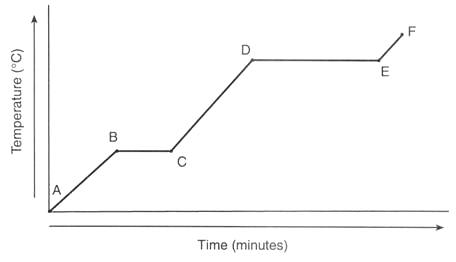
Between which points is the temperature of the substance remaining constant? (Diagram F)
A-B only.
A-B, C-D, E-F
B-C only.
B-C, D-E
True or false: melting and freezing occur at the same temperature
True
False
I don't know

A substance's heating curve is shown in the graph. What is its boiling point? (Diagram B)
100 C
60 C
80 C
20 C
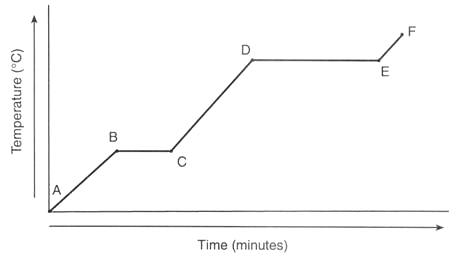
Moving left to right across the diagram, are the particles moving faster or slower as time goes on? (Diagram F)
Faster
Slower

Which letter represents where vaporization is occurring?
A
B
C
D
E

If a substance is freezing, what is happening to it?
It is changing from a liquid to a solid
It is losing thermal energy to its surroundings
the particles of the substance are making bonds
all of the above
If a substance is melting, what is happening to it?
It is changing from a solid to a liquid
It is gaining thermal energy from its surroundings
the particles of the substance are breaking bonds
all of the above
Boiling and evaporation are forms of vaporization
True
False

What is happening at letter D?
Evaporation of a liquid
Condensation of a gas
Boiling of a liquid
The answer depends on if there is thermal energy being added or removed
If energy is being added at letter D, what is happening on the phase change graph?
Evaporation of a liquid
Condensation of a gas
Boiling of a liquid
Both A and B
What is happening at absolute zero
A liquid is changing to a solid
All particle motion stops.
water can no longer change into a solid
solids are permanently in their form
Without the sun's heat, what would happen to earth?
aliens would invade
the earth would explode
it would be too cold to survive
What is a conductor?
a material that heat moves through easily
a material that heat does not move through easily
a material that turns cold when heated
a tool for measuring temperature
Which of these is a better conductor?


Stir frying vegetables is an example of
Convection
Conduction
Radiation

Hot water rises and cold water sinks. Is this:
Convection
Conduction
Radiation

Cold Pack on Person
Heat is transferred from the cold pack to the person.
Heat is transferred from the person to the cold pack
The cold pack is getting colder. The person is getting warmer.

In heat transfer, heat always flows from the _______________ substance to the _______________ substance.
hotter to colder
colder to hotter
hotter to hotter
colder to colder
Which is an example of heat being transferred by conduction?
a furnace blowing hot air through vents
an ice cube melting in a person’s hand
boiling water transferring heat to noodles
the sun heating water in a swimming pool


If I want two things to stay different temperatures from each other, I need to:
Maximize heat Transfer
Minimize heat transfer
Make them touch a lot
Blow on both with a fan

Near the ceiling of a room the air is warmer. The warm air rises because of ________.
conduction
convection
radiation

When I emit (send out) IR radiation, my body gets:
Hotter
Cooler
Stays the Same
Humans don't emit radiation

The heat transferred from the Sun to the Earth by waves is called ________.
conduction
radiation
convection

The baby chickens kept warm by the heat lamps. This is an example of ________.
conduction
convection
radiation
The heat transferred from the Sun to the Earth by waves is called ________.
conduction
radiation
convection
When matter goes from liquid to solid, that's called...
Freezing
Melting
Evaporation
Condensation
What happens to matter during freezing?
Solid turns liquid.
Liquid turns into solid.
What did we pour into the smaller zip lock bag?
water
ice
milk
shampoo
What state of matter is the milk when you begin?
solid
liquid
gas
plasma
What state of matter should the milk be when you were finished?
solid
liquid
gas
plasma
Why do we add salt to the ice?
To add flavor to the ice cream
to lower the temperature at which water freezes
to melt the ice faster
to completely stop the ice from ever melting
What did you do make the milk turn into ice cream?
take it outside in the sunshine
shake and rub the bag
put it in the freezer
put in in an ice cream machine
Why did we add sugar to the milk in the bag?
to make it freeze faster
to keep it from sticking to the bag
to make it sweeter
because we wanted to
Why do you need to use a small towel or napkin and wear it on your hands?
to keep your hands from getting so cold
in case you spilled your milk you could clean it up quickly
to make you look cooler while making ice cream
so you could catch the football better at recess
Why did the outside of the bag get wet? (Choose the best response)
condensation occurred because the moisture in the air cooled when it came in contact with the cold ice
bags leak
What types of phase changes will take place when we are making ice cream? (Choose all that apply)
freezing
melting
vaporization/boiling
condensation
sublimation
How do the molecules in the milk mixture respond to the addition of ice & salt?
the molecules speed up
the molecules slow down
the molecules come to a stop
the molecules return to normal
What happened to the heat energy that left the milk?
the heat energy disappears
the heat energy transfers to the ice
the heat energy energy changes to electricity
the heat energy becomes a liquid
Why did the outside of the bag get wet? (Choose the best response)
condensation occurred because the moisture in the air cooled when it came in contact with the cold ice
bags leak
How could you turn your ice cream back into a liquid?
remove heat from the ice cream
freeze molecules
put it in the freezer
add heat to the ice cream
At which phase do molecules move the fastest and spread apart?
solid
liquid
gas
plastic
What do you not put into the smaller plastic bag?
ice
vanilla
white sugar
half and half
What letter is used to represent specific heat capacity?
H
P
C
T


Which will heat up slower?
water
lead
granite
iron

Which will heat up faster?
copper
granite
iron
basalt
Which of the following best explains why the sand at the beach is hotter than the water?
Sand has a higher specific heat than water.
Sand has a lower specific heat than water.
There is more water than sand at the beach.
There is more sand than water at the beach.
The amount of energy required to raise the temperature 1ºC for every gram is called____?
Thermal Energy
Specific Heat
Temperature
Kinetic Energy


Which material heats up quickest?
Aluminium
Concrete
Diamond
Glass
Water

Which material heats up slowest?
Aluminium
Concrete
Diamond
Glass
Water


What letter is used to represent specific heat capacity?
H
P
C
T
Which will heat up slower?
water
lead
granite
iron
Which will heat up faster?
copper
granite
iron
basalt
Which of the following best explains why the sand at the beach is hotter than the water?
Sand has a higher specific heat than water.
Sand has a lower specific heat than water.
There is more water than sand at the beach.
There is more sand than water at the beach.
The amount of energy required to raise the temperature 1ºC for every gram is called____?
Thermal Energy
Specific Heat
Temperature
Kinetic Energy
Which material heats up quickest?
Aluminium
Concrete
Diamond
Glass
Water
Which material heats up slowest?
Aluminium
Concrete
Diamond
Glass
Water
The equation for heat transfer is H= m×c×ΔT What is represented by H?
heat, measured in calories
mass, measured in grams
specific heat, in calories/gram/degree C
temperature change in degree C
The equation for heat transfer is H = m×c×ΔT What is represented by ΔT ?
heat, measured in calories
mass, measured in grams
specific heat, in calories/gram/degree C
temperature change in degree C
The equation for heat transfer is H = m×c×ΔT What is represented by m ?
heat, measured in calories
mass, measured in grams
specific heat, in calories/gram/degree C
temperature change in degree C
The equation for heat transfer is H = m×c×ΔT What is represented by c ?
heat, measured in calories
mass, measured in grams
specific heat, in calories/gram/degree C
temperature change in degree C
We know inuitively that it takes more energy to boil two kettles of water than one kettle. Mathematically, we say this as:
heat energy is proportional to mass
heat energy is proportional to change in temperature
heat energy is proportional to specific heat capacity
When making a kettle of tea, we start with room temperature water instead of cold water because
heat energy is proportional to mass
heat energy is proportional to change in temperature
heat energy is proportional to specific heat capacity
We had some nails and water that were both too hot too touch. The nails cooled down faster because:
heat energy is proportional to mass
heat energy is proportional to change in temperature
heat energy is proportional to specific heat capacity
The sand at a beach gets very hot during the day, and cools down rapidly at night. The water stays close to the same temperature, because
the sand has a higher specific heat capacity
the water has a higher specific heat capacity
Something that has a high specific heat capacity is likely to:
stay at close to a constant temperature
heat up easily and stay hot
cool down easily and stay cold
heat up and cool down easily
Something that has a low specific heat capacity is likely to:
stay at close to a constant temperature
heat up easily and stay hot
cool down easily and stay cold
heat up and cool down easily
The equation for heat transfer is H = m×c×ΔT Using this equation, figure out how much heat is required to warm up 2000 g of water from 20 degree C to 100 degrees C. Conveniently, the specific heat capacity of water is 1 cal/gram/degree C
40,000 cal
160,000 cal
20,000 cal
80,000 cal
The equation for heat transfer is H = m×c×ΔT Using this equation, figure out how much heat is released when 100 grams of olive oil cool by 40 degrees C. The specific heat capacity of olive oil is c = 0.5 calories/gram/degree C.
40 cal
100 cal
1000 cal
2000 cal

A metal cube with a mass of 55grams at temperature of 85°C is immersed in 150grams of water at temperature of 20°C. The metal and water then reach a final temperature of 23oC. How much heat does the water gain?
1881 J
690 J
14253 J
38874 J
A metal cube with a mass of 55grams at temperature of 85°C is immersed in 150grams of water at temperature of 20°C. The metal and water then reach a final temperature of 23oC. How much heat does the metal lose?
-1881 J
-690 J
-14253 J
-38874 J
A metal cube with a mass of 55grams at temperature of 85°C is immersed in 150grams of water at temperature of 20°C. The metal and water then reach a final temperature of 23oC. What is the specific heat of the metal?
0.55 J/goC
2120 J/goC
11.4 J/goC
4.18 J/goC
0.75 J/goC

