wayground logo

Free Printable Worksheets

Font size

S
M
L
XL
Worksheets

REVIEW - Chem MIDTERM EXAM

Total questions: 182

Worksheet time: 5hrs 52mins

Name
Class
Date
1.
What is the noble gas shorthand electron for Sulfur atom?
a)
[Ar] 3p4
b)
[He] 3s23p4
c)
[Ne] 3s23p4
d)
[Na] 3s23p4
2.
What is the electron configuration for this atom?
a)
1s22s22p6
b)
1s22s22p5
c)
1s22s22p3
d)
2s22p3
3.
What atom matches this electron configuration?
1s22s22p63s2
a)
Neon
b)
Magnesium
c)
Aluminum
d)
Potassium
4.
Which element is depicted from this orbital diagram
a)
Fluorine
b)
Neon
c)
Chlorine
d)
Argon
5.
Which is associated with more energy? 
a)
2p
b)
2s
c)
3p
d)
1s
6.
What is the charge of an atom that has lost one electron?
a)
-1
b)
-2
c)
+1
d)
+2
7.
What is the charge of an atom that has gained one electron?
a)
-1
b)
-2
c)
+1
d)
+2
8.
Anions are _______ that form ____________ ions and __________ electrons.
a)
nonmetals, positive, lose
b)
nonmetals, negative, gain
c)
metals, positive, gain
d)
metals, positive, lose
9.
Which element is pictured?
a)
neon
b)
fluorine
c)
magnesium
d)
argon
10.
What atom matches this electron configuration?
1s2s2p3s2
a)
Neon
b)
Magnesium
c)
Aluminum
d)
Potassium
11.
How many electron can be found in a s orbital?
a)
2
b)
3
c)
4
d)
1
12.
What atom matches this electron configuration?
1s2s2p3s2
a)
Neon
b)
Magnesium
c)
Aluminum
d)
Potassium
13.
How many electron can be found in a p orbital?
a)
2
b)
3
c)
4
d)
6
14.
What is the electronic configuration of sodium?
a)
1s22s22p63s1
b)
[Ne]3s1
c)
1s22s22p7
d)
Both A and B are correct
15.
What is the electronic configuration of iron?
a)
1s22s22p63s23p64s23d6
b)
1s22s22p63s23p63d8
c)
1s22p63s23p64s23d6
d)
1s22s22p63s23p64s13d6
16.
Which is the electron configuration for an oxygen atom?
a)
1s22s22p63s23p64s2
b)
electronic configuration
1s22s22p4
c)
1s22s22p6
d)
1s22s22p63s23p6
17.
What is the maximum number of electrons that an orbital can have?
a)
1 electron
b)
2 electrons
c)
3 electrons
d)
4 electrons
18.
How many d orbitals are there in a given sublevel?
a)
1
b)
3
c)
5
d)
7
19.
How many p orbitals are there in a sublevel?
a)
2
b)
1
c)
4
d)
3
20.
How many electrons can the d sublevel hold?
a)
8
b)
10
c)
2
d)
4
21.
What is this element? 
1s22s22p63s23p6
4s23d104p6
a)
Argon
b)
Krypton
c)
Selenium
d)
Bromide
22.
What atom matches this electron configuration?
[Xe] 6s2 4f14 5d9
a)
Mercury
b)
Gold
c)
Platinum
d)
Thallium
23.
How many electrons can the first energy level hold?
a)
1
b)
2
c)
8
d)
0
24.
How many valence electrons does Chlorine have?
a)
5
b)
2
c)
7
d)
5
25.
How can you tell how many energy levels an atom has? 
a)
APE MAN
b)
By the Group
c)
By the Period
d)
By the atomic mass
26.
How many valence electrons does Calcium have? How many energy levels does Calcium have?
a)
2 valence: 4 energy levels 
b)
20 valence:  4 energy levels 
c)
4 valence: 2 energy levels 
d)
2 valence: 3 energy levels 
27.
If an atom has 4 protons, how many valence electrons will it have?
a)
4
b)
6
c)
2
d)
0
28.

What rule(s) do you need to know for Electron Configuration?

a)

Aufbau Principle

b)

Pauli Exclusion Principle

c)

Hund's Rule

d)

All of the above

29.

Which are the four atomic orbitals?

a)

s,p,d,f

b)

a,b,c,d

c)

s,t,e,p

d)

d,r,o,f

30.

Within an energy level, which orbitals are the lowest in energy?

a)

s

b)

f

c)

d

d)

p

31.

What is the Aufbau principle?

a)

Within an energy level, s orbitals are the lowest energy, followed by p, d and then f. F orbitals are the highest energy for that level.

b)

The lower the principal quantum number (n) the lower the energy.

c)

All three.

d)

The Aufbau Principle states that electrons enter the lowest energy orbitals first.

32.
How many valence electrons are in Phosphorus?
a)
15
b)
4
c)
5
d)
31
33.
How many electrons should Beryllium have around its Lewis dot model?
a)
1
b)
2
c)
3
d)
4
34.
How many electrons should Flourine have around its Lewis dot model?
a)
5
b)
6
c)
7
d)
8
35.

This could be the dot diagram of

a)

Mg

b)

Cl

c)

C

d)

O

36.
An electron occupies the lowest energy orbital that can receive it.
a)
Hund’s rule
b)
Pauli exclusion principle
c)
Bohr model of the atom
d)
Aufbau principle
37.
An electron occupies the lowest energy orbital that can receive it.
a)
Hund’s rule
b)
Pauli exclusion principle
c)
Bohr model of the atom
d)
Aufbau principle
38.
All orbitals of equal energy are occupied by one electron before any single orbital is occupied by a second electron.
a)
Aufbau principle
b)
Pauli exclusion principle
c)
Hund’s rule
d)
Core Notation
39.
No two electrons in the same atom can have the same four quantum numbers.
a)
Aufbau principle
b)
Pauli exclusion principle
c)
Hund’s rule
d)
Noble gas notation
40.
Electrons occupy orbitals of lowest energy first is part of what electron configuration rule?
a)
Hund’s Rule
b)
Aufbau Principle
c)
Pauli Exclusion Principle
41.
17. Which coefficients correctly balance the formula equation below? KClO3 (s)---> KCl(s) + O2(g)
a)
1,1,1
b)
1,1,3
c)
2,2,3
d)
2,1,1
42.
18.  Choose the correct coefficients to balance the following equation: PbO2 ---> PbO + O2
a)
1,1,2
b)
2,2,1
c)
2,2,2
d)
1,2,1
43.
19.  Choose the correct coefficients to balance the following equation: Zn(OH)2 +HC2H3O2---> Zn(C2H3O2)2 + H 2O
a)
1,2,1,2
b)
1,1,1,2
c)
2,2,1,1
d)
2,1,2,1
44.
20.  Choose the correct coefficients to balance the following equation: Cl2 + KBr ---> KCl + Br2
a)
2,1,2,1
b)
1,2,2,1
c)
1,2,1,1
d)
1,1,2,2
45.
A charged atom
a)
Ion
b)
Isotope
c)
Electron Cloud
d)
Quark
46.
Arrangement of elements organized by atomic number
a)
Electron Cloud 
b)
Periodic Table 
c)
Electron Configuration
d)
None of these
47.
Proposed the Modern Electron Cloud Model of the atom
a)
Schrodinger & Heisenberg
b)
Dalton
c)
Chadwick
d)
Rutherford
48.
"wave theory"
a)
Planck
b)
Heisenberg
c)
de Broglie
d)
Schrodinger
49.
"Electrons have particle and wave-like properties."
a)
Planck
b)
Heisenberg
c)
de Broglie
d)
Schrodinger
50.
created an equation to treat the electron as a wave
a)
Planck
b)
Heisenberg
c)
de Broglie
d)
Schrodinger
51.
The position & momentum of the electron cannot be known at the same time. 
a)
Planck
b)
Heisenberg
c)
de Broglie
d)
Schrodinger
52.

What did Dmitri invent?

a)

Children

b)

Periodic Table

c)

Russian currency

d)

Calculator

53.

How are the elements arranged on the periodic table today?

a)

By atomic mass

b)

By number of electrons

c)

By atomic number

d)

By alphabetic order

54.

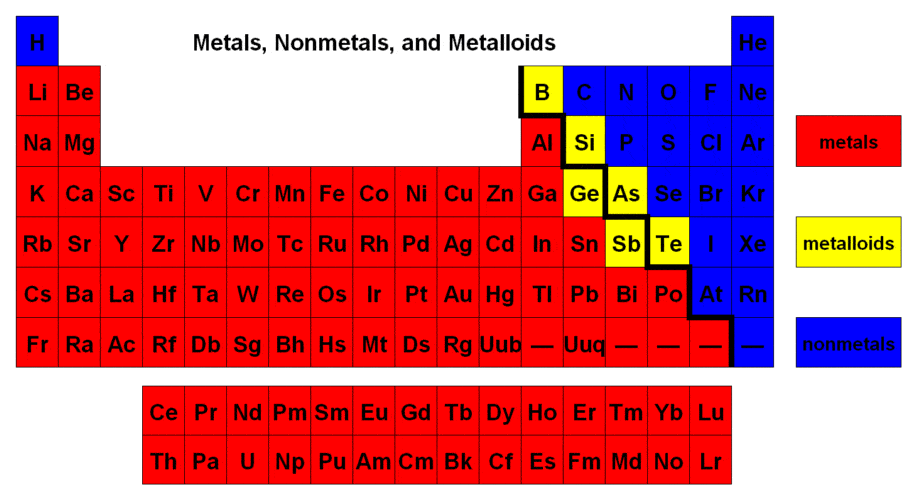
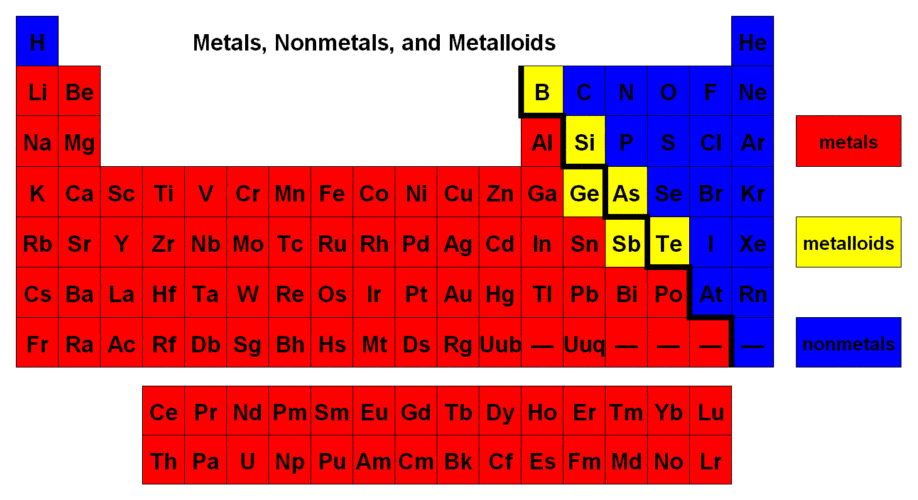
what is the biggest group on the table

a)

metals

b)

nonmetals

c)

metaloids

d)

halogens

55.

how many rows are on the table

a)

4

b)

5

c)

6

d)

7

56.

how many groups/families are on the table

a)

15

b)

16

c)

17

d)

18

57.

what is the name of group number 1

a)

halogens

b)

noble gases

c)

alkali

d)

alkaline earth

58.

what is the name of group number 2

a)

transition metals

b)

halogens

c)

metaloids

d)

alkaline earth

59.

where are the metaloids found

a)

far left, vertical

b)

stair step/diagonal

c)

far right horizontal

d)

at the bottom

60.

what group number are the halogens

a)

18

b)

1

c)

2

d)

17

61.

what is the small group of elements called that include C,N,O

a)

metals

b)

nonmetals

c)

metaloids

d)

noble gases

62.

what group number are the noble gases

a)

17

b)

18

c)

14

d)

15

63.

symbols must have at least

a)

1 cap. letter

b)

2 cap. letters

c)

2 lower case letters

d)

any letter you want

64.
What is the atomic number of Rubidium?
a)
37
b)
44
c)
45
d)
86
65.
What is the atomic number of Oxygen?
a)
6
b)
7
c)
8
d)
9
66.
Which of the following will have a larger radius than Zinc?
a)
Gallium
b)
Aluminum
c)
Magnesium
d)
Strontium
67.
Which of the following will have a higher electronegativity than arsenic (As)?
a)
Carbon (C)
b)
Neon (Ne)
c)
Antimony (Sb)
d)
Germanium (Ge)
68.
Which of the following will have a lower ionization energy than Scandium (Sc)?
a)
Helium (He)
b)
Titanium (Ti)
c)
Calcium (Ca)
d)
Magnesium (Mg)
69.
As atoms of elements in group 16 are considered in order from top to bottom, the electronegativity of each successive element....
a)
decreases
b)
increases
c)
remains the same
d)
none of the above
70.
Which atom has the largest atomic radius?
a)
potassium
b)
rubidium 
c)
francium
d)
cesium
71.
As you move down the periodic table atoms get bigger.  This is because ____________.
a)
The atoms have more mass.
b)
The atoms have more protons.
c)
The atoms have more energy levels
d)
The atoms have more nuetrons
72.
As you move across the periodic table atoms tend to get smaller because, ______________.
a)
the atoms have more mass.
b)
the atoms have less mass
c)
the atoms have more protons.
d)
the atoms have less electrons.
73.
Atoms that have a high electronegativity, _______________.
a)
give up their electrons more easily.
b)
hold on to their electrons more tightly.
c)
have more electron shells.
74.
Electronegativity is...
a)
how good an atom is at attracting electrons
b)
the ability of an atom to lose electrons
c)
the energy required to remove an electron from a specific atom
d)
how easy it is to make friends. 
75.
Ionization energy is...
a)
the energy required to add an electron to a specific atom
b)
how much energy it takes to remove an electron from an atom
c)
the energy required to shield the outer electrons from the nucleus
d)
a measure of the ability of an atom to attract electrons
76.

The element with the lowest electronegativity in Period 3 is -

a)

Na

b)

Cl

c)

Ar

d)

Mg

77.
Atomic radius generally increases as we move __________.  
a)
down a group and from right to left across a period 
b)
up a group and from left to right across a period 
c)
down a group and from left to right across a period 
d)
up a group and from right to left across a period 
78.
Looking at atoms in the same valence energy level, what factor affects Coulombic attraction?
a)
number of protons
b)
distance from the nucleus
79.
Looking at atoms in the same group/family, what factor affects Coulombic attraction?
a)
number of protons
b)
distance from the nucleus
80.
As the Coulombic attraction increases the atomic radius: increases or decreases?
a)
increases
b)
decreases
81.
As the Coulombic attraction in an atom increases, the energy needed to remove an electron: increases or decreases?
a)
increases
b)
decreases
82.
Which element has the greatest ionization energy: Aluminum (Al)    or    Chlorine (Cl)?
a)
Aluminum (Al)
b)
Chlorine (Cl)
83.
As the Coulombic attraction of an atom increases, the electronegativity of the atom: increases or decreases?
a)
increases 
b)
decreases
84.

Which of the following elements is most likely to have similar properties to those of sodium (Na)?

a)

Magnesium (Mg)

b)

Sulfur (S)

c)

Francium (Fr)

d)

Titanium (Ti)

85.

Which element is located in group 3?

a)

Yttrium (Y)

b)

Carbon (C)

c)

Sodium (Na)

d)

Lithium (Li)

86.

Which element is located in period 4?

a)

Zirconium (Zr)

b)

Silicon (Si)

c)

Beryllium (Be)

d)

Iron (Fe)

87.

Which element is located in period 4?

a)

Zirconium (Zr)

b)

Silicon (Si)

c)

Beryllium (Be)

d)

Iron (Fe)

88.

Two elements that have similar physical and chemical properties are most likely in the same...

a)

period

b)

row

c)

group

89.
Which atom has more shielding?
a)
Ca
b)
Be
c)
Ba
d)
Mg
90.
The concept of shielding happens because of
a)
attraction between nucleus and valence electrons
b)
attraction between nucleus and core electrons
c)
repulsion between valence electrons and other valence electrons
d)
repulsion between core electrons and valence electrons
91.

What is a cation's charge?

a)

positive

b)

negative

c)

neutral

d)

depends on the element

92.

What is an anion's charge?

a)

positive

b)

negative

c)

neutral

d)

depends on the element's charge

93.

Is potassium a cation or an anion?

a)

cation

b)

anion

94.

What is the charge of iron (III)?

a)

+3

b)

+2

c)

+6

d)

+4

95.

Is the ion ammonium a cation or an anion?

a)

cation

b)

anion

96.

Which of the following elements LOSES 1 electron in order to attain an octet?

a)

potassium

b)

calcium

c)

helium

d)

boron

e)

fluorine

97.

Which of the following elements GAINS 1 electron in order to attain an octet?

a)

sodium

b)

calcium

c)

helium

d)

boron

e)

chlorine

98.

According to the Octet Rule, atoms of elements react with each other in order to attain ____ electrons in their outermost energy level or shell.

a)

2

b)

4

c)

6

d)

8

e)

10

99.

Which of the following elements GAINS 2 electrons in order to attain an octet?

a)

cesium

b)

magnesium

c)

phosphorus

d)

sulfur

e)

iodine

100.

Each of the following elements will LOSE ELECTRONS in order to attain an octet EXCEPT _______

a)

iodine

b)

magnesium

c)

potassium

d)

copper

e)

strontium

101.
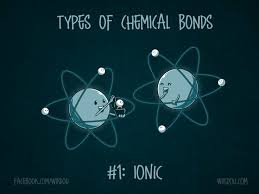
What elements generally make an ionic bond?
a)
metal and nonmetal
b)
2 or more nonmetals
c)
metal
d)
none of the above
102.
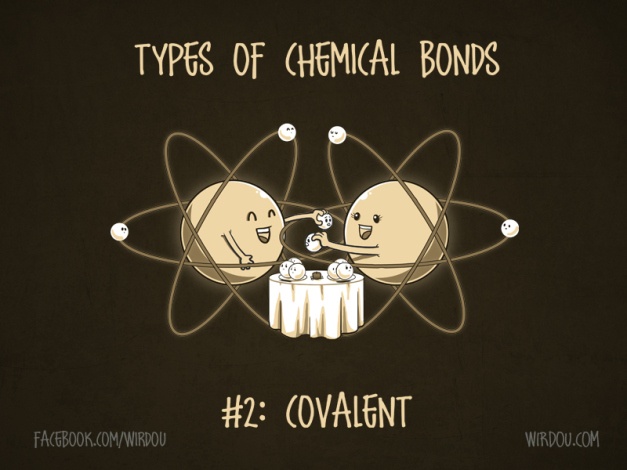
What elements generally make a covalent bond?
a)
metal and nonmetal
b)
2 or more nonmetals
c)
metal
d)
none of the above
103.
An ionic bond forms when 
a)
Valence electrons are shared
b)
a sea of mobile electrons surround the cations
c)
valence electrons are transferred between atoms
d)
none of the above
104.
In chemical compounds, covalent bonds form when
a)
the electronegativity difference between two atoms is very large.
b)
electrons are completely transferred between two metals.
c)
pairs of electrons are shared between two nonmetal atoms.
d)
two nonmetal atoms are attracted to each other by opposite charges.
105.
Predict the bond that will form between Be and F.
a)
Ionic
b)
Covalent
106.
What is a valence electron?
a)
an electron that is found in the outermost shell of an atom. 
b)
an electron found in the innermost shell of an atom.
c)
an electron found in the middle shell.
107.
What is the basis of a metallic bond?
a)
the attraction of neutral metal atoms.
b)
the attraction between protons and neutrons.
c)
the attraction between positive metal ions and interlocking electrons.
d)
the attraction between positive metal ions and free floating electrons.
108.
At room temperature, most metals are
a)
liquid
b)
solid
c)
gas
d)
an alloy
109.
What does malleable mean?
a)
able to be shaped
b)
will break easily
c)
can be used for wire
d)
is shiny
110.
Electrons that are free to move in metals
a)
delocalized electrons
b)
oxidation number
c)
chemical bond
d)
salts
111.
Why do metals conduct
a)
They are shiny
b)
The electrons are held tightly within the lattice
c)
The electrons are delocalised and able to move
d)
The electrons are shared between two metal ions
112.

Based in sulfur's charge, what would be copper's charge in Cu2S?

a)

+1

b)

+2

c)

-1

d)

-2

113.

What does malleable mean?

a)

able to be flattened

b)

will break easily

c)

able to be pulled into a wire

d)

is shiny

114.

What is the formula unit for a compound of calcium and chlorine?

a)

CaCl

b)

Ca2Cl

c)

CaCl2

d)

ClCa

115.
Group 17 always has ions with a charge of ____.
a)
+1
b)
+2
c)
-1
d)
-2
116.

An electronegativity difference greater than 1.7 results in ________.

a)

Nonpolar Covalent bonding

b)

Metallic bonding

c)

Ionic bonding

d)

Polar Covalent bonding

117.

Nitrogen and oxygen react. Their bond is __________.

a)

Polar Covalent

b)

Metallic

c)

Ionic

d)

Nonpolar Covalent

118.
__________are neutral particles formed as  result of sharing electrons.
a)
Protons
b)
Electrons
c)
Molecules
d)
Ions
119.
Atoms can form double or triple ______depending on whether they share two or three pairs of electrons.
a)
Molecules
b)
Bonds
c)
Compounds
d)
Elements
120.
What explains the very high melting and boiling point of water
a)
Strong dipole-dipole bonds between water molecules
b)
Strong hydrogen bonds between water molecules
c)
Dispersion forces which are present in all molecules
d)
Asymmetrical shape of the polar bonds.
121.
Hydrogen bonding occurs when hydrogen is bonded to N, O, or F.  Which of the following has hydrogen bonding?
a)
CBr4
b)
NO2
c)
H2S
d)
NH3
122.
Does H2O have hydrogen bonding?
a)
yes
b)
no
123.
Does HF have hydrogen bonding?
a)
yes
b)
no
124.
Which is the second strongest intermolecular force, after hydrogen bonding?
a)
dipole-dipole attraction
b)
London forces
125.
All molecules have London forces between them, but dipole-dipole and hydrogen bonding are so much stronger that when they are present we can ignore London forces.  Which of these has ONLY London forces?
a)
I2
b)
NH3
c)
OCl2
d)
SH2
126.

Which substance would have the weakest intermolecular forces of attraction?

a)

CH4

b)

NaCl

c)

H2O

d)

MgF2

127.

________________________ have the strongest intermolecular forces of attraction.

a)

Dipole- Dipole

b)

Dispersion

c)

Hydrogen Bonds

128.
In an exothermic reaction, heat is ...
a)
taken in
b)
given out
129.

In an endothermic reaction, heat is ...

a)

taken in

b)

given out

130.
If a chemical reaction is EXOTHERMIC, the temperature would....
a)
Stay the same
b)
Increase
c)
Decrease
131.
In an endothermic reaction the system is releasing energy.
a)
True
b)
False
132.
During an endothermic reaction in a beaker if we are part of the surroundings and touched the beaker, it would feel _______. 
a)
Warm
b)
Cold
133.

What type of reaction occurs in a hand warmer?

a)

exothermic

b)

endothermic

134.

Bond breaking is referring to

a)

Exothermic

b)

Endothermic

135.

Solid --> liquid --> gas is what type of reaction?

a)

endothermic

b)

exothermic

c)

catalytic

d)

inhibited

136.

what is the name of CCl4?

a)

carbon tetrachloride

b)

monocarbon tetrachloride

c)

tetracarbon monochloride

d)

carbon chloride

137.

Name this formula:

KNO3

a)

Potassium Nitrogen Oxide

b)

Potassium Nitride

c)

Potassium Nitrate

d)

Potassium (I) Nitrite

138.
Name the following ionic compound: LiNO3
a)
lithium nitrate
b)
lithium III nitrate
c)
lithium nitride
d)
lithium oxide
139.
Name the following ionic compound: LiNO3
a)
lithium nitrate
b)
lithium III nitrate
c)
lithium nitride
d)
lithium oxide
140.

Name the compound CuO

a)

copper (II) oxide

b)

copper oxide

c)

copper (I) oxide

d)

carbon uranium oxide

141.

Name the compound NH4OH

a)

ammonium hydroxide

b)

ammonia oxyhydride

c)

mononitrogen tetraoxihydride

d)

hydrogen nitrate

142.

Name the compound CuCO3

a)

cobalt carbonate

b)

copper (III) carbonate

c)

copper (II) carbonate

d)

copper carbonate

143.

True or false? In naming ionic compounds,

the cation is always named first and the anion

second.

a)

True

b)

False

144.

Titanium(IV) oxide has the formula

a)

Ti4O

b)

TiO4

c)

Ti(IV)O

d)

TiO2

e)

Ti4O2

145.

The name for Al(OH)3 is

a)

aluminum(III) hydroxide

b)

aluminum trihydroxide

c)

aluminum hydroxide

d)

monaluminum trihydroxide

e)

aluminum(I) hydroxide

146.

Potassium chlorate has the formula

a)

KCl

b)

KClO

c)

KClO2

d)

KClO3

e)

KClO4

147.

The name for Al(OH)3 is

a)

aluminum(III) hydroxide

b)

aluminum trihydroxide

c)

aluminum hydroxide

d)

monaluminum trihydroxide

e)

aluminum(I) hydroxide

148.
Name the following compound: SnO2
a)
tin(II) oxide
b)
tin(IV)oxide
c)
tin(II)oxygen 
d)
tin oxide
149.
The name of Mg₃N₂ is
a)
manganese nitride
b)
magnesium nitride
c)
magnesium (III) nitride
d)
trimagnesium dinitride
150.
What is the formula for iron (II) hydroxide?
a)
FeO
b)
FeOH
c)
Fe(OH)2
d)
FeOH2
151.
Which of the following molecular shapes would have a bond angle of 180 Degrees?
a)
Bent
b)
Trigonal Planar
c)
Tetrahedral
d)
Linear
152.
What is the measure of a tetrahedral bond angle?
a)
90 Degrees
b)
109.5 Degrees
c)
120 Degrees
d)
180 Degrees
153.
Which molecule would have this shape?
a)
BF3
b)
CH4
c)
PCl5
d)
CO2
154.
The bond angle for a trigonal planar molecule is 
a)
90 Degrees
b)
109.5 Degrees
c)
120 Degrees
d)
180 Degrees
155.
Who could this molecule be?
a)
CH4
b)
CO2
c)
PCl5
d)
BF3
156.
Which of these has a linear molecular shape?
a)
SCl2
b)
SiH4
c)
NH3
d)
O2
157.
VSEPR stands for ________ theory.
a)
Valence Structure of Electron Pyramids and Regression
b)
Varied Structures of Electrons Paired and Replaced
c)
Varied Shell Energy of Protons and Radiation
d)
Valence Shell Electron Pair Repulsion
158.
According to VSEPR, molecules adjust their shapes to keep which of the following as far away as possible?
a)
Pairs of valence electrons
b)
Inner shell electrons
c)
Mobile Electrons
d)
Electrons closest to the nucleus
159.
The molar mass of an element is equal to its...
a)
Atomic mass
b)
Atomic number
c)
Oxidation number
d)
Valence electrons
160.
The mass of one mole of substance is called...
a)
molecular mass
b)
mole constant
c)
molar mass
d)
atomic weight
161.
What is the molar mass of table salt (NaCl)?
a)
116.886 g/mol
b)
35.453 g/mol
c)
22.990 g/mol
d)
58.443 g/mol
162.
What is the mass of one mole of aluminum chloride (remember to determine the correct formula first)?
a)
62.435g
b)
116.399g
c)
133.341g
d)
97.888g
163.
What is the percent by mass of oxygen in MgO?
a)
20%
b)
40%
c)
50%
d)
60%
164.
What is the percent by mass of fluorine in CaF2 (gram-formula mass = 78 g/mol)?
a)
24%
b)
49%
c)
51%
d)
65%
165.
You are given the following percentages: 40.05% S and 59.95% O. Find the empirical formula for these elements.
a)
SO
b)
SO2
c)
SO3
d)
SO4
166.
A compound consists of 72.2% magnesium(Mg) and 27.8% nitrogen(N) by mass. What is the empirical formula?
a)
Mg4N3
b)
MgN2
c)
Mg3N
d)
MgN
167.
Which pair has the same empirical formula?
a)
NaCrO4 and Na2Cr2O7
b)
C2H4O2 and C6H12O6
c)
C3H6Oand C2H6O2
d)
CH4 and C2H6
168.
A formula with the lowest whole # ratio of elements in a compound is called
a)
Molecular Formula
b)
Chemical Formula
c)
Empirical Formula 
d)
Distance Formula
169.
What is the molecular formula if the empirical formula is CH2O and the molecular molar mass is 180.18?
a)
CH2O
b)
C2H4O2
c)
C4H8O4
d)
C6H12O6
170.
A chemical formula that shows the actual # and kinds of atoms present in one molecule of a compound is called_________
a)
ionic formula
b)
covalent formula
c)
empirical formula
d)
molecular formula
171.
Which of these is NOT a sign that a chemical change has occurred? 
a)
A loss of transparency 
b)
An unexpected color change
c)
A temperature change
d)
The formation of a precipitate
172.
The Law of Conservation of Mass states
a)
that matter exists in all states and reacts the same
b)
that matter can only be changed into new substances by introducing a catalyst
c)
that matter exists in the same state throughout any chemical change
d)
that matter cannot be created or destroyed and that the mass of the products must equal the mass of the reactants
173.
How many Al atoms are in this compound?         4Al2O3
a)
2
b)
8
c)
6
d)
4
174.
How many F atoms are in this compound?
6MgF2 
a)
2
b)
6
c)
8
d)
12
175.
In the reaction methane + oxygen turns into carbon dioxide + water, the methane and oxygen are called _______________.
a)
reactants
b)
products
c)
neutrals
d)
energizers
176.
How do chemical reactions turn substances into new substances?
a)
with burning acid
b)
the molecules mix together and create new substances
c)
the atoms break apart and combine back together in new ways
d)
the ionic compounds mix in water to form solutions
177.
True or False
In a chemical reaction, no new atoms are created, and no atoms are destroyed. 
a)
true
b)
false
178.
A number in front of a chemical formula in an equation that indicates how many molecules or atoms of each reactant and product are involved in a reaction.
a)
Coefficient
b)
reactant
c)
subscript
d)
product 
179.
Which of the following is NOT a sign of a chemical reaction? 
a)
Color changes
b)
Cutting into fourths
c)
Light is produced
d)
Gas is formed
180.
What type of reaction is illustrated below?
FeS + Hal --> H2S + FeCl
a)
synthesis
b)
decomposition
c)
single replacement
d)
double replacement
181.
Which of the following answers will balance the equation below?
__K + __Br2 --> __KBr
a)
2, 1, 1
b)
2, 3, 2
c)
2, 1, 2
d)
1, 2, 3
182.

What type of reaction is illustrated below?

Zn + H2S --> ZnS + H2

a)

synthesis

b)

decomposition

c)

single replacement

d)

double replacement