
 Worksheets
chem ST 1.1
Total questions: 184
Worksheet time: 3hrs 4mins
is anything that has mass and volume. a substance made up of various types of particles that occupies physical space and has inertia.
(a)
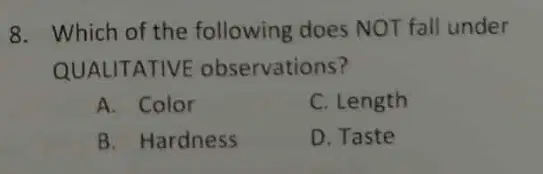
(a)
defined by the relative positions of its particles (particles & atoms)
(a)
ST ID
(a)
MACROSCOPIC
fixed shape; does NOT conform with the shape of the container
MICROSCOPIC
particles lie next to each other; regular, three-dimensional array
(a)
MACROSCOPIC
varying shape that conforms to the shape of the container but only to the extent of the liquid’s volume; has an upper surface
MICROSCOPIC
particles lie close together but move randomly around each other
(a)
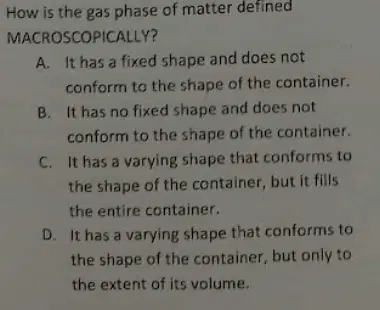
MACROSCOPIC
varying shape that conforms to the shape of the container, but it fills the entire container; does NOT have a surface
MICROSCOPIC
particles have large distances between them & move randomly throughout the container
(a)
According to the kinetic theory, particles of different gases at the same temperature
have the same
volume
pressure
average kinetic energy
Below are the example of crystalline solid except for
Diamond
Salt (NaCl)
Na
Glass
similar to a gas, but it's made up of ionized gas, meaning it contains charged particles like ions and electrons. Unlike a regular gas, plasma conducts electricity due to these free charges.

Describe the process shown here.
chromotagraphy
distillation
filtration
sublimation
____________________is a made up of two or more elements combined chemically
elements
mixtuers
compound
________________is a separation technique for homogeneous mixtures that is based on the differences in boiling points of substances.
distillation
filtration
crystallization
sublimation
______________is a technique that uses a porous barrier to separate a solid from a liquid in a heterogeneous mixture.
distillation
filtration
crystallization
sublimation
The _____________________ states that mass is neither created nor destroyed in a chemical reaction, it is conserved
Law of Conservation of Water
Law of Conservation of Matter
Law of Conservation of Atoms
Law of Conservation of Minerals
The ability of a substance to combine with or change into one or more other substances is called a ______________
physical property
extensive property
chemical property
intensive property
______________are dependent on the amount of substance present, such as mass, length, or volume.
intensive properties
chemical properties
physical properties
extensive properties
____________is a characteristic that can be observed or measured without changing the sample’s composition.
physical property
chemical property
Which of the following would be considered a homogeneous mixture?
sweet tea
14k gold
vegetable soup
distilled water
Which of the following would be considered a physical property?
color
ph
flammability
reactivitiy
Which of the following is an example of a chemical change?
melting butter
mixing milk and chocolate syrup
breaking a pencil
burning a marshmallow
New substances are always formed when matter undergoes a ___.
change in shape
change in temperture
physical change
chemical change
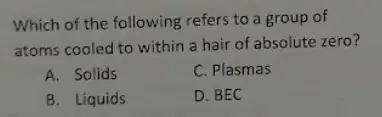
, a state of matter in which separate atoms or subatomic particles, cooled to near absolute zero (0 K, − 273.15 °C, or − 459.67 °F; K = kelvin), coalesce into a single quantum mechanical entity—that is, one that can be described by a wave function—on a near-macroscopic scale.
(a)
Matter is converted into energy by atomic reactions, also known as.
(a)
The TOTAL ENERGY an object possesses is the SUM of its _ ENERGY.
(a)
Energy due to the POSITION of the object relative to other objects.
(a)
Energy due to the MOTION of the object.
(a)
When energy is converted from one form to the other, it is [], NOT destroyed
(a)
Situations of [] energy, are more stable, and therefore favored, over situations of [] energy (less stable)
(a)
ENERGY is stored in the bonds of [].
(a)
ENERGY is Released during chemical reaction in the form of []
(a)
Reactions that require an input of heat to proceed may store some of that energy as chemical energy in newly formed bonds.
t/f
(a)
Are characteristics a substance shows by itself, WITHOUT changing into or interacting with one another.
(a)
Are characteristics a substance as it changes into or interacts with another substance/s.
(a)
physical property that DOES NOT DEPEND ON THE QUANTITY OR SIZE
COLOr,TEXTURE
,ODOR,STATE OF MATTER,DENSITY,MELTING POINT,BOILING POINT,SOLUBILITY,CONDUCTIVITY
DUCTILITY,HARDNESS,TRANSPARENCY,LUSTER,VISCOSITY
(a)
physical property that DEPENDs ON THE QUANTITY OR SIZE
MASS
VOLUME
ENERGY
TOTAL CHARGE
NUMBER OF PARTICLES
MOLES
AMOUNT OF SUBSTANCE
TOTAL MOMENTUM
TOTAL KINETIC ENERGY
TOTAL POTENTIAL ENERGY
(a)
substance reacts with another substance to form new compounds
(a)
ability of a substance to burn or undergo combustion.. refers to a material’s ability to burn when ignited, but not necessarily easily or quickly. Combustible materials can burn, but usually require higher temperatures or more effort to ignite than flammable ones.
(a)
reaction of a substance with oxygen and moisture
Ex. Rusting of Iron (Fe) - Iron + oxygen (presence of moisture) => Iron Oxide (rust)
(a)
pH level of a substance
(a)
ease with which a substance can catch fire and burn; low ignition temperature; under rapid combustion. how easily a substance ignites at normal temperatures. Flammable materials catch fire quickly and easily, often at relatively low temperatures.
(a)
substance that can cause harm after reacting with another substance
(a)
substance are chemically stable and do not readily react with other substances under normal conditions Ex. Noble gases - high chemical stability
(a)
non uniform mixture;uniform mixture
(a)
Separates the components of mixtures on the basis of DIFFERENCES IN PARTICLE SIZE.
It is used most often to separate a liquid from a solid particle
Key step in the purification of tap water
(a)
It is based on the DIFFERENCES IN SOLUBILITY. Key substances in computer chips and other electronic devices are purified by this type. its a physical change.
it is the process of obtaining crystals of the solute from a hot saturated solution
(a)
amount that dissolves in a fixed volume of solvent at a given temperature.
(a)
Separates components through DIFFERENCES IN VOLATILITY, the tendency of a substance to become a gas.
(a)
is a separation technique used to isolate a desired substance from a mixture using a suitable solvent.
The process takes advantage of differences in solubility, where the target substance is soluble in the chosen solvent while the other components are not. Once dissolved, the desired substance can be separated from the insoluble materials and, if needed, recovered from the solvent through processes such as evaporation, distillation, or precipitation.
(a)
Another technique based on DIFFERENCES IN SOLUBILITY.
Mobile Phase & Stationary Phase
Different types of chromatography: Gas-Liquid Chromatography (GLC),
High-Performance (high pressure) Liquid Chromatography (HPLC)
(a)
is the solvent or gas that flows through the chromatographic system and transports the analyte (substance being analyzed) along the stationary phase.
(a)
The [] is the non-moving phase in chromatography that interacts with the components of the mixture being separated.
Different substances in the mixture are attracted to the stationary phase to varying degrees, which causes them to move at different speeds and separate from one another.
ex. the fibers of the filter paper
(a)
CENTRAL THEME OF CHEMISTRY
(a)
various industrial, domestic & environmental needs
H₂O
(a)
Disinfectant, bleaching agent, rocketry
H₂O₂
(a)
Natural gas; for heating & electricity generation
CH₄
(a)
Simple sugar; energy source of living organisms
C₆H₁₂O₆
(a)
Strong acid; battery manufacturing and mineral processing
H₂SO₄
(a)
Carbonation of beverages & refrigerant
CO₂
(a)
Seasoning & Food Preservation
NaCl
(a)
Beverages, fuels, solvent in many industries
C₂H₅OH
(a)
Cleaning products, fertilizers, industrial processes
NH₃
(a)
Manufacturing fertilizers, explosives & chemicals
HNO₃
(a)
Respiration, combustion, industrial and medical applications
O₂
(a)
Cooking, cleaning, solvent
CH₃COOH
(a)
Construction, manufacturing, antacid
CaCO₃
(a)
Soaps, detergents, chemical manufacturing
KOH
(a)
Industrial processes (pickling and pH control
HCl
(a)
Various industrial processes; soap making
NaOH
(lye or caustic soda)
(a)
Antifreeze in automobile radiators
C₆H₅O₂
(a)
Pain reliever; anti-inflammatory
C₉H₈O₄
(a)
High-nitrogen fertilizer; explosives
NH₄NO₃
(a)
Sweetening foods and beverages
C₁₂H₂₂O₁₁
(a)
Natural processes and industrial activities
H₂S
(a)
Anaesthetic; whipped cream dispensers
N₂O
(a)
Various industrial processes (winemaking)
SO₂
(a)
Food and beverage production; manufacturing detergents & fertilizers
H₃PO₄
(a)
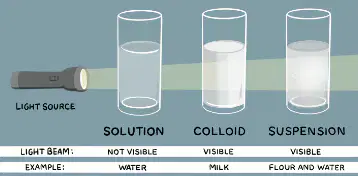
MIXTURES
solutions
Homogeneous/Heterogeneous
(a)
MIXTURES
colloids and suspensions
Homogeneous/Heterogeneous
(a)
MIXTURES
particle size: 0.01-1nm; can be atoms, ions, molecules
don't separate on standing
cannot be separated by filtration
do not scatter light
(a)
MIXTURES
particle size: 1-1000nm; dispersed; can be aggregates or large molecules
don't separate on standing
cannot be separated by filtration
scatter light (tyndall effect)
(a)
MIXTURES
particle size: >1000nm; dispersed; can be aggregates or large particles
particle settle out
can be separated by filtration
may scatter light but not transparent
(a)
MIXTURES
is a homogeneous mixture with tiny particles. The particles are too small to see and also too small to settle or be filtered out of the mixture. When the salt is thoroughly mixed into the water in this glass, it will form a []. The salt will no longer be visible in the water, and it won’t settle to the bottom of the glass.
(a)
MIXTURES
is a heterogeneous mixture with medium-sized particles. The particles are large enough to see but not large enough to settle or be filtered out of the mixture.
(a)
just ans .
(a)
(a)
(a)
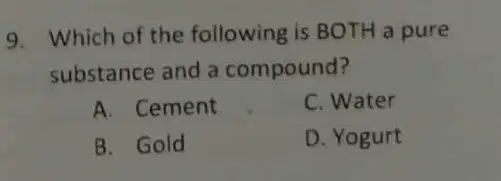
(a)
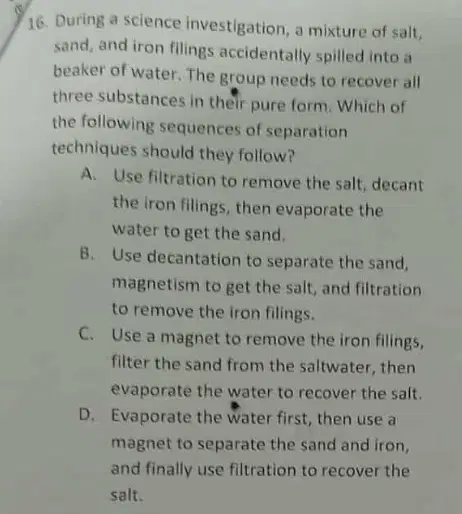
(a)
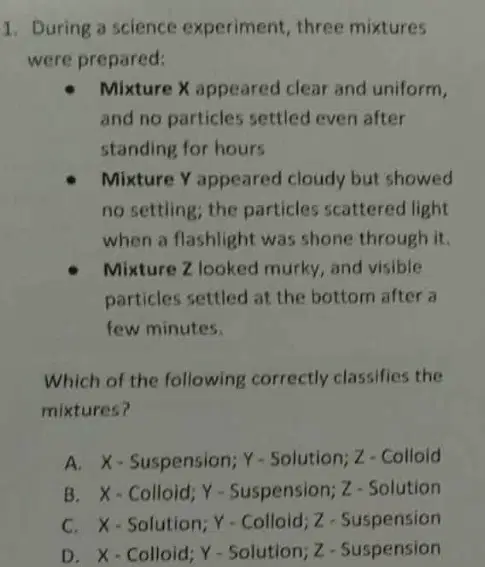
(a)
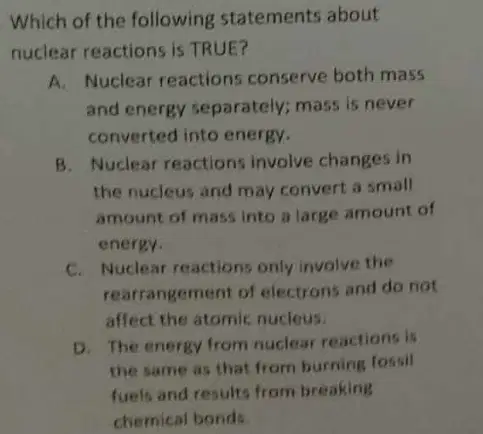
(a)
(a)
current system of measurement began in [], that led to the []. (National Assembly in France; Lavoisier was a member)
(a)
In 1960, another international committee (General Conference on Weights and Measures) met in France to establish the[]
(a)
The SI system is based on a set of [] fundamental/base units, each of which is identified with a [] quantity.
(a)
All other units called [], are combination of these seven basic units.
(a)
For quantities that are much smaller or much larger than the base unit, we use [] and [].
(a)
metric system km -> mili
NOTE: units before km, multiply by 10
NOTE: units after mili, divide by 10
(a)
The introduction of the SI SYSTEM in measurement, consists of 7 fundamental units, makes it easier to measure matter.
(a)
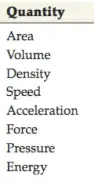
(a)
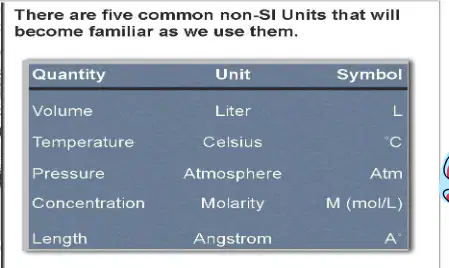
type .
(a)
The meter is based on two quantities:
(a)
SI base UNIT: Kilogram (Kg)
Refers to the quantity of matter it contains
The only base unit whose standard is a physical object (platinum-iridium cylinder in France)
(a)
mass/volume
Matter has its own specific value
Under given condition of temperature and pressure, it is a characteristic physical property of a substance.
(a)
Based on atomic standard (atomic clock measures the oscillations of microwave radiation absorbed by gaseous cesium atoms cooled to around 10⁻⁶ K)
(a)
All measuring devices are made to limited specifications.
The device we use depends on how much [] is acceptable.
We always estimate the [] DIGIT of a measurement.
(a)
The [] the number of significant figures, the greater is the CERTAINTY of measurement.
(a)
All digits are SIGNIFICANT, except [] used only to position the decimal point.
ex. 0.0123
Count that digit and every digit to its right as significant, even trailing zeroes (ex.0.05400 has 4 significant figures)
(a)
The answer contains the same number of significant figures as there are in the measurement with the FEWEST DECIMAL PLACES.
(a)
The answer contains the same number of significant figures as there are in the measurement with the FEWEST SIGNIFICANT FIGURES.
(a)
The general rule for rounding off: The [] certain measurement sets the limit on certainty for the entire calculation and determines the number of [] in the final answer.
(a)
probs involving multistep or chain calcs
1. Always [] sig fig through the multistep calc and round off in []
2. the final ans should be rounded off based on the number of sig figs of the [] performed operation
(a)
The [] you choose determines the number of significant figures you can obtain
(a)
EXACT NUMBERS have no uncertainty associated with.
Exact numbers [] the number of significant figures
(a)
Precision and accuracy in the laboratory.
Produces values that are EITHER ALL HIGHER or ALL LOWER than the actual value
Factors: Faulty measuring device (instrumental error); Consistent mistake in taking a reading (operator error); method error
(a)
Precision and accuracy in the laboratory.
Produces values that are HIGHER and LOWER than the actual value
Factors: Measurer’s skill, Instrument’s precision, Natural causes, Set up of experiment
(a)
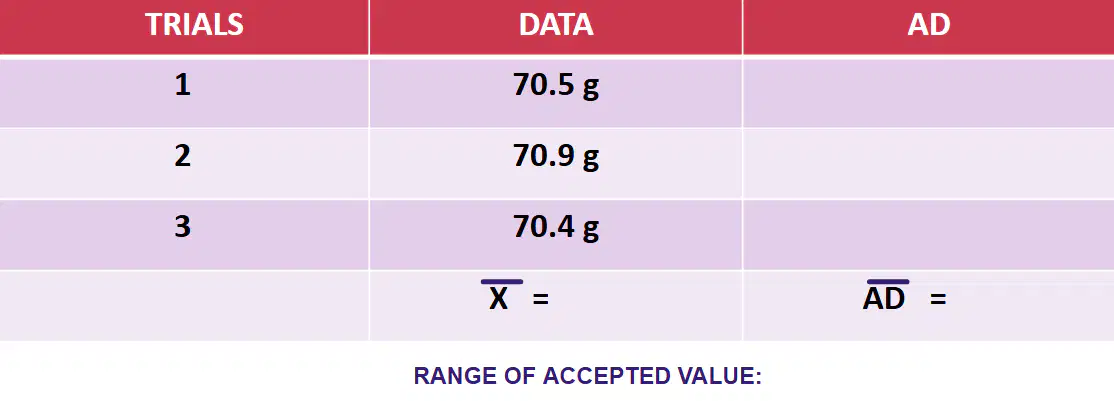
PRECISION (Uncertainty)
how to get AVERAGE/MEAN of data(x)
(a)
PRECISION (Uncertainty)
how to get ABSOLUTE DEVIATION (AD)
NOTE: the value of AD is in absolute value(always positive)
(a)
PRECISION (Uncertainty)
how to get AVERAGE DEVIATION (AD) with line above AD(also referred to as the uncertainty)
(a)
PRECISION (Uncertainty)
RANGE OF ACCEPTED VALUE:
(a)
This is used when comparing an experimental result to a value determined by theory or to an accepted known value.
(a)
formula for %error
(a)

This is used when comparing two values that are both determined by experimentation, we do not have a “correct” or accepted value to which to compare, so we simply look at how different the two values are as a percentage of their average values.
(a)
Scientists used a tool called [] (Factor-label Method) to convert numbers and units in an organized fashion.
(a)
The MAIN GOAL in conversion:
(a)
conversion steps
(a)
Ratios used to express a measured quantity in different units.
(a)
1200.0−0.56
(a)
0.002340×2.10
(a)
solve
(a)
convert 650g to kg. use the conversion factor method
(a)
states that no matter what its source , a particular compound is composed of the same elements in parts (fractions) by mass.
(a)
formula for mass of element in law of definite composition
(a)
Pitchblende is the most important compound of uranium. Mass analysis of an 84.2-Kg sample shows that it contains 71.4 Kg of uranium, with oxygen the only other element. How many grams of uranium are in 102 kg of pitchblende?
Given: 84.2 Kg = mass (m1) of pitchblende
71.4 Kg = mass (mU1) of uranium
102 Kg = mass (m2) of pitchblende
Mass (Kg) of Uranium
= 102 Kg pitchblende(71.4 kg uranium/84.2 kg pitchblende)
= 86.5 Kg U or 8.65 x 10⁴ g U
(a)
It states that if elements A and B react to form two compounds, the different masses of B that combine with a fixed mass of A can be expressed as a ratio of small whole numbers.
(a)
All matter consists of atoms, tiny indivisible particles of an element that cannot be created or destroyed.
(a)
atoms of one element CANNOT be converted into atoms of another element. In chemical reactions, the atoms of the original substances recombine to form different substances.
(a)
Atoms of an element are identical in mass and other properties are different from atoms of any other element.
(a)
Compounds result from the chemical combination of a specific ratio of atoms of different elements.
(a)
Atoms cannot be created or destroyed (postulate 1) or converted into other types of atoms (postulate 2). Therefore, a chemical reaction, in which atoms are combined differently, cannot possibly result in a mass change.
(a)
A compound of a specific ratio of different atoms (postulate 4), each of which has a particular mass (postulate 3). Thus, each element in a compound constitutes a fixed fraction of the total mass.
(a)
Atoms of an element have the same mass (postulate 3) and are indivisible (postulate 1). The masses of element B that combine with a fixed mass of element A give a small, whole-number ratio because different numbers of B atoms combine with each A atom in different compounds.
(a)
the NEGATIVE particles surrounding the nucleus of an atom.
discovered by []
(a)
positively charged particle in the nucleus of the atom
Discovered by []
(a)
a neutral subatomic particle present in the nucleus of an atom
Discovered by []
(a)
mass of neutron > proton > electron
(a)
Democritus – Greek philosopher around the year 400 BC
He concluded that atom could not be divided into smaller and smaller pieces forever. Eventually, the smallest piece of matter would be found.
He used the word “atomos” to describe the smallest possible piece of matter
(a)
John Dalton – English chemist that proposed the first atomic theory in 1803
(a)
Cathode rays consist of negatively charged particles found in all matter.
The rays appear when these particles collide with the few remaining gas molecules in an evacuated tube.
Cathode ray particles were later named .
(a)
J.J. Thomson – English scientist who discovered electrons in 1897
Sometimes called the “plum pudding” model, Thomson thought of an atom as being composed of a positively charged material with the negatively charged electrons scattered through it
(a)
1909, measured the charge of the electron by observing the movement of oil droplets in an apparatus that contained electrically charged plates and an x-ray source.
(a)
Ernest Rutherford – British physicist who, in 1908 proved the atom had a small, dense, positively charged nucleus.
Rutherford’s model proposed that an atom is mostly empty space. There is a small, positive nucleus with the negative electrons scattered around the outside edge
(a)
Niels Bohr – Danish scientist who, in 1913, proposed the “Planetary Model” of the atom
Electrons move in definite orbits around the nucleus, like planets moving around the sun. Bohr proposed that each electron moves in a specific energy level
(a)
The probable location of an electron is based on how much energy it has.
The more energy an electron has, the farther it is from the nucleus
The small positively charged nucleus is surrounded by a large space in which there are enough electrons to make the atom neutral
(a)
Based on wave mechanics, this model proposed that electrons have no definite path in an atom
(a)
The more energy an electron has, the [] it is from the nucleus
(a)
a count of the total number of
protons and neutrons in an atom’s
nucleus.
(a)
weighted average mass of an atom
based on the relative abundance of
that element’s isotopes.
(a)
one of two or more species of atoms of a
chemical element with the different number of
neutrons but with same atomic
number and position in the periodic table.
h-1 is an isotope btw. itll only not become an isotope if that variation rly doesnt exist
(a)
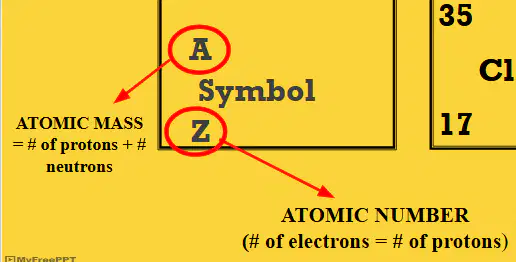
Atomic Number ([]) 🡪 number of unit positive charges
Number of Protons = Z
Mass Number ([]) 🡪 total number of protons and neutrons
A = number of neutrons + number of protons
A = number of neutrons + Z
(a)
(a)
The mass of the atom is relative to the mass of an []
(a)
The modern atomic mass standard =
Atomic mass unit (amu) = ½ the mass of a []
Atomic mass unit (amu) has been changed to Dalton (da)
One [] has a mass of 12 Daltons (12 Da or 12 amu)
(a)
The isotopic makeup of an element is determined by []
Method for measuring the relative masses and abundances of atomic-scale particles very precisely.
The measurements gathered provide data for obtaining the atomic mass (atomic weight) of an element.
ATOMIC MASS = the average of the masses of its naturally occurring isotopes weighted according to their abundance.
(a)
avg isotopic masses formula
(a)
just ans . since i aint sure
dont apply the sig figs rule for calculating avg isotopic mass
(a)
Isotopes such as carbon-14 (^14C) and uranium-238 (^238U) are used in archaeology and geology to determine the age of fossils, rocks, and archaeological artifacts. This helps in understanding the history of Earth and its inhabitants.
Radioactive isotopes like technetium-99m (^99mTc) and iodine-131 (^131I) are used in medical imaging techniques such as positron emission tomography (PET) and single-photon emission computed tomography (SPECT) to diagnose and treat various medical conditions.
(a)
: Radioactive isotopes are employed in cancer treatment. For example, iodine-131 is used in the treatment of thyroid cancer, while cobalt-60 (^60Co) and other isotopes are used in external beam radiation therapy.
Americium-241 (^241Am) is commonly used in smoke detectors. It emits alpha particles that ionize air, creating a small electric current. When smoke enters the detector, it disrupts the current, triggering an alarm.
(a)
Which subatomic particle is responsible for isotopes of the same element having different masses?
(a)
Which statement best explains why electrons are not included in the calculation of atomic mass?
(a)
Which subatomic particle is responsible for chemical bonding between atoms?
(a)
quartium is an isotope of hydrogen t/f
(a)
What is the average atomic mass of boron if B-10 (10.0129 amu) has an abundance of 19.9% and B-11 (11.0093 amu) has an abundance of 80.1%?
(a)
Why do isotopes of the same element have nearly identical chemical behavior?
(a)
Which subatomic particle contributes most to the mass of an atom?
(a)
Which subatomic particle determines the identity of an element?
(a)
(a)
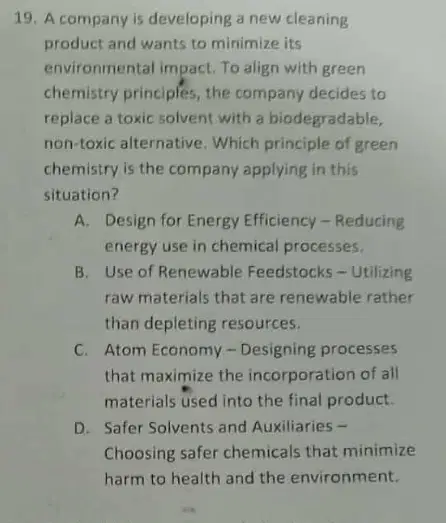
Which among the given physical quantities
below is NOT a derived quantity?
A. Amount of substance
B. Density
C. Pressure
D. Volume
(a)
What do you call a procedure used to convert
between units in solving chemistry problems?
A. Dimensional Analysis
B. Factor-Exponent Method
C. Number-Unit Method
D. Variable-Label Analysis
(a)
4. What term is used to refer to the closeness of a
measurement to each other?
(a)
used when comparing an experimental result to a value determined by theory or to an accepted known value.
(a)
Which of the following BEST describes a set of
measurements that is precise but not accurate?
A. Measurements that are scattered and
far from the accepted value.
B. Measurements that are both close tp
each other and close to the accepted
value.
C. Measurement that are consistently
close to each other but far from the
accepted value.
D. Measurements that are close to the
true or accepted value but vary widely
from one another
(a)
10. Which of the following BEST describes what
percent error measures in an experiment?
A. The total deviation of all measurements
from the mean value.
B. The closeness of a measurement to the
actual or accepted value.
C. The difference between measured
values repeated multiple times.
D. The ratio of the absolute error to the
accepted value, expressed as a
percentage.
(a)

