
 Worksheets
general
Total questions: 136
Worksheet time: 1hrs 28mins
how many types of sounds there are?
3
4
5
6
how many consonant sounds there are?
(a)
consonant sound name includes:
voicing place of articulation manner of articulation consonant sound
x
vowel sound name includes:
x
long/short, tongue height, part of the tongue which is raised, degree of lip rounding
phonemes
distinguise meaning
distinguise pronunciation
allophones
distinguise pronunciation
distinguise meaning
identify phonemes by looking for...
(a)
phonemes
/ /
[ ]
allophones
/ /
[ ]
dấu phụ là gì
(a)
phonemic/broad transcription
/ /
[ ]
phonetic/narrow transciption
/ /
[ ]
what are three main areas of phonetics?
articulatory
acoustic
auditory
what are three main subjects of phonology?
phonemic system
phoneme sequences and syllable structure
suprasegmental phonology
types of sound
consonant/vowel
oral/nasal
voiced/voiceless
Phonetics is the linguistic science that studies speech sounds (the way in which they are produced, the way in which they are perceived, and their physical characteristics.
TRUE
FALSE
Phonology is the study or description of the distinctive sound units of a language and their relationship to one another.
TRUE
FALSE
Oral sound
Oral tract
Nasal tract
Nasal sound
Oral tract
Nasal tract
Consonant sound
obstructed airstream
no obstructed
Vowel sound
obstructed airstream
non obstruction
Voiced sound
vibration of vocal cords
no vibration of vocal cords
Voiceless sound
vibration of vocal cords
no vibration of vocal cords
Vowel sounds are normall VOICED
TRUE
FALSE
Vowel sounds depend mainly on the variations of toungue positions
FALSE
TRUE
Dipthongs
glide from one vowel to another
first part - longer/stronger
second part - shorter/quieter
centering dipthongs
ending in /ə/
ending in /ɪ/
ending in /ʊ/
Closing dipthongs
ending in /ə/
ending in /ɪ/ or /ʊ/
Tripthongs
glide from one vowel to another and to a third one
end with /ə/
A phoneme is the smallest segment of sound which
can distinguish two words.
FALSE
TRUE
Stress is an (a) exerted on a particular syllable or word in spoken language
The stressed syllable/word is said with GREATER ENERGY, and stands out in a word/phrase/sentence
TRUE
FALSE
How many types of stress are there?
1
2
3
4
types of stress
word stress
sentence stress
Is word stress fixed?
YES
NO
Is sentence stress fixed?
YES
NO
We study NATURE OF STRESS from what perspective?
production
perception
Nature of stress from the PRODUCTION point of view
the production of stress is generally depend on speakers' using more muscular energy than for unstressed syllable
x
Nature of stress from the PERCEPTION point of view
all stressed syllables have one thing in common: PROMINENCE
4 factors (loudness, length, pitch, vowel quality)
not always 4
How many levels of stress are there?
1
2
3
4
Name levels of stress
primary stress (tonic/nuclear)
secondary stress (non-tonic)
unstressed
Primary stress is marked by a small VERTICAL LINE high up before the syllable it relates to
TRUE
FALSE
Secondary stress is marked by a low mark and usually in words of 4-5 syllables
FALSE
TRUE
We place stress within words depend on
word is simple/derived/compound
grammatical category the word belongs
the number of syllables in the word
PLACEMENT OF STRESS on two-syllable verb/adj/adv/prep
2nd syllable contains a long vowel/dipthong/ends with more than one consonant -> 2nd syllable stressed
2nd syllable contains a short vowel/ends with one or no consonant -> 1st syllable stressed
2nd syllable contains /əʊ/
-> 1st syllable stressed
PLACEMENT OF STRESS in two-syllable nouns
2nd syllable contains a short vowel -> 1st syllable strssed
otherwise - 2nd syllable stressed
PLACEMENT OF STRESS on three-syllable verbs
3rd syllable contains a short vowel/ends with one or no consonant -> 2nd syllable stressed
3rd syllable contains a long vowel/dipthong/ ends with more than one consonant -> 3rd syllable stressed
PLACEMENT OF STRESS on three-syllable noun/adj
3rd syllable contains a short vowel -> 3rd syllable unstrssed
2nd syllable contains a long vowel/dipthong/ends with more than one consonant -> 2nd syllable strssed
3rd syllable contains a short vowel + 2nd syllable contains a short vowel and ends with one or no consonant -> 1st syllable stressed
3rd syllable contain a long vowel/dipthong/ends with more than one consonant -> 1st syllable strssed
PLACEMENT OF STRESS on derived words
stress on the affix
no change in stress placement
stress remains on the stem but is shifted to a different syllable
PLACEMENT OF STRESS on compound words
primary stress on 2nd element
(TT-DT)
primary stress on 1st element (DT-DT)
Word class pairs are pairs of TWO-SYLLABLE WORDS with IDENTICAL SPELLING which differ from each other in stress placement according to word class
TRUE
FALSE
Word class pairs rule
verb -> 2nd syllable stressed
noun/adj -> 1st syllable stressed
Certain well-known English words can be pronounced in 2 different way: weak n strong
FALSE
TRUE
Strong form is used when
at the end of a sentence
a weak from is being CONSTRASTED with another word
(co-ordinate use of prep)
a weak form word is stressed to emphasise
a weak form word is being "cited"/"quoted"
Rhythm is the relatively ... between stressed syllables
(a)
Stress-timed rhythm in English?
x
stressed syllables tend to occur at relatively intervals
(seperated by unstressed syllables or not)
Syllable-timed rhythm?
all syllaables tend to occur at a regular intervals of time
time between stressed syllables will be shorter/longer depend on the number of unstressed syllables
Stressed group
a stressed syllable + following unstressed syllable
stress group within a word group is given the SAME amount of TIME
Rhythm unit (foot) begin with a stressed syllable and includes all following unstressed syllables up to the following stressed syllable.
TRUE
FALSE
Does a rhythm unit include the following stressed syllable?
YES
NO
Stresses are altered according to context
FALSE
TRUE
Stress-timed rhythm is the characteristic of one style of
(a)
It is widely claimed that English speech tends towards a regular alternation between stronger and weaker, and tends to adjust stress levels to bring this about, called...
(a)
Assimilation is the process which takes place when one sound adapts itself to become similar to a neighbouring sound in one or more aspects
FALSE
TRUE
Assimilation is the (a) of one phoneme upon another neighbouring phoneme so that they become more alike
Assimilation may occur across
word boundaries
between words
across morpheme bounderies
whithin a morpheme/word
2 kinds of assimilations across word boundaries in terms of direction of change are
regressive assimilation
(Cf->Ci)
progressive assimilation (Ci->Cf)
3 kinds of assimilations across word boundaries in terms of the way in which phonemes change are
Assimilation of place
assimilation of manner
assimilation of voice
Cf->Ci
/t/ becomes [p] before bilabials
TRUE
FALSE
/d/ becomes [b] before bilabials
FALSE
TRUE
/n/ becomes [m] before bilabials
FALSE
TRUE
/t/ becomes [k] before /k/ and /g/
FALSE
TRUE
/d/ becomes [g] before /k/ and /g/
TRUE
FALSE
/n/ becomes [ŋ] before /k/ and /g/
TRUE
FALSE
alveolar + dental = dentalised
FALSE
TRUE
/s/ becomes [ʃ] before /ʃ/ and /j/
TRUE
FALSE
/z/ becomes [ʒ] before /ʃ/ and /j/
FALSE
TRUE
alveolar stops + /j/ -> affricate
TRUE
FALSE
/t/ + /s/ = [s]
FALSE
TRUE
/t/ + /z/ = [z]
TRUE
FALSE
/d/ + /s/ = [s]
TRUE
FALSE
/d/ + /z/ = [z]
FALSE
TRUE
/t/ + /n/ = [n]
TRUE
FALSE
/d/ + /n/ = [n]
FALSE
TRUE
Cf (lenis) + Ci (fortis) -> Cf devoiced
FALSE
TRUE
Cf (fortis) + Ci (lenis) -> Cf voiced
FALSE
TRUE
Elision is the ... of sounds in speech
(a)
Under certain circumstances, sounds disppear. A phoneme may be realised as ... or have zero realisation
(a)
Weak vowel /ə/ disappears before syllabic consonants /n,l,r/
TRUE
FALSE
aspirated stops + (weak vowel /ə/) = aspirated stops
FALSE
TRUE
stop + (stop) + stop
FALSE
TRUE
stop + (stop) + fricative
TRUE
FALSE
fricative + (stop) + fricative
TRUE
FALSE
/-st/ + stop/nasal/fricative = /-s/
TRUE
FALSE
/-ft/ + stop/nasal/fricative = /-f/
FALSE
TRUE
/-nd/ + lenis stop/nasal = /-n/
TRUE
FALSE
/-md/ + lenis stop/nasal = /-m/
FALSE
TRUE
Loss of final /v/ in "of" + consonant
FALSE
TRUE
types of linking
linking final consonant to initial vowel
linking identical consonants
linking /r/ and instrusive /r/
intrusive /j/
intrusive /w/
Tone is the overall behaviour of ... in a syllable
(a)
intonation language DO NOT use tone to distinguish meaning
TRUE
FALSE
English is an intonation language
FALSE
TRUE
tone languages DO use tone to distinguish meaning
FALSE
TRUE
Vietnamese is NOT a tone language
FALSE
TRUE
descriptions of tones
the level tone
the falling tone
the rising tone
the fall-rise tone
the rise-fall tone
Level tone
is the one in which the pitch remains at a constant level
is one which descends from a higher to a lower pitch
is a movement from a lower pitch to a higher one
is one in which the pitch falls and then rises
The falling tone
is one in which the pitch rises and then falls
is one which descends from a higher to a lower pitch
is one in which the pitch falls and then rises
is the one in which the pitch remains at a constant level
The rising tone
is a movement from a lower pitch to a higher one
is the one in which the pitch remains at a constant level
is one in which the pitch falls and then rises
is one which descends from a higher to a lower pitch
The fall-rise tone
is one in which the pitch rises and then falls
is one which descends from a higher to a lower pitch
is one in which the pitch falls and then rises
is the one in which the pitch remains at a constant level
The rise-fall tone
is one in which the pitch falls and then rises
is a movement from a lower pitch to a higher one
is one which descends from a higher to a lower pitch
is one in which the pitch rises and then falls
FUNCTION
the level tone almost always convey a feeling of saying something
routine
uninteresting
boring
FUNCTION
the falling tone
~neutral
give an impression of FINALITY
FUNCTION
the rising tone conveys
an impression that sth more is to follow
an invitation to continue
FUNCTION
the rise-fall tone is usually used to show
response with reservations
limited agreement
FUNCTION
the rise-fall tone is used to convey rather
strong feelings sof approval/disapproval
surprise
A ... is a group of syllables over which a tone extends
(intonation group/tone group)
(a)
The syllable which carries the tone in a tone unit is called the "..."
(a)
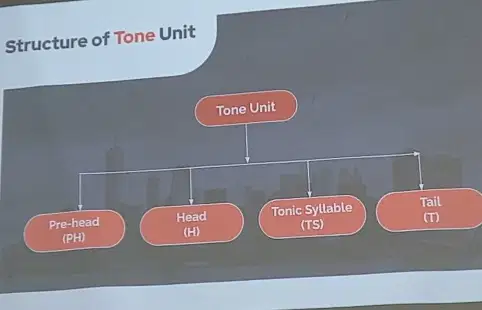
Which one is the obligatory component of the tone unit?
pre-head
head
tonic syllable
tail
How many tonic syllable can one tone unit have?
one
multiple
The HEAD is all that part of a tone-unit that extends from the ... up to but not including the tonic syllable
(a)
If there is no stressed syllable before the tonic syllable, can there be a HEAD?
YES
NO
The PRE-HEAD is composed of all the unstressed syllables in a tone-unit preceding the first stresses syllable
FALSE
TRUE
Any syllables between the tonic syllable and the end of the tone unit are called ...
(a)
Rules for identifying tone-unit boundaries
detect sudden change from the pitch level at the end of one tone-unit to the pitch level that starts the following tone unit
rhythmical way: within the tone unit, speech has a regular rhythm
Intonation is the pattern of ... that occurs over a phrase wich may be a complete sentence
(a)
The part of a sentence over which a particular pattern extends is called a ...
(a)
It is usually impossible to predict which syllable will be the tonic syllable in a tone group. It depends on what the speaker considers important. In general, ... is more likely to receive a tonic stress than meterial that has already been mentioned.
(a)
tune shapes depend on
the number of important words in the group
the exact attitude u wish to express
important words are words that
carry the most meaning in a word group
must be stressed
NOT all stressed words are important
FALSE
TRUE
Functions of intonation
attitudinal
(express emotions x attitudes -> special meaning)
accentual
(produce the effect of prominence on syllables)
grammatical
(help listener recognise the grammar and syntatic structure)
discourse
(new vs given info)
Basic English tunes
the falling tune/glide down
the rising tune/glide up
the second rising tune/take off
the falling-rising tune/dive
The... is the intonation pattern consisting a fall in the voice from a fairly high pitch to a very low one
(a)
The... is the intonation pattern consisting of a rise at the end of a sentence but the tune starts at a high pitch
(a)
The... is the intonation pattern that ends with a rise in the voice but any words/syllables before the rise are low
(a)
The... is the intonation pattern consisting of a fall from a rather high pitch to a low one and then rise to about the middle of the voice
(a)

