Wayground logo

Free Printable Worksheets

Font size

S
M
L
XL
Worksheets

SGO Review Academic Chemistry

Total questions: 36

Worksheet time: 59mins

Name
Class
Date
1.

Which of the following is a formula for a compound?

a)

Fe

b)

Cl2

c)

C

d)

H2O

2.

Which of the following is the formula for an element

a)

Br2

b)

H2O

c)

CO2

d)

FeO

3.

What is the nuclear symbol for the atom shown in the image?

a)

4Be

b)

4He

c)

2He

d)

2Be

4.
How many neutrons does the isotope of lithium have?
a)
8
b)
3
c)
4
d)
5
5.

What is the relationship between the given atoms?

a)

ions

b)

isotopes

c)

neutral atom

6.

How many electrons does this magnesium ion have?

a)

24

b)

12

c)

10

d)

14

7.

Which are signs of a chemical change? CHOOSE ALL THAT APPLY

a)

gas bubbles forming

b)

solid melting

c)

solid dissolving

d)

formation of a precipitate

e)

formation of a precipitate

8.
Which of the following is the correct Lewis dot structure for the molecule fluorine (F2)?
a)
A
b)
B
c)
C
d)
D
9.
What is the correct formula for this molecule?
a)
Si4F
b)
SiF4
c)
SiF
d)
Si4F4
10.

LiBr is called

a)

lithium bromine

b)

lithium (I) bromine

c)

lithium bromide

d)

lithuim (I) bromide

11.

Name the following ionic compound: BeCl2

a)

beryllium chlorine

b)

beryllium II chloride

c)

beryllium chloride

d)

beryllium dichloride

12.

Name the following ionic compound: Cs2S

a)

cesium sulfide

b)

cesium sulfate

c)

cesium II sulfate

d)

cesium II sulfide

13.
What atom matches this electron configuration?
1s2 2s2 2p6 3s2
a)
Neon
b)
Magnesium
c)
Aluminum
d)
Potassium
14.
Which is the electron configuration for an oxygen atom?
a)
1s22s22p63s23p64s2
b)
1s22s22p4
c)
1s22s22p6
d)
1s22s22p63s23p6
15.
The following is what type of reaction:
NH3 + HCl  → NH4Cl
a)

Combination/Synthesis

b)
Decomposition
c)

Single Displacement

d)

Double Displacement

16.
3Ca + 2AlCl3 --> 3CaCl2 + 2Al
a)
Synthesis
b)
Decomposition
c)
Single Displacement
d)
Double Displacement
17.
4Si   + S8   -->   2Si2S4
a)

Combination/Synthesis

b)
Decomposition
c)
Single Displacement
d)
Double Displacement
18.

Which type of reaction is:

NiCl2 → Ni + Cl2

a)

Synthesis

b)

Decomposition

c)

Single Displacement

d)

Double Displacement

19.
C4H12 + O2 → CO2 + H2O
a)
Synthesis
b)
Combustion
c)
Single Replacement
d)
Double Replacement
20.

What are the products of complete combustion?

a)

Hydrogen + oxygen

b)

Carbon dioxide + water

c)

Carbon dioxide + hydrogen

d)

Carbon + water

21.
Write a Balanced Equation for this reaction:
C2H4 + 2 O2 -->
a)
C2O2 + H4
b)
CO2 + HOH
c)
CO + H
d)
2 CO2 + 2H2O
22.
Balancing this reaction: ____ CH4 + ____ O2 ---> ____ CO2 + ____ H2O
a)
2,1,3,1
b)
1,2,1,2
c)
1,2,2,1
d)
2,1,1,2
23.

What is the correct formula for magnesium nitride?

a)

MgN

b)

Mg2N3

c)

MgNO2

d)

Mg3N2

24.
What is the correct formula for the compound, lithium oxide?
a)
LiO
b)
Li2O
c)
LiO2
d)
Li2O2
25.

How many atoms of Carbon are in this formula? C6 H12O6C_{6\ }H_{12}O_6  

a)

6

b)

1

c)

12

26.

What is the total number of atoms in this formula? H2O2H_2O_2  

a)

2

b)

4

c)

3

27.

Which chemical formula correctly displays 1 atom of nickel and 2 atoms of Fluorine?

a)

niF2

b)

NIF2

c)

Ni1F2

d)

NiF2

28.
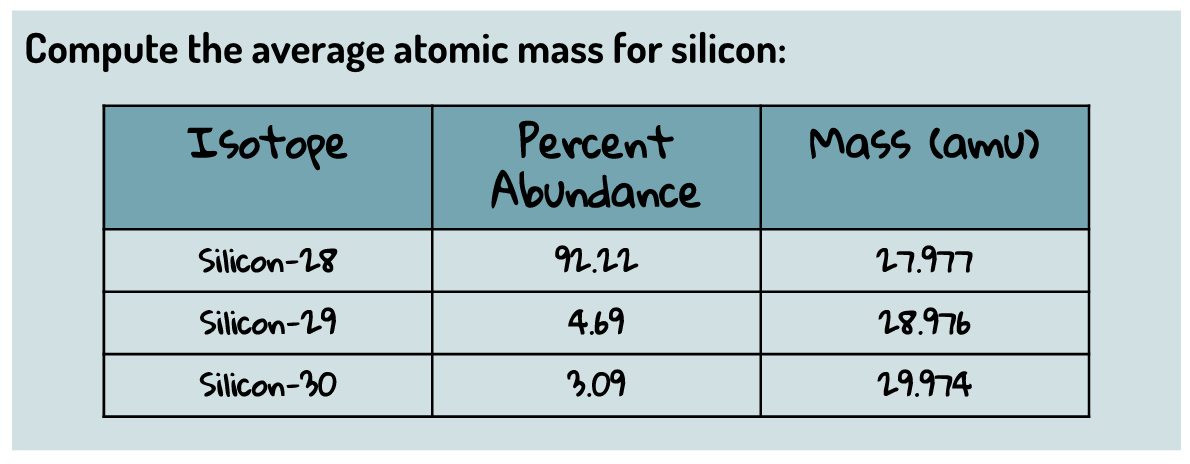
Compute the average atomic mass for silicon:
a)
27.977
b)
28.09
c)
28.976
d)
The average mass cannot be determined from provided information.
29.

Subatomic particles with a negative charge

a)

Electrons

b)

Neutrons

c)

Protons

d)

Quarks

30.
Subatomic particles with a positive charge
a)
neutrons
b)
atomic mass
c)
protons
d)
isotopes
31.
Subatomic particles that are neutral in charge
a)
Neutrons
b)
Protons
c)
Nucleus 
d)
Electrons
32.
Subatomic particles with a positive charge
a)
neutrons
b)
atomic mass
c)
protons
d)
isotopes
33.
What does the nucleus of an atom contain?
a)
Electrons & Neutrons
b)
Protons & Neutrons
c)
Neutrinos & Positrons
34.
Calculate the average atomic mass of silver.
a)
106.38649amu
b)
111.91896amu
c)
107.8677amu
d)
121
35.
Isotopes are atoms of the same element that have the same number of __________ but different number of __________ . Therefore, isotopes of the same element have different masses. 
a)
protons, neutrons
b)
protons, electrons
c)
neutrons, protons
d)
electrons, protons
36.

An element exists as the three isotopes shown. What is the average atomic mass?

a)

20.74 amu

b)

22.56 amu

c)

18.39 amu

d)

24.31