
 Worksheets
FA-4-Microeconomics
Total questions: 20
Worksheet time: 10mins
Which of the following is NOT a factor influencing demand?
the price of substitute goods
The price of labour
The income of consumers
The price of complementary goods
Which of the following creates a shift in the supply curve?
Employing more labour to work the capital.
Cleaning and maintaining the capital.
An increase in the cost of land.
An increase in competition in the market.
What is opportunity cost?
Difference between the price and the price of the next best
Difference in production cost and selling price.
The cost of production of the good in question.
The price of the good in question.
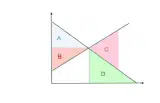
On the diagram, what is the producer surplus?
A
B
C
D
Which one of the following is NOT a definition of allocative efficiency?
When producer and consumer surplus are maximized.
When MSC equals MSB
When supply equals demand, taking intp account externalities
When all consumer wants are satified
A free market is...
One without tax on income or sales
One without any government imposed legal restriction
One that always operates in society's best interests
One where price mechanism dictates prices and output
Free markets operating at allocative efficiency ensure that ...
Everybody has everything that they want and need
Resources are allocated in the best interests of society
Resource allocation is unsustainable
Everything is awesome

Which of the following goods is most likely to have highly inelastic demand?
A litre of petrol (95 octaine fuel)
A Mars Bar
A Norweigian Air flight ticket
A Hesburger
When XED is negative, the goods in question are...
complementary goods
Substitute goods
Unrelated goods
Consumer goods
When YED is negative, the good in question...
doesn't actually exist
is a normal good
is a necessity
is an inferior good
An indirect tax is one that...
consumers pay on what they buy
consumers pay on what they receive as income
consumers pay to local government via the central government
consumers pay on all imported goods
Which of the following is an example of a ceiling price?
Milk prices in the EU
Minimum wages in Finland
Rent controls in Berlin
Oil prices of over $150/barrel
In theory a minimum wage is a bad idea because...
It removes the incentive to work.
reduces the supply of labour.
it increases the demand for labour.
it creates unemployment in the labour market
Which of the following is an example of market failure?
Hesburger going bankrupt because of Burger King & McDonald's
Starbucks not openning an outlet near by.
An intelligent student not going to Oxford due to the cost
Picking mushrooms and berries for personal consumption
What is a free rider?
Motorcycle riders on private roads
People who pay no taxes
People that benefit from public goods without contributing.
A person riding illegally
Which of the following is NOT a solution to market failure in higher education?
Government support to pay private university tuition fees
Government subsidy to private universities
Building and expanding free public universities
Privatising free public universities
CO emissions from the burning of fossil fuel are an example of...
Sustainable use of scarce resources
A complete failure of the price mechanism and free market
Allocative efficiency in the free market
The efficiency of the price mechanism
When governments attempt to control a perfectly competitive market, _____ is a result.
deadweight loss
monopoly
subsidy
marginal cost
Which type of tax is a percentage of the price of an item?
Direct tax
Indirect Tax
Ad Valorem Tax
Specific Tax
Any consumer who is willing and able to buy a good for a higher cost but doesn't have to = ?
consumer surplus
consumer expenditure
excess demand
positive consumer externality

