
 Worksheets
Meiosis Quiz
Total questions: 20
Worksheet time: 40mins
The end of mitosis results in ____ to each other.
2 cells that are identical
4 cells that are identical
2 cells that are not identical
4 cells that are not identical


segregation of sister chromatids
condensation and segregation of alleles
mutationin which the DNA content of the gene is altered
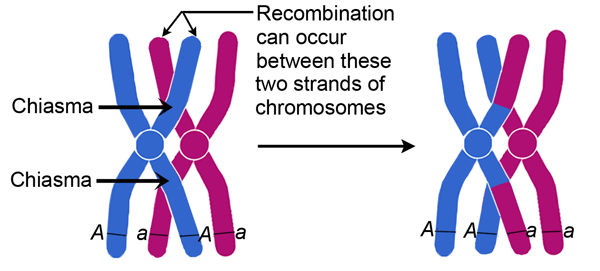
crossing - over in which genes are exchanged
A pair of homologous chromosomes (a tetrad) is composed of (a) matching chromosomes, and (b) sister chromatids.
In which type of cell division does crossing over occur?
mitosis
meiosis
During meiosis, if an organism has 10 chromosomes, how many will the new daughter cells have?
10
8
5
2
In mitosis the (a) daughter cells that are created are (b) . In meiosis the (c) daughter cells that are created are (d)

What phase is this?
Metaphase II
Prophase I
Telophase I
Anaphase I

What phase is this?
Prophase II
Telophase II
Telophase I
Prophase I

What phase is this?
Telophase I
Metaphase I
Metaphase II
Telophase II

In humans, the haploid number of chromosomes is ____.
23
46
69
92
What is unique to Prophase I- is that the duplicated chromosomes pair up to form _______.
a centrosome
a tetrad
the mitotic spindle
sister chromatids
In Anaphase I, the _________ are separated by the pulling of the spindle fibers to opposite poles of the cell.
homologous pairs of chromosomes
sister chromatids
centromeres
centrosomes
At the start of Meiosis II, which of the following is NOT true?
There are two cells.
The cells are haploid.
The chromosomes are paired up as homologues.
DNA is present as two sister chromatids joined at the centromere.
How many cells are formed at the end of Meiosis II?
2
3
4
8
The products of MEIOSIS have _______ number of chromosomes.
haploid
diploid

