
 Worksheets
MBB 504 Assessment
Total questions: 50
Worksheet time: 22mins
Which document may contain useful information about the hazards of a chemical?
Chemical Hygiene Plan
Chemical Risk Document
Course Syllabus
Material Safety Data Sheet
Which statement is true?
All chemicals are hazardous
Only chemicals that are toxic are considered hazardous
Only chemicals in open beakers are hazardous.
Only liquids and gaseous chemicals are hazardous.

Why are safety symbols important?
Tells about how to do the experiment.
Because the icon looks cool
Tells about the content of the substances
Tells about specific dangers of the contents

Solid chemicals spilt on the skin can usually be brushed off with no adverse consequences
Yes
No

Examples of personal protective equipment do NOT include:
Long-sleeve shirts
Goggles and long pants
Lab coats
Contact lenses

Long hair in the laboratory must be
Should be cut short.
Tied back or kept entirely out of the way
Always neatly groomed.
Held away from the experiment with one hand.
When you finish working with chemicals, biological specimens, and other lab substances, always
Treat your hands with skin lotion.
Wipe your hands on a towel.
Wipe your hands on your clothes.
Wash your hands thoroughly with soap and water
What is the goal of aseptic techniques?
To prevent contamination from the worker only
To prevent contamination from the environment only
To prevent any source of contamination
To prevent cross contamination

What is the bunsen burner used for in a LAF chamber?
Keeping warm
Sterilizing equipment
Collecting/spreading bacteria
Stopping contamination
The equipment used to avoid contamination of culture materials
Safety shower
Fume chamber
Laminar flow cabinet
Fire extinguisher
Which among these is used for sterilizing media and apparatus?


What type of shoes should you wear to lab?
Flip flops
Socks and sandals
Closed toed shoes
No shoes required

keeping your nose close to the glassware
wafting
to sniff only a small amount
Trick question; you never are allowed to smell chemicals in class
It looks decent
I won't lose my supplies in the clutter.
It keeps the room from looking messy.
It helps prevent accidents.
A technique for making millions of copies of a specific region of DNA.
Southern blotting
restriction digestion
gel electrophoresis
polymerase chain reaction
At what temperature does the Extension step of PCR occur?
95°C
50-65°C
72°C
Any temperature
If two copies of a double-stranded DNA molecule are present in a polymerase chain reaction (PCR) process, how many double-stranded DNA molecules can be obtained after three cycles?
6
8
12
16
Pattern of DNA fragments obtained by examining a person's unique sequence of DNA pairs.
DNA Fingerprint
Allele
RAPD
Karyotype
A method for separating molecules, such as DNA or protein, according to their size and electrical charge
Electrophoresis
DNA Fingerprint
DNA Probe
PCR
Why do the fragments of DNA in gel electrophoresis travel away from the Anode?
DNA is negatively charged so attracted to the positive end of the unit
DNA is positively charged to attracted to the negative end of the unit
the agarose gel in negatively charged
the agarose gel is positively charged
Which statement is true about plasmids?
Which of the following terms describes the uptake of recombinant plasmids into bacteria cells?
Cloning
Insertion
Transformation
Screening
Which restriction enzyme listed below was isolated from E. coli?
EcoRI
HindIII
HaeII
SmaI
What happens in the denaturation step of PCR?
The phosphodiester bonds are denatured.
The nitrogenous bases are released.
The DNA is fragmented.
The hydrogen bonds are broken.
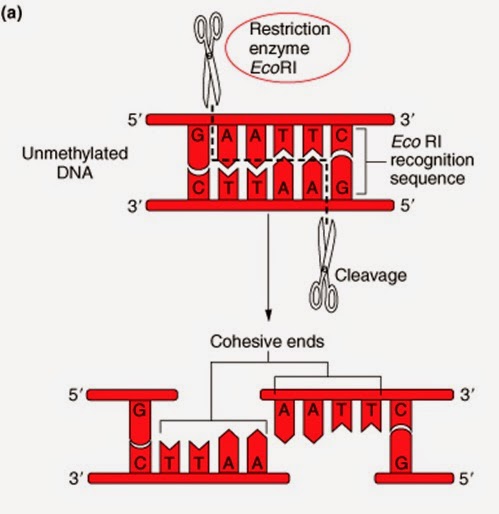
The recognition sites for restriction enzymes are :
a).Tautomer
b). Pallindrome
c).Metamere
d).Acronym
Restriction Enzymes were primarily used for
Defence by Protozoa against antibiotics
Cleaving Bacterial genome by viruses
Defence by Bacteria against bacteriophages
All of the above
Northern blotting:
Uses antibodies to detect proteins
Uses DNA probes to detect DNA
fragments
Uses DNA probes to detect RNA
fragments
Sorts DNA fragments by size
Southern blotting:
Uses antibodies to detect proteins
Uses DNA probes to detect DNA
fragments
Uses DNA probes to detect RNA
fragments
Sorts DNA fragments by size
Western blotting:
Uses antibodies to detect proteins
Uses DNA probes to detect DNA
fragments
Uses DNA probes to detect RNA
fragments
Sorts DNA fragments by size

This diagram represents
Gel electrophoresis
Polymerase chain reaction
Western blotting
Southern blotting
What is a cDNA?
Collection of total genomic DNA
tDNA found in plants
DNA complementary to mRNA
A class of double-stranded RNA
Choose the enzyme that can be used to seal the ends of a plasmid
Taq polymerase
DNA ligase
EcoRI
SmaI
A mixture of DNA fragments with varying sizes is loaded on an agarose gel and a voltage is applied, the DNA will migrate. Which molecules will migrate the slower?
The shortest
The longest
Molecules with more of A/T nucleotides
Molecules with more of G/C nucleotides
What does the term Molecular cloning refer to?
Cutting DNA with restriction nucleases
Putting a foreign gene into a cell
Making identical copies of DNA
Making identical copies of a cell
ELISA can detect
Enzymes
Antibodies
Viruses
All of the above
SDS-PAGE can be used to determine purity of a protein sample
True
False
When protein sample is treated with sodium dodecyl sulfate (SDS)
Proteins become negatively charged.
Proteins become positively charged.
Stabilises the native protein structure.
Adjust the pH of protein.
What is the purpose of using bromophenol blue in the sample buffer?
To ionize the sample.
To monitor the electrophoretic run.
To act as standard control
To adjust the pH of sample.
To make 30% Polyacrylamide solution: Dissolve 29g acrylamide and 1g bisacrylamide in __________mL of water
50
80
100
200

How will you prepare a 10% v/v HCl?
10 ml HCl in 10 ml water
1ml HCl in 9 ml water
10 ml water in 1ml HCl
10 ml HCl in 20 ml water
Calculate the molarity of a solution containing 1.5 moles of NaCl in 0.5 L of solution.
1.5 M
3 M
0.33 M
0.75 M
Molarity is measured in
mols per L
mols per kg
mols per kJ
mols per mL

This is the formula used to determine
Percentage by mass
Percentage by volume
Molality
Mole fraction
Molecular mass
Normality
Molarity
Molality
How many mL of water should be added to 1 mL of a 10x solution to get the working solution
10
9
99
100
The 2nd Carbon atom of ribose sugar is reduced in
Peptide bond
RNA
DNA
NADH
The polymerase which does not require a primer
RNA polymerase
DNA polymerase
Taq polymerase
Reverse transcriptase

