wayground logo

Free Printable Worksheets

Font size

S
M
L
XL
Worksheets

Molecular Genetics Test Review

Total questions: 18

Worksheet time: 9mins

Name
Class
Date
1.
Which of these BEST describes the primary goal of meiosis?
a)
The nucleus is divided without mutation.
b)
A single cell divides into two daughter cells.
c)
All chromosomes are replicated and passed on to the daughter cells.
d)
Four cells are produced with only half the chromosomes of the parent cell.
2.
The central dogma of molecular biology is centered upon the fact that DNA determines an organism’s traits. Which of the following represents the central dogma?
a)
proteins→ RNA → DNA
b)
DNA→ proteins→ RNA
c)
enzymes→ traits→ organisms
d)
DNA→ RNA→ proteins
3.
In nucleotides, the letters A, G, C, T represent:
a)
phosphate groups
b)
deoxyribose sugars
c)
nitrogenous bases
d)
ribose sugars
4.
Which of these is a segment of DNA that contains the information necessary to produce a protein?
a)
a phosphate
b)
a gene
c)
a mutation
d)
an enzyme
5.

A strand of DNA is CGG TCG AGT GAT.

What would be the correct mRNA transcription?

a)

GCC AGC TCA CTA

b)

GCC AGG TGA CTA

c)

GCC UGC TCA CTU

d)

GCC AGC UCA CUA

6.

Which enzyme “unzips” the bonds holding DNA nucleotides together?

a)

ligase

b)

primase

c)

helicase

d)

nitrogenous base

7.
Which statement correctly distinguishes between DNA and RNA?
a)
DNA contains uracil and RNA does not.
b)
DNA contains nitrogenous bases and RNA does not.
c)
RNA contains the sugar ribose and DNA does not.
d)
RNA is arranged in a double helix and DNA is not.
8.
Which process MUST occur before mitosis and meiosis can occur?
a)
DNA transcription
b)
DNA translation
c)
DNA replication
d)
DNA conjugation
9.
A normal human body cell, or somatic cell, contains how many chromosomes?
a)
36 total, 18 pairs
b)
46 total, 23 pairs
c)
23 total, 12.5 pairs
d)
72 total, 36 pairs
10.

A DNA strand is used to make a complementary mRNA strand. This process is called ____.

a)

messaging

b)

replication

c)

transcription

d)

translation

11.

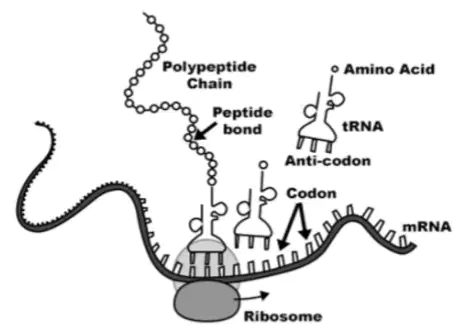
What process is taking place in this image?

a)

DNA replication

b)

transcription

c)

translation

d)

meiosis

12.
Messenger RNA carries a(n) _____ of the DNA’s instructions out of the nucleus to the _____.
a)
exact copy; ribosome
b)
transcript; ribosome
c)
exact copy; mitochondria
d)
transcript; mitochondria
13.

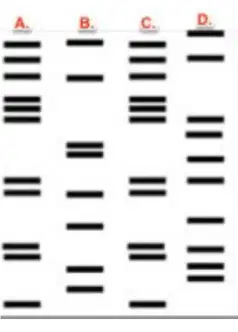
Sample A is DNA from a crime scene. Does the DNA match any of the three suspects (B, C, D)?

a)

No. The DNA (A) is not a match for any of the three suspects.

b)

Yes. The DNA (A) matches suspect B.

c)

Yes. The DNA (A) matches suspect C.

d)

Yes. The DNA (A) matches suspect D.

14.
Changes in the DNA sequence that affect the expression of genetic information are called:
a)
infiltrations
b)
mutations
c)
replications
d)
transformations
15.
A segment of a DNA strand is shown. Which of the strands below is the correct complementary DNA strand for the segment shown? 3’ AGGTCAGGT 5’
a)
5’ AGGTCAGGT 3’
b)
5’ ACCUGAGGU 3’
c)
5’ TGGACTGGA 3’
d)
5’ TCCAGTCCA 3’
16.

In normal humans, sex cells (egg & sperm) contain the ______ number of chromosomes.

a)

diploid

b)

haploid

c)

multiploid

d)

tetraploid

17.

A normal strand of DNA is shown below, followed by the same strand of DNA after a mutation has occurred. Identify the type of mutation.

a)

This mutation is a deletion mutation.

b)

This mutation is an insertion mutation.

c)

This mutation is a substitution mutation.

d)

This is not a mutation.

18.

A gene from an Artic Flounder (fish) is inserted into tomato plant DNA

The tomato plant is now resistant to cold temperatures using _______.

a)

DNA fingerprinting

b)

tissue culture

c)

recombinant DNA

d)

in vitro fertilization