
 Worksheets
Meiosis vs Mitosis
Total questions: 28
Worksheet time: 20mins

Which phase is this in?
Interphase
Metaphase
Anaphase
Telephase

Which phase is this in?
Interphase
Metaphase
Anaphase
Telephase

Which phase is this in?
Prophase
Metaphase
Anaphase
Telephase

Which phase is this in?
Prophase
Metaphase
Anaphase
Telephase

Which phase is this in?
Prophase
Metaphase
Anaphase
Telephase

If a cat skin cell containing 36 chromsomes goes through mitosis, how many chromosomes will be in the new somatic cells?
36
13
72
Which of the following is the best definition for MEIOSIS?
the process of two haploid cells uniting
the counting of chromosomes within a diploid cell
a two-step process that reduces the number of chromosomes in half such that there is only one copy of all the chromosomes
the equational division of a cell into two identical copies

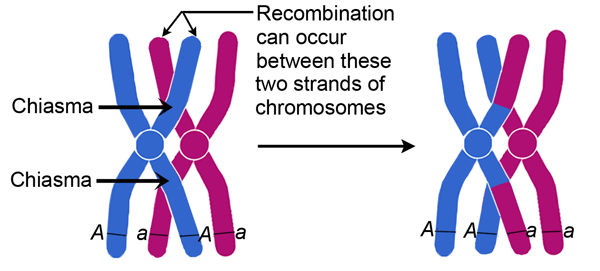
In which stage of MEIOSIS does crossing over occur? (The exchange of genetic material between chromosomes in a tetrad.)
Anaphase I
Metaphase I
Prophase I
Telophase I
How many cells are formed at the end of Meiosis II?
2
3
4
8
The products of MEIOSIS have _______ number of chromosomes.
haploid
diploid
segregation of sister chromatids
condensation and segregation of alleles
mutationin which the DNA content of the gene is altered
crossing - over in which genes are exchanged
During meiosis, if an organism has 10 chromosomes, how many will the new daughter cells have?
10
8
5
2
During mitosis, if an organism has 10 chromosomes, how many will the new daughter cells have?
10
8
5
2
Which event is an important factor in increasing variety among sexually reproducing organisms?
crossing over
gene linkage
testcross
mitosis
After meiosis II, which of the following is true about the cells that are produced?
Four cells are produced. They are identical to each other and each contains half the number of chromosomes that the parent cell has.
Four cells are produced. Each is unique and contains half the number of chromosomes that the parent cell has.
Four cells are produced. Each is unique and contains the same number of chromosomes that the parent cell has.
Two cells are produced. Each is unique and contains the same number of chromosomes that the parent cell has.
What effect does crossing over has in terms of traits of offspring?
Results in identical traits of offsprings.
Causes variation in the traits of offsprings.
It really does nothing to the traits of offspring.
The four cells that are produced after Meiosis are _______.
haploid because they contain just half the number of chromosomes as the parent cell.
diploid because they contain as many chromosomes as the parent cell.
diploid because they contain twice as many chromosomes as the parent cell.

How does MEIOSIS preserve gentic continuity?
Cell 6 shows different colored chromatids than Cell 1. When meiosis is a part of reproduction, the offspring's DNA will be entirely different from the parent's DNA.
Cell 2 shows twice as many chromosomes as Cell 3. When meiosis is a part of reproduction, the offspring inherits twice as much DNA as its parent.
Cell 5 shows half the number of chromatids present in Cell 1. When meiosis is a part of reproduction, half of the offspring's DNA will come from each parent.
Cell 7 shows different colored chromosomes than Cell 8. When meiosis is a part of reproduction, none of the offspring will have similar DNA.

Which image correctly represents Meiosis?
Left
Right
What process results in more diverse offspring by combining genetic material from a male parent and a female parent?
Asexual Reproduction
Sexual Reproduction
Binaary Fission
Mitosis
Which process will cause different varieties in cats?
Meiosis
Mitosis
Binary Fission
Apoptosis
Pairs of similar chromosomes are called...
chromosomes
homologous chromosomes
cytokinesis
DNA
The chromosomes that pair up during meiosis, are called __________ chromosomes.
Analogous
Parental
Homologous
Gene
How does crossing over increase genetic variation?
It creates no genetic variation since it is hard to swap genes.
It increases genetic diversity through deletion.
It decreases genetic diversity by inserting nucleotides into genes.
It creates new combinations of genes.

