wayground logo

Free Printable Worksheets

NEW

Font size

S
M
L
XL
Worksheets

Genetics, Heredity, and Inheritance Review

Total questions: 43

Worksheet time: 3600secs

Name
Class
Date
1.
The physical appearance or the way a gene looks is known as it's....
a)
genotype
b)
allele
c)
gene
d)
phenotype
2.
The different forms of genes are known as
a)
environment
b)
probability
c)
traits
d)
alleles
3.
An allele or gene that always shows is
a)
recessive
b)
dominant
c)
hidden
d)
present
4.
Two of the same genes for a trait (sometimes called purebred). BB or bb
a)
homozygous
b)
hetrozygous
c)
protein
d)
chromosome
5.
Two different genes for a trait (sometimes called hybrid). Bb
a)
protein
b)
homozygous
c)
heterozygous
d)
genotype
6.
Heredity is the passing of traits from _____________________ to _____________________
a)
predators to prey
b)
water to rain
c)
parents to offspring
d)
fungi to protists
7.
He is known as the father of modern day genetics.
a)
Gregory Mendel
b)
Greg Mendel
c)
Gregor Mendel
d)
Grace Mendel
8.
Which is a true statements about this picture?
a)
Brown is recessive
b)
Brown is dominant
c)
Blue is dominant
d)
Blue is codominant
9.
What are the possible phenotypes in this punnett square?
a)
Bb, bb, BB
b)
purple, white
c)
Bb, bb
d)
light purple
10.
What is a gene?
a)
An entire chromosome that  codes for a trait
b)
a piece of clothing
c)
a piece of a DNA on chromosome that codes for a trait
d)
Chemical messengers in your brain that code for a trait
11.

The blending of two traits is known as ---

a)

incomplete dominance

b)

codominance

12.

A condition in which both alleles for a gene are expressed so that both traits are visible is known as ---

a)

Codominance

b)

Incomplete dominance

13.

What type of inheritance pattern is shown here?

a)

Codominance

b)

Incomplete dominance

14.

A calico cat shows both the traits for orange fur and black fur. What kind of allele expression is this?

a)

Incomplete dominance

b)

Codominance

15.

This is an example of ---

a)

Incomplete dominance

b)

Codominance

16.

This is an example of ---

a)

Incomplete dominance

b)

Codominance

17.
Aa, DD, bB, yy are all examples of
a)
genotypes
b)
phenotypes
18.
AA and Aa always show up as
a)
dominant
b)
recessive
19.
A heterozygous long-tusked elephant is crossed with a homozygous recessive short-tusked elephant. What is the probability of the offspring having short tusks?
a)
0%
b)
25%
c)
50%
d)
75%
20.
What is the probability of a purple-horned unicorn if a heterozygous pink-horned unicorn is crossed with a heterozygous pink-horned unicorn?
a)

0%

b)

25%

c)

50%

d)

75%

21.

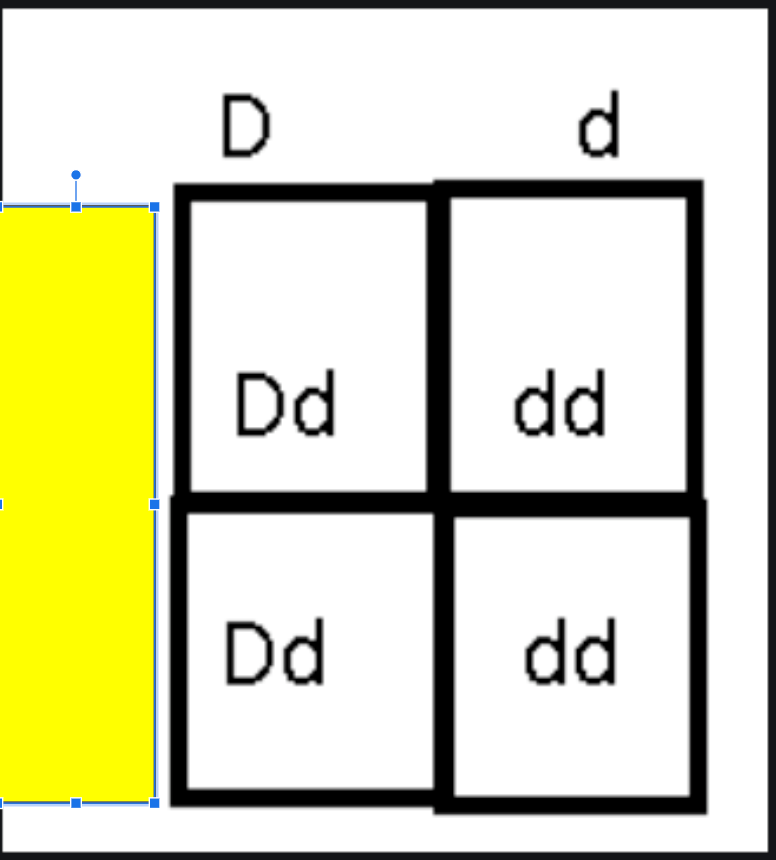
What is the mother's genotype?

a)

DD

b)

Dd

c)

dd

22.

In a pedigree chart, men are represented by

a)

Circles

b)

Diamonds

c)

Squares

23.

In a pedigree chart, women are represented by

a)

Circles

b)

Diamonds

c)

Squares

24.

In a pedigree, individuals that are carriers are represented as shapes that are

a)

Not shaded

b)

Fully shaded

c)

Half shaded

25.

In a pedigree, individuals that are unaffected are represented as shapes that are

a)

Not shaded

b)

Fully shaded

c)

Half shaded

26.

In a pedigree, individuals that are affected are represented as shapes that are

a)

Not shaded

b)

Fully shaded

c)

Half shaded

27.

How many alleles does a person carry for a trait?

a)

1

b)

2

c)

3

d)

4

28.

How many alleles does a child get from each parent for a trait?

a)

1

b)

2

c)

3

d)

4

29.

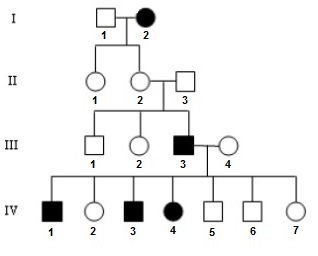
How many individuals are there in the 3rd generation?

a)

1

b)

2

c)

4

d)

6

30.

How are individuals III-2 and II-4 related?

a)

Brother and sister

b)

Dad and daughter

c)

Uncle and niece

d)

Grandfather and granddaughter

31.

If this pedigree shows a recessive disorder, what MUST the genotype of individual 4 be?

a)

HH

b)

Hh

c)

hh

32.
This pedigree represents the inheritance of hemophilia in this family. How many of the females have the hemophilia trait?
a)
8
b)
5
c)
2
d)
3
33.
Does this pedigree show a dominant or recessive trait?
a)
Dominant
b)
Recessive
34.
What is the genotype of the mother?
a)
BB
b)
bb
c)
Bb
d)
BB or Bb
35.
What is the genotype of the father?
a)
AA
b)
aa
c)
Aa
d)
AA or aa
36.

The process by which a cell directs a gene to make a certain protein is called

a)

DNA Extraxtion

b)

genetic modification

c)

gene expression

d)

chromosome assembly

37.

1. Epigenetics is most concerned with

a)

changes in a person’s genotype resulting from environmental influences.

b)

the expression of a particular gene as influenced by external inputs.

c)

environmental influences on gene expression over experiential influences.

d)

the heritability of genotypes that have been altered over multiple generations.

38.

What does methyl do to gene expression

a)

allows genes to be expressed by loosening the reading code

b)

inhibits reading of a specific gene code by “tagging” to the CpG Island

c)

activates DNA to be read.

d)

activates cell growth

39.
Which factor can affect the epigenome?
a)
nutrition
b)
exercise
c)
stress 
d)
all of these factors can affect the epigenome
40.
At what stage in the life of identical twins is the epigenome expected to be most similar?
a)
Age 6 months
b)
Age 21
c)
Age 55
d)
Trick quesiton; the epigenome never changes
41.
The difference between DNA code and the epigenome is that the DNA code is
a)
flexible, while the epigenome is fixed for life
b)
fixed for life, while the epigenome is flexible
c)
determined by the environment, while the epigenome is not
d)
determined by one's stress level, while the epigenome is not
42.

Why do identical twins begin to look different as they age?

a)

Their environment causes mutation of the MAOA gene.

b)

Mutations accumulate which deactivates histone proteins.

c)

Exposure to different environments causes the addition of epigenetic tags that result in changes in gene function.

d)

The DMNT gene is silenced.

43.

These two mice are genetically identical. How do you explain the difference in their coat colors?

a)

The brown mouse has a different form of the agouti gene.

b)

The brown mouse has been fed a diet that donated methyl groups that inactivated the agouti gene.

c)

The mice come from two different families.

d)

The brown mouse was fed a diet that donated acetyl groups and inactivated the agouti gene.