
 Worksheets
Unit Exam -1920's
Total questions: 25
Worksheet time: 13mins
Name
Class
Date
1.
This was a series of programs passed by President Franklin Roosevelt in order to combat high unemployment during the 1930s
a)
Fair Deal
b)
Square Deal
c)
New Deal
2.
What is Social Security?
a)
A program that employed young men to work on environmental and conservation projects
b)
A program that created a social safety net for older Americans approaching retirement
c)
A program that built hydroelectric dams to to control river flooding and provide electricity to rural southern states
d)
A program that provided economic and agricultural relief to farmers who were struggling to get by during the 1930s
3.
What was the Tennessee Valley Authority?
a)
A program that created a social safety net for older Americans approaching retirement
b)
A program that employed young men to work on environmental and conservation projects
c)
A program that provided economic and agricultural relief to farmers who were struggling to get by during the 1930s
d)
A program that built hydroelectric dams to to control river flooding and provide electricity to rural southern states
4.
During the 1930s, many farmers on the Great Plains experienced widespread drought and crop failures know as the Dust Bowl. What was a factor that contributed to this?
a)
Insects such as locusts ate their way through crops
b)
Over-farming of the topsoil and draining of its nutrients.
c)
Water relocation projects drained the rivers and lakes to provide water for farmers
d)
Widespread tornadoes destroyed grain storage supplies
5.
During the 1920s, more Americans began to move and live in the cities centers instead of the rural areas as cities began to expand. This is an example of
a)
Industrialization
b)
Immigration
c)
Urbanization
d)
Ruralization
6.
What is the significance of the Harlem Renaissance?
a)
It was a period beginning in the 1920s when African American culture was thriving and creating the idea that "black is beautiful"
b)
It was one of the first times when African Americans began to celebrate and embrace their own cultural identity
c)
The arts from the Harlem Renaissance, including music, art, and literature, are still influencing the mass media that we consume today
d)
All of the above
7.
Which of the following was not a New Deal program?
a)
Works Progress Administration
b)
Social Security
c)
Federal Deposit Insurance Corporation
d)
Federal Interstate Highway Act
8.
What were the 3' R's" for FDR in trying to fight the Great Depression?
a)
Roosevelt, Regulation, and Resistance
b)
Resistance, Reform, and Regulation
c)
Relief, Recovery, and Reform
d)
Reform, Recovery, and Regulation
9.
What was a name given to women in the 1920s who pushed the boundaries of gender norms
a)
Speakeasies
b)
Modernists
c)
Flappers
d)
Bootleggers
10.
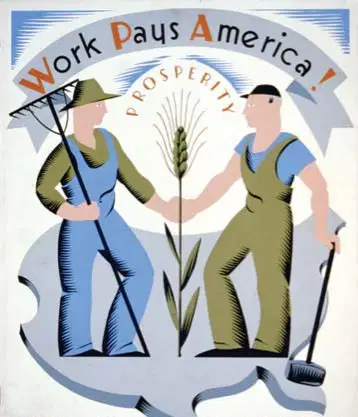
Which New Deal program is featured in the poster below?
a)
Social Security
b)
Tennessee Valley Authority
c)
Securities and Exchange Commission
d)
Works Progress Administration
11.
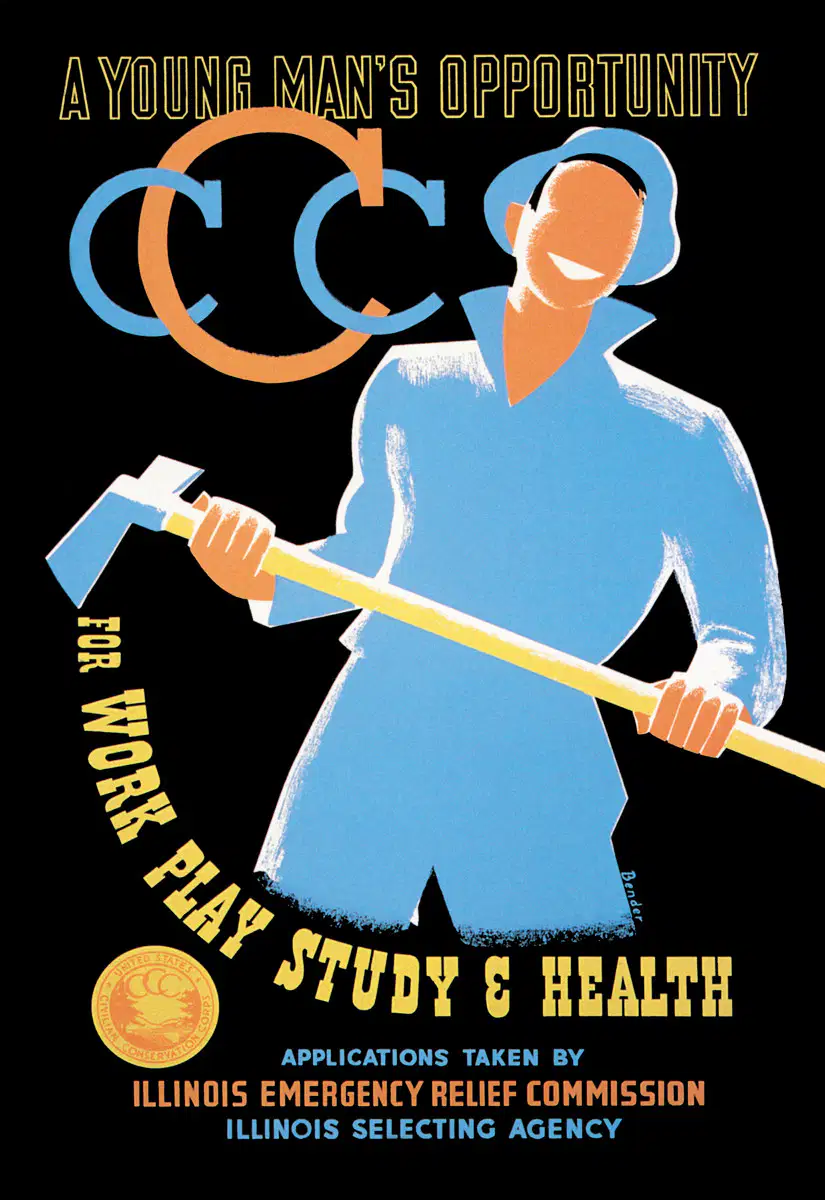
How did the following poster for the Civilian Conservation Corps appeal to American's during the Great Depression?
a)
African- Americans moving from the South to the North during the Great Migration could apply for factory jobs with equal pay with whites
b)
Farmers who had gone through foreclosure would be able to apply for subsidies to be able to pay off debts due to crop failures
c)
Women who fought for the right to vote would be able to work for government agencies to expand and protect the rights of women in the workforce
d)
Men who lost jobs due to the stock market crash would be able to find it by working on conservation projects
12.
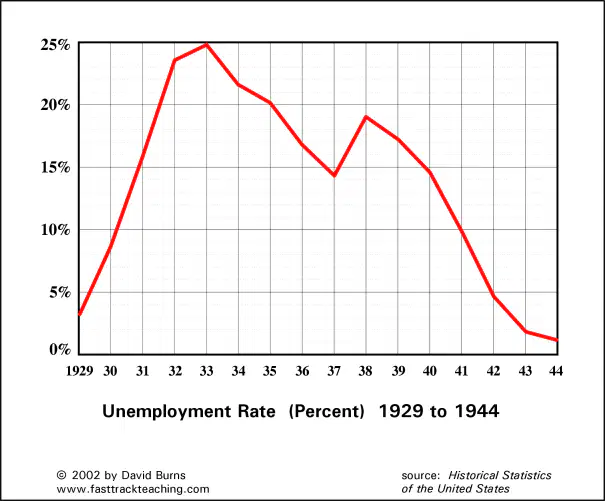
According to the graph below, after FDR becomes President in 1932, when did the unemployment rate drop to 10%?
a)
1935
b)
1937
c)
1939
d)
1941
13.

Which of the following conclusions does the graph support?
a)
The stock market recovered the pre- crash levels by the end of the 1930s
b)
The stock market crash to its lowest point in less than a year
c)
The stock market hit its highest point towards the end of 1929
d)
The stock market was relatively unchanged during this time
14.
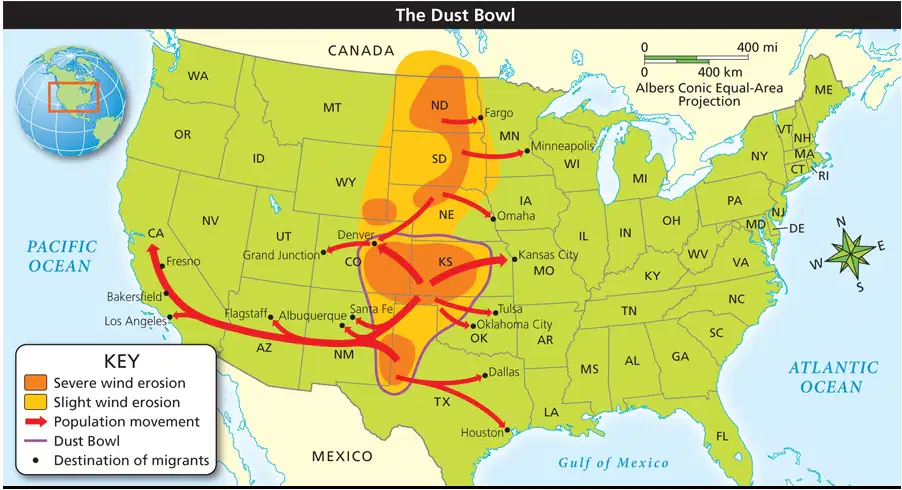
What conclusions about the Dust Bowl can be made from the map below?
a)
Then Dust Bowl was limited to the agricultural south
b)
The states hit hardest included Kansas, Texas, and Colorado
c)
People who left the Great Plains moved to cities like New York, Miami, and Seattle
d)
All of the above
15.
What were some events that were happening during the 1920s to become known as the Roaring 20s?
a)
People were buying more goods than ever before with the introduction of the credit card
b)
More wealth and money was generated in the stock market than in any other period in US history
c)
New innovations such as radio and movies allowed for more Americans to enjoy leisure activities than in previous generations
d)
All of the above
16.
While influential in changing the landscape of the 1930s, do most historians and economists agree that the New Deal was successful in ending the Great Depression?
a)
No, the New Deal led to higher unemployment and a decrease in government spending
b)
Yes, the New Deal ended the Great Depression and the US had fully recovered by 1936
c)
No, the Great Depression did not end in the US until the beginning of WWII
d)
Yes, the New Deal employed millions of Americans that built new infrastructure projects like the Hoover Dam that are still used today
17.
Which of the following is a legacy of the 1920s?
a)
Violence towards African Americans continued to grow with the resurgence of the KKK
b)
More Americans began to purchase home appliances and conveniences like washing machines and radios
c)
Mass consumer culture continued to grow with the rise of Hollywood films and jazz music
d)
All of the above
18.
While the 1920s have been known as the Roaring 20s, what was an event that points to this decade being less than "roaring"?
a)
More Americans than ever were going into debt buying consumer goods such as automobiles
b)
Organized crime was continuing to go down as police were cracking down on bootleggers and moonshiners during prohibition
c)
Americans by the millions were moving to the Great Plains due to the availability of cheap land
d)
Money was unequally distributed at the bottom of the social ladder and those at the top were struggling and falling further behind everyone else in society
19.
As America transitioned in the 1920s, we saw a clash between Conservative and Liberal ideas. Which of the following DOES NOT correctly identify with ideas that would be most associated with that of LIBERAL ideologies from the 1920s.
a)
Lived in Urban Areas
b)
Preferred newer more modern ways of life
c)
Supported the Flapper ideal.
d)
Supported the Policies of Prohibition
20.
As America transitioned in the 1920s, we saw a clash between Conservative and Liberal ideas. Which of the following DOES correctly identify with ideas that would be most associated with that of CONSERVATIVE ideologies from the 1920s. (Choose all that apply)
a)
Lived in rural areas
b)
Paid with Cash
c)
Supported the Policies of Prohibition
d)
Supported the Flapper ideal.
e)
Bought on credit
21.
The Ku Klux Klan of the 1920s was primarily motivated by
a)
the prospect of reviving the confederacy
b)
the desire to isolate the US from the rest of the world
c)
the goal of saving the "true" Americans from modern influences and foreign influences
d)
the idea of making the US a strictly Socialist country
22.
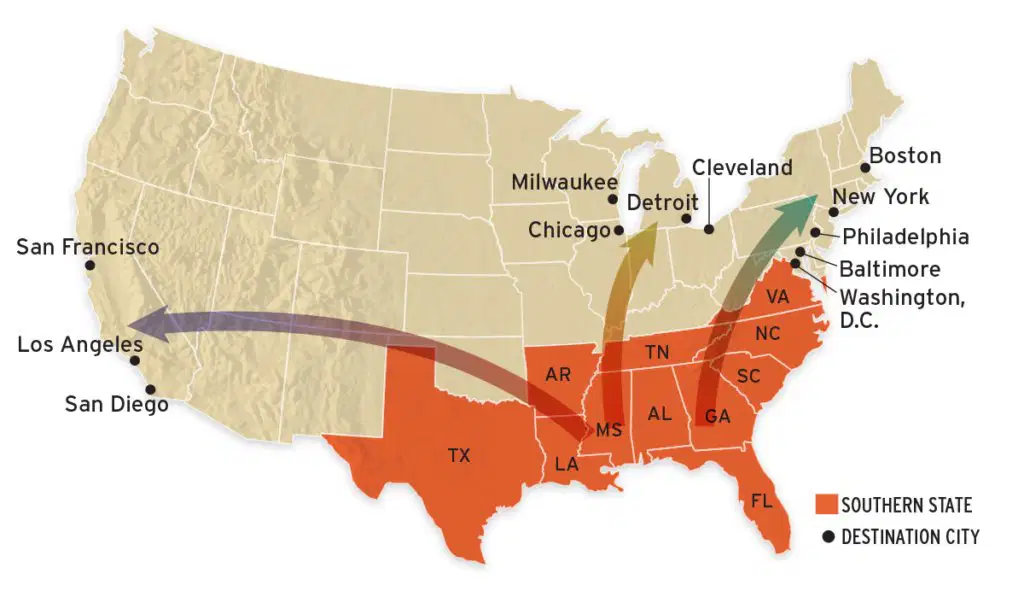
What event does the following map show?
a)
Dust Bowl
b)
Great Migration
c)
Transcontinental Railroad
d)
Growth of Jim Crow laws
23.
Which of the following author is most associated with coming out the Harlem Renaissance?
a)
Booker T Washington
b)
F. Scott Fitzgerald
c)
Langston Hughes
d)
Ernest Hemingway
24.
Which of the following major historical events occurred in the 1930s?
a)
End of Prohibition
b)
The construction of the Hoover Dam
c)
Franklin Roosevelt is elected to his first term as President
d)
All of the above
25.
Which of the following is considered to be a cause of the Great Depression?
a)
Americans carrying too much debt
b)
Farmers and businesses overproducing crops and goods
c)
An unbalanced distribution of wealth and a series of bank failures
d)
All of the above
100 %

