
 Worksheets
NET1L - Lesson 4 (Physical Layer)
Total questions: 79
Worksheet time: 42mins
Provides the physical topology of the system.
Physical Layer
Data Link Layer
Network Layer
Transport Layer
Physical Layer is the first layer in the OSI Reference Model.
True
False
Communication starts at the 7th Layer (Application).
True
False
Tangible parts that we can see which enables communication.
- Ex: end devices, intermediary devices
Physical Layer
Data Link Layer
Network Layer
Transport Layer
Before any network communications can occur, a physical connection is not needed to a local network for it to be established.
True
False
A PHYSICAL connection can be a ______ connection using a cable or a ______ connection using radio waves.
wired
wireless
data
user
A _______________ connects a device to the network.
Network Interface Card (NIC)
Physical Port
Interfaces
Some devices may have just one NIC, while others may have multiple NICs (Wired and/or Wireless, for example).
True
False
What are the components of an access point?
Wireless antennas
Several ethernet switchports
Internet port
LAN port
_____________ are used for a wired connection, whereas ___________________ are used for wireless.
Ethernet NICs, Wireless local area network (WLAN) NICs
Wireless local area network (WLAN) NICs, Ethernet NICs
An end-user device may include one or both types of NICs.
Ex: A network printer - only have an Ethernet NIC
Tablets and smartphones - only contain a WLAN NIC and must use a wireless connection.
True
False
All physical connections are equal, in terms of the performance level, when connecting to a network.
True
False
Transports bits across the network media.
Physical Layer
Data Link Layer
Network Layer
Application Layer
PDU of the data link layer.
Frame
Packet
Segment
Bits
Accepts a complete frame from the Data Link Layer and encodes it as a series of signals that are transmitted to the local media.
Physical Layer
Data Link Layer
Network Layer
Application Layer
[Physical Layer]
Accepts a complete frame from the __________ and encodes it as a series of signals that are transmitted to the local media.
Data Link Layer
Network Layer
Transport Layer
Application Layer
The physical layer is only concerned with wired network connections.
True
False
When a frame is encoded by the physical layer, all bits are sent over the media at the same time.
True
False
The physical layer of the receiving device passes bits up to which higher level layer?
Application Layer
Presentation Layer
Network Layer
Data Link Layer
What PDU is received by the physical layer for encoding and transmission?
Frame
Segment
Packet
Bits
The next device in the path to the destination receives the bits and re-encapsulates the frame, then decides what to do with it.
Physical Layer
Data Link Layer
Network Layer
Application Layer
The Data Link Layer has 2 sublayers:
LLC (Logical Link Control)
MAC (Media Access Control)
MLC (Media Link Control)
[2 sublayers of Data Link Layer]
- LLC - Logical Link Control (the higher sublayer)
- MAC - Media Access Control (the lower sublayer)
True
False
The TCP/IP standards are implemented in software and governed by the
______.
IETF (Internet Engineering Task Force)
IAB (Internet Architecture Board)
ICANN (Internet Corporation for Assigned Names and Numbers)
The protocols and operations of the upper OSI layers are performed using software designed by software engineers and computer scientists.
True
False
The physical layer consists of electronic circuitry, media, and connectors developed by engineers.
Therefore, it is not appropriate that the standards governing this hardware are defined by the relevant electrical and communications engineering organizations.
True
False
The physical layer standards are implemented in hardware and are
governed by many organizations including:
International Organization for Standardization (ISO)
Telecommunications Industry Association/Electronic Industries Association (TIA/EIA)
International Telecommunication Union (ITU)
American National Standards Institute (ANSI)
Institute of Electrical and Electronics Engineers (IEEE)
The physical layer standards are implemented in hardware and are
governed by many organizations including:
[National telecommunications regulatory authorities]
Federal Communication Commission (FCC) in the USA
European Telecommunications Standards Institute (ETSI)
CSA (Canadian Standards Association)
CENELEC (European Committee for Electrotechnical Standardization)
JSA/JIS (Japanese Standards Association)
The physical layer standards are implemented in hardware and are
governed by many organizations including:
[Regional cabling standards groups]
Federal Communication Commission (FCC) in the USA
European Telecommunications Standards Institute (ETSI)
CSA (Canadian Standards Association)
CENELEC (European Committee for Electrotechnical Standardization)
JSA/JIS (Japanese Standards Association)
ISO
International Organization for Standardization
International Organization for Serialization
Internet Organization for Standardization
What is the meaning of TIA/EIA?
Telecommunications Industry Association/Electronic Industries Association
Telecommunications Internet Association/Electronic Industries Association
Telecommunications Industry Association/Electronic Industries Authority
ITU
International Telecommunication Union
International Telephone Union
Internet Telecommunication Union
ANSI
American National Standards Institute
American Nation Standards Institution
American Nationality Standards Institute
IEEE
Institute of Electrical and Electronics Engineers
Institute of Electricity and Electronics Engineers
Institute of Electronics and Electrical Engineers
FCC
Federal Communication Commission
Federal Communication Company
Federal Commission Communication
ETSI
European Telecommunications Standards Institute
Electronic Telecommunications Standards Institute
European Telecommunications Standards Institution
The physical layer standards address three functional areas:
Physical components
Encoding
Signaling
Decoding
Are the electronic hardware devices, media, and other connectors that transmit the signals that represent the bits.
Physical Components
Hardware Components
The physical components are the electronic hardware devices, media, and other connectors that transmit the signals that represent the _____.
Bits
Frame
Segment
Data
_____________ such as NICs, interfaces and connectors, cable materials, and cable designs are all specified in standards associated with the physical layer.
Physical Components
Hardware Components
Converts the stream of bits into a format recognizable by the next device in the network path.
Physical components
Encoding
Signaling
Encoding is also called line encoding.
True
False
Is a method of converting a stream of data bits into a predefined "code”.
Physical components
Encoding
Signaling
Are groupings of bits used to provide a predictable pattern that can be recognized by both the sender and the receiver.
Codes
Data
Binary
Is the method or pattern used to represent digital information.
Physical components
Encoding
Signaling
Encoding is not similar to how Morse code encodes a message using a series of dots and dashes.
True
False
Examples of encoding methods include:

Manchester
4B/5B
8B/10B
6B/7B
Is how the bit values, “1” and “0” are represented on the physical medium.
Physical components
Encoding
Signaling
The physical layer must generate the electrical, optical, or wireless signals that represent the "1" and "0" on the media.
True
False
______________ must define what type of signal represents a "1" and what type of signal represents a "0".
Physical Layer Standards
Network Layer Standards
Data Link Layer Standards
The method of signaling will not vary based on the type of medium being used.
True
False
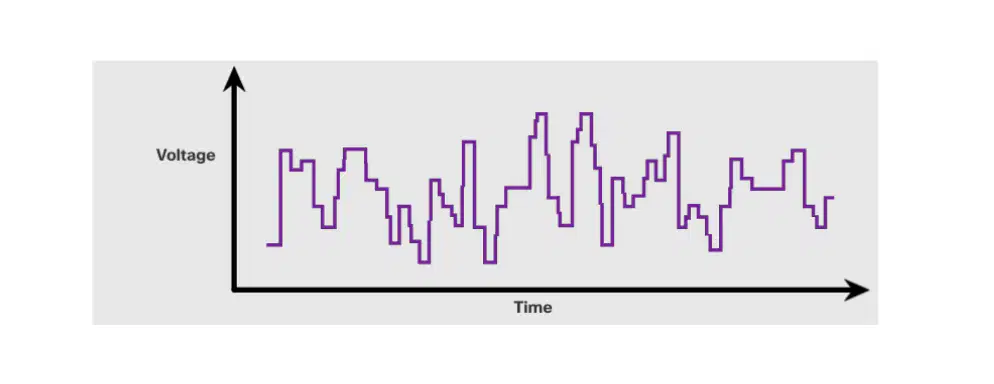
Electrical Signals Over Copper Cable
Light Pulses Over Fiber-Optic Cable
Microwave Signals Over Wireless

Electrical Signals Over Copper Cable
Light Pulses Over Fiber-Optic Cable
Microwave Signals Over Wireless
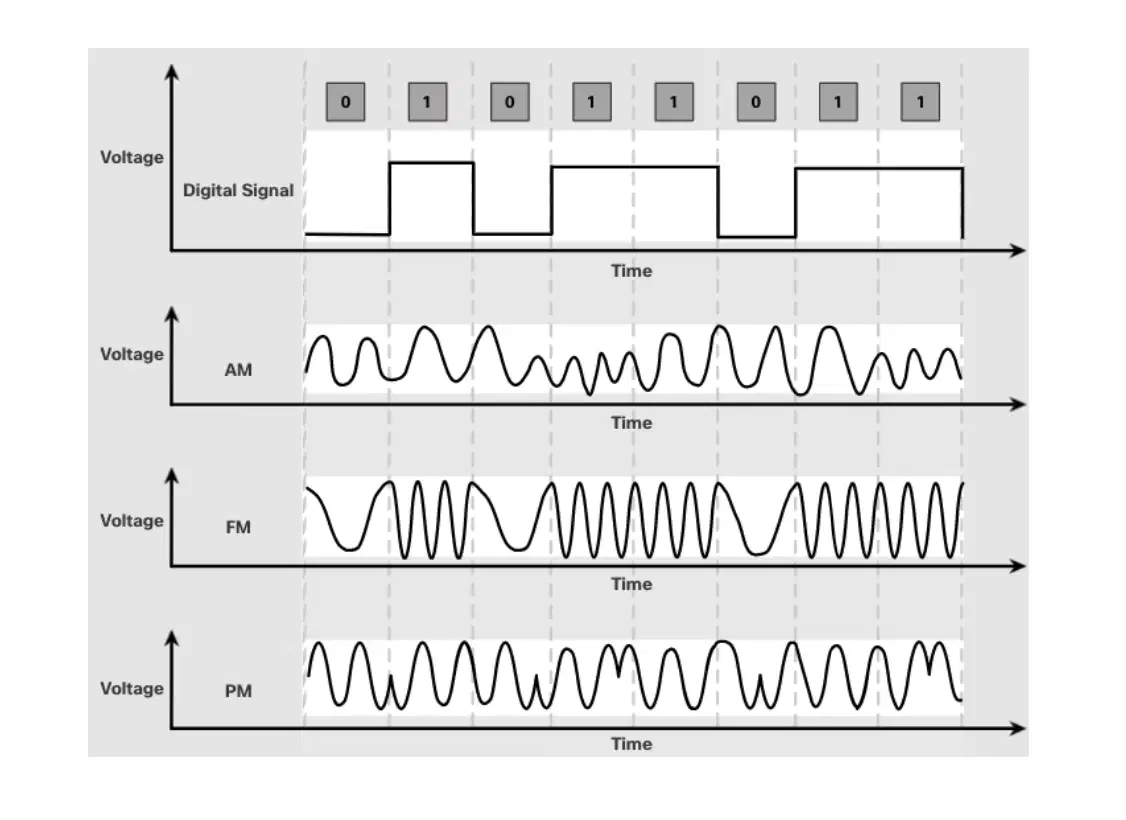
Electrical Signals Over Copper Cable
Light Pulses Over Fiber-Optic Cable
Microwave Signals Over Wireless
Is the capacity at which a medium can carry data.
Bandwidth
Transfer rate
Storage capacity
Digital Bandwidth
Measures the amount of data that can flow from one place to another in a given amount of time; how many bits can be transmitted in a second.
Bandwidth
Transfer rate
Storage capacity
Digital Bandwidth
Physical media properties, current technologies, and the laws of physics do not play a role in determining available bandwidth.
True
False
Bandwidth is typically measured:
kilobits per second (kbps)
megabits per second (Mbps)
gigabits per second (Gbps)
Terabits per second (Tbps)
Bandwidth is sometimes thought of as the speed that bits travel, however this is accurate.
True
False
1 bps (Bits per second) = fundamental unit of bandwidth
True
False
1 Kbps = ______ bps = _____ bps
1,000 (10^3)
1,000,000 (10^6)
1,000,000,000 (10^9)
1,000,000,000,000 (10^12)
1 Mbps = __________ bps = _____ bps
1,000 (10^3)
1,000,000 (10^6)
1,000,000,000 (10^9)
1,000,000,000,000 (10^12)
1 Gbps – _____________ bps = ____ bps
1,000 (10^3)
1,000,000 (10^6)
1,000,000,000 (10^9)
1,000,000,000,000 (10^12)
1 Tbps = __________________ bps = _____ bps
1,000 (10^3)
1,000,000 (10^6)
1,000,000,000 (10^9)
1,000,000,000,000 (10^12)
Amount of time, including delays, for data to travel from one given point to another.
Latency
Throughput
Goodput
In an internetwork, or a network with multiple segments, throughput cannot be faster than the slowest link in the path from source to destination.
True
False
The measure of the transfer of bits across the media over a given period of time.
Latency
Throughput
Goodput
You can't reveal the throughput of an internet connection through online speed tests.
True
False
The measure of usable data transferred over a given period of time.
Latency
Throughput
Goodput
Goodput = _________ - __________
Throughput, traffic overhead
Throughput, traffic underhead
Throughput, Latency
Throughput, Delays
Goodput is always lower than throughput, which is generally lower than the bandwidth.
True
False
5 Factors why we can’t get the maximum speed:
Time of the day
No. of users
Weather
Specification
Type of data processed
The best time of the day to use the internet is early morning.
True
False
Our maximum speed depends on our devices, cabling, media.
(Ex: Switch can only accommodate 10 mbps, Fiber cable is faster)
Time of the day
No. of users
Weather
Specification
Type of data processed
Ex: downloading, streaming, gaming
Time of the day
No. of users
Weather
Specification
Type of data processed
2 combinations that determines the practical bandwidth of a network:
The properties of the physical media
The technologies chosen for signaling and detecting network signals
The properties of the logical media
Which media uses patterns of microwaves to represent bits?
copper
wireless
fiber-optic
Which media uses patterns of light to represent bits?
copper
wireless
fiber-optic
Which media uses electrical pulses to represent bits?
copper
wireless
fiber-optic

