
 Worksheets
TaAP - Brayton and Engines
Total questions: 11
Worksheet time: 4mins
The efficiency of the Brayton cycle is always _ the efficiency of the Carnot cycle.
equal to
greater than
double
less than
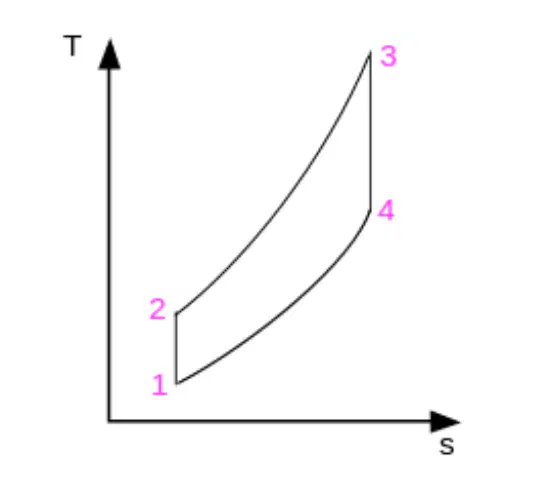
Which process is represented by 1-2 in the Brayton cycle diagram?
isobaric compression
isothermal compression
isentropic compression
isochoric compression
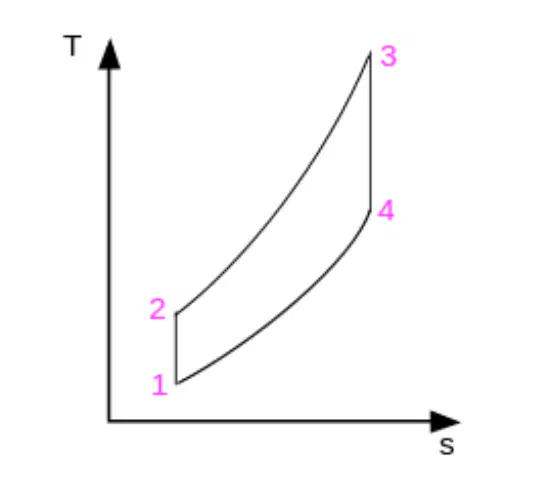
Which processes shown in the Brayton cycle diagram are isobaric?
2-3 and 4-1
1-2 and 2-3
3-4 and 4-1
1-2 and 3-4
A gas turbine engine has a pressure ratio of 26. Assuming the engine cycle can be represented by the air-standard Brayton cycle, what will be the cycle efficiency?
26%
60.6%
0.6%
74%
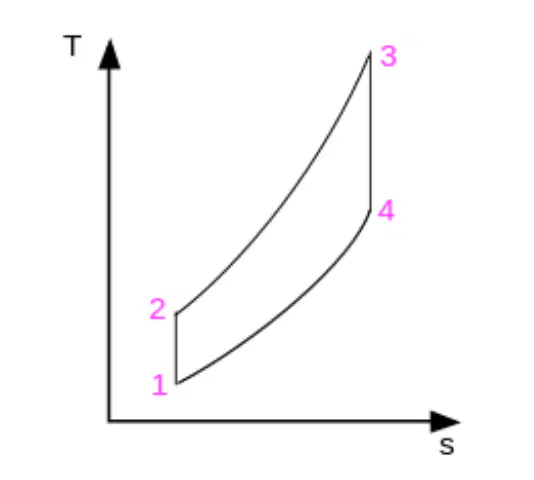
The Brayton cycle diagram shown represents which gas turbine hardware?
1-2: combustion, 2-3: compressor, 3-4: exhaust, 4-1: turbine
1-2: turbine, 2-3: exhaust, 3-4: compressor, 4-1: combustion
1-2: exhaust, 2-3: compressor, 3-4: combustion, 4-1: turbine
1-2: compressor, 2-3: combustion, 3-4: turbine, 4-1: exhaust
Turboprops are most efficient in:
High speed, high altitude operations.
Low speed, low altitude operations.
Which of the following is most efficient at high speeds?
Turbo-prop
Low by-pass turbofan
High by-pass turbofan
Pure turbojet
For a thermodynamically ideal turbo-jet, the process that occurs through the outlet nozzle is:
isentropic compression
isothermal compression
isentropic expansion
isothermal expansion
Which of the following features 'supersonic combustion'?
High by-pass turbofans
Scramjets
Ramjets
Pure turbojets
For a thermodynamically ideal turbo-jet, the combustion process can be considered:
adiabatic
isentropic
isothermal
isobaric
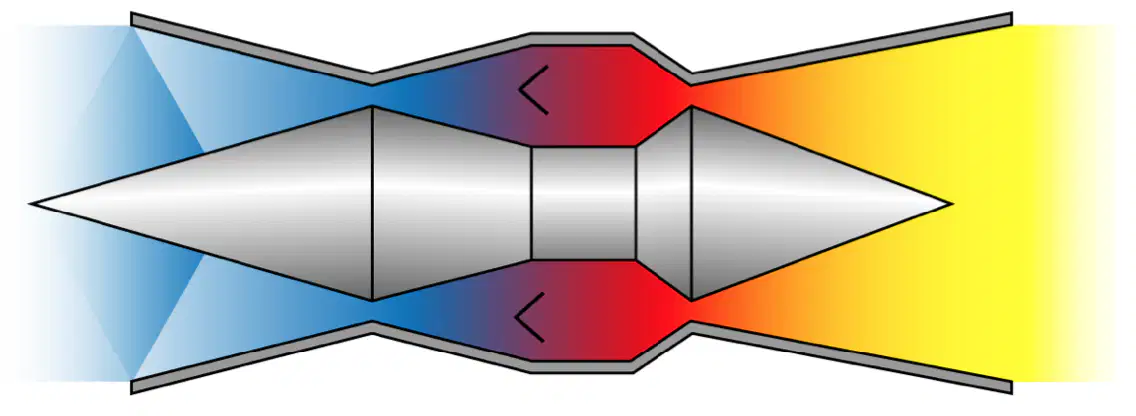
This diagram is representative of which type of engine?
A ramjet
A low by-pass turbofan
A scramjet
A pure turbojet

