wayground logo

Free Printable Worksheets

Font size

S
M
L
XL
Worksheets

Weather

Total questions: 27

Worksheet time: 54mins

Name
Class
Date
1.
How do we characterize an air mass that forms over the ocean?
a)
Dry
b)
Wet
c)
Cold
d)
Warm
2.

What is the name of an air mass that forms over the ocean?

a)

Polar

b)

Continental

c)

Maritime

d)

Tropical

3.

What is the name of an air mass that forms over land?

a)

Polar

b)

Continental

c)

Maritime

d)

Tropical

4.
How do we characterize an air mass that forms over land?
a)
Dry
b)
Wet
c)
Cold
d)
Warm
5.
How do we characterize an air mass that forms over near the equator?
a)
Dry
b)
Wet
c)
Cold
d)
Warm
6.

What is the name of an air mass that forms over near the equator?

a)

Arctic

b)

Continental

c)

Tropical

d)

Polar

7.
How do we characterize an air mass that forms near the poles?
a)
Dry
b)
Wet
c)
Warm
d)
Cold
8.
What types of air masses form over oceans?
a)
Maritime
b)
Continental
c)
Polar
d)
Tropical
9.
What's the humidity and temperature of a continental tropical air mass?
a)
Wet and cold
b)
Dry and warm
c)
Wet and warm
d)
Dry and cold
10.
What's the humidity and temperature of a maritime tropical air mass?
a)
Wet and cold
b)
Dry and warm
c)
Wet and warm
d)
Dry and cold
11.
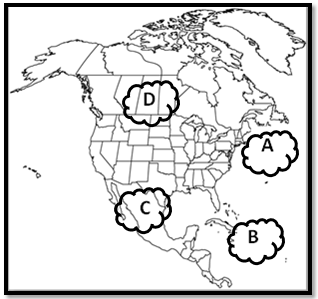
Which type of air would you find at air mass B?
a)
cold, dry
b)
warm, humid
c)
warm, dry
d)
cold, humid
12.
Where would you find a tropical maritime air mass?
a)
over the ocean, near the equator
b)
over the ocean, near the poles
c)
over a continent, near the equator
d)
over a continent, near the poles
13.

Which name of an air mass can be identified as dry and hot?

a)

Continental Polar

b)

Maritime Polar

c)

Continental Tropical

d)

Maritime Tropical

14.

Which abbreviation of an air mass can be identified as cool and moist?

a)

Continental Polar

b)

Maritime Polar

c)

Continental Tropical

d)

Maritime Tropical

15.
How do we name air masses?
a)

Pressure and temperature

b)
Air pressure
c)
Humidity and temperature
d)
Cold and warm
16.
Which global winds are found at the poles? 
a)
Polar Westerlies
b)
Prevailing Easterlies
c)
Polar Easterlies
d)
Trade Winds
17.
Which global winds directly effect weather in the U.S.?
a)
Trade Winds
b)
Prevailing Westerlies
c)
Polar Easterlies
d)
Doldrums
18.
What is the initial source for global winds and convection in the atmosphere? 
a)
continental deflection
b)
the rotation of the Earth
c)
Moon's gravity
d)
unequal heating of the Earth by the sun
19.
In which direction do prevailing westerlies flow?
a)
from east to west
b)
from west to east
c)
from north to south
d)
from south to north
20.
The tropical winds running from 0 to 30 degrees latitude are called:
a)

subtropical westerlies

b)

polar westerlies

c)

tropical easterlies

d)

polar winds

21.

Which front causes precipitation? (Check all that apply)

a)

Cold

b)

Warm

c)

Stationary

d)

Occluded

22.

True or False: Stationary front air masses try to move in the opposite direction, while occluded front air masses move in the same direction

a)

True

b)

False

23.

Which front is this

a)

Occluded front

b)

Cold front

c)

Stationary front

d)

Warm front

24.

Which front is this

a)

Cold front

b)

Warm front

c)

Occluded front

d)

Stationary front

25.

Which front is this

a)

Cold front

b)

Warm front

c)

Occluded front

d)

Stationary front

26.

Match the following

a)
1.

Cold front

b)
2.

Warm front

c)
3.

Occluded front

d)
4.

Stationary front

27.

Which front has the densest air?

a)

Occluded

b)

Stationary

c)

Cold

d)

Warm