Wayground logo

Free Printable Worksheets

Font size

S
M
L
XL
Worksheets

Ecology 1 Review

Total questions: 36

Worksheet time: 23mins

Name
Class
Date
1.
Non-living factor that affects an ecosystem
a)
biotic factor
b)
abiotic factor
c)
food chain 
d)
biome
2.

What percentage of energy is passed on to the next trophic level?

a)

5%

b)

10%

c)

50%

d)

90%

3.

In some environments, wolves prey on deer for their source of food. If all of the wolves were taken from the environment, what would most likely happen to the deer population?

a)

A The deer population would increase and begin to compete for food.

b)

B The deer population would become larger and healthier animals.

c)

C The deer population would decrease, because there would be an increase in disease.

d)

D The deer population would change color, because they would not have to hide from wolves.

4.

The living parts of an ecosystem

a)

Biotic factors

b)

Abiotic factors

c)

Mother Earth

d)

Flowers

5.

The study of how living things interact with one another and with their environment.

a)

Biology

b)

Lithology

c)

Ecology

d)

Farmacology

6.

What is a producer?

a)

an organism that gets energy from eating other organisms

b)

an organism that uses sunlight or chemical energy to make its own food

c)

an organism that gets energy from eating dead organisms, non-living material or waste

7.

An organism that gets energy from eating other organisms is a ______________.

a)

producer

b)

consumer

c)

decomposer

d)

prey

8.
All of the living and nonliving things in an area that interact with each other are called a/an ______.
a)
community
b)
habitat
c)
population
d)
ecosystem
9.

A rock is considered ________ .

a)

Living

b)

Nonliving

c)

Dormant

d)

Dead

10.
An individual belonging to a specific species
a)
Biotic
b)
Community
c)
Organism
d)
Reptile
11.
Two or more members of a particular species living and interacting in the same area
a)
Community
b)
Population
c)
Organisms
d)
Biosphere
12.
Different populations living and interacting with each other in the same area
a)
Biome
b)
Ecosystem
c)
Community
d)
Niche
13.
A living relationship between two species in which one organism is harmed is called...
a)
mutualism
b)
commensalism
c)
parasitism
d)
niche
14.
Water temperature would be an example of ...
a)
A biotic factor
b)
An abiotic factor
15.
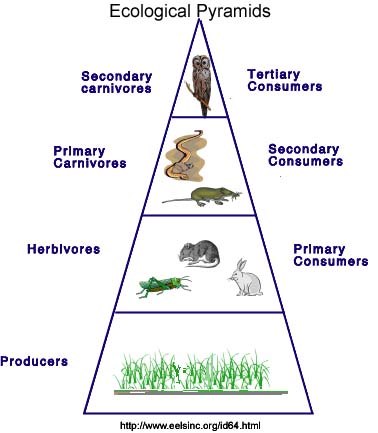
In the energy pyramid here, which organisms have the most energy available?
a)
Producers
b)
Carnivores
c)
Herbivores
d)
Top Predator
16.
If there is 1000 Kcal available in the producers in trophic level 1, how much energy is available in the herbivores in trophic level 2?
a)
10 Kcal
b)
1 Kcal
c)
100 Kcal
d)
1000 Kcal
17.
Grass --> Grasshopper --> Mockingbird represents __________. 
a)
food chain
b)
food pyramid
c)
food web
d)
ecosystem
18.
An animal that eats plants and meat is a(n) __________.
a)
herbivore
b)
omnivore
c)
carnivore
d)
decomposer
19.
What is the source of energy that flows through most of the food chains on Earth?
a)
plants
b)
the sun
c)
temperature
d)
wind
20.
What is a herbivore?
a)
an animal that gets energy from eating other animals
b)
an organism that gets energy from eating only plants
c)
an animal that gets energy by eating both plants and other animals
d)
an animal that eats only herbs
21.
An organism that gets energy from breaking down dead organisms, non-living material or waste is a(an) ___________.
a)
producer
b)
consumer
c)
decomposer
d)
autotroph
22.

What would happen to the rabbit population if the fox population moved out of the area represented by the food web?

a)

The rabbit population would increase

b)

The rabbit population would decrease

c)

The rabbit population would neither increase nor decrease

23.
What might happen if you remove a primary consumer from the ecosystem?
a)
There would be more food for secondary consumers.
b)
The number of primary consumers would increase.
c)
The number of plants would increase.
d)
The number of secondary consumers would increase.
24.

How does the mouse get energy in this food web?

a)

From a producer

b)

From a consumer

c)

By turning light into food

d)

By releasing Carbon Dioxide

25.

Both species benefit

a)

symbiosis

b)

parasitism

c)

mutualism

d)

commensalism

26.

Tapeworms reside in human intestine and take nutrients from the human

a)

symbiosis

b)

parasitism

c)

mutualism

d)

commensalism

27.
In the food web shown, the snail would be considered...
a)
primary consumer
b)
secondary consumer
c)
tertiary consumer
d)
producer
28.

Barnacles are animals that cannot move. In order to get food, they attach to whales and catch any floating plankton in the water. The whale is neither helped nor harmed in the interaction. What type of symbiosis is this?

a)

Mutualism

b)

Commensalism

c)

Parasitism

d)

Neutralism

29.

What is the correct order for this food chain?

a)

Owl, Mouse, Grasshopper, Grass

b)

Grass, Mouse, Owl, Grasshopper

c)

Grass, Owl, Grasshopper, Mouse

d)

Grass, Grasshopper, Mouse, Owl

30.
Which organism recieves the least amount of energy from the producer?
a)
Owl
b)
Grasshopper
c)
Lilypad
d)
Mouse
31.
The largest group of organisms found in a food web would be:
a)
Primary Consumers
b)
Producers
c)
Decomposers
d)
Tertiary Consumers
32.
a system of food chains that shows the transfer of energy  is termed
a)
food web
b)
food chain
c)
prey
d)
predator
33.
Which of the following is an organism that eats only meat?
a)
herbivore
b)
carnivore
c)
omnivore
34.
What does a food web represent?
a)
All connections of energy flow throughout all organisms in a habitat.
b)
The specific ways that mutualism is carried out.
c)
A single pathway or energy flow between organisms. 
d)
How carnivores get their food. 
35.
The rabbit in this food web would be considered a:
a)
Decomposer
b)
Producer
c)
Secondary Consumer
d)
Primary Consumer
36.

A bee receives nectar from a flower and carries the pollen to other flowers:

a)

predation

b)

parasitism

c)

mutualism

d)

commensalism