
 Worksheets
Concept 1 Examples for evolution
Total questions: 30
Worksheet time: 18mins
All of the genetic information found in a population.
population
genetic drift
evolution
gene pool

Which of the following is an example of the founder effect?
Humans choose two dogs they like the characteristics of and breed them together.
Affected individuals with blue skin can trace their ancestry back to one of the first settlers in the region.
The environment of a fox population changes and over time foxes who are white survive and pass on their genes to their offspring.
Cheetah populations reach their lowest levels with reduced diversity and as they rebound are so genetically similar they appear to be inbred.
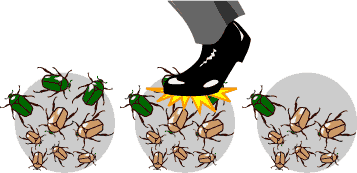
Someone steps on some bugs and randomly removes their alleles from the population. This is an example of
gene flow
genetic drift
speciation
allele frequency
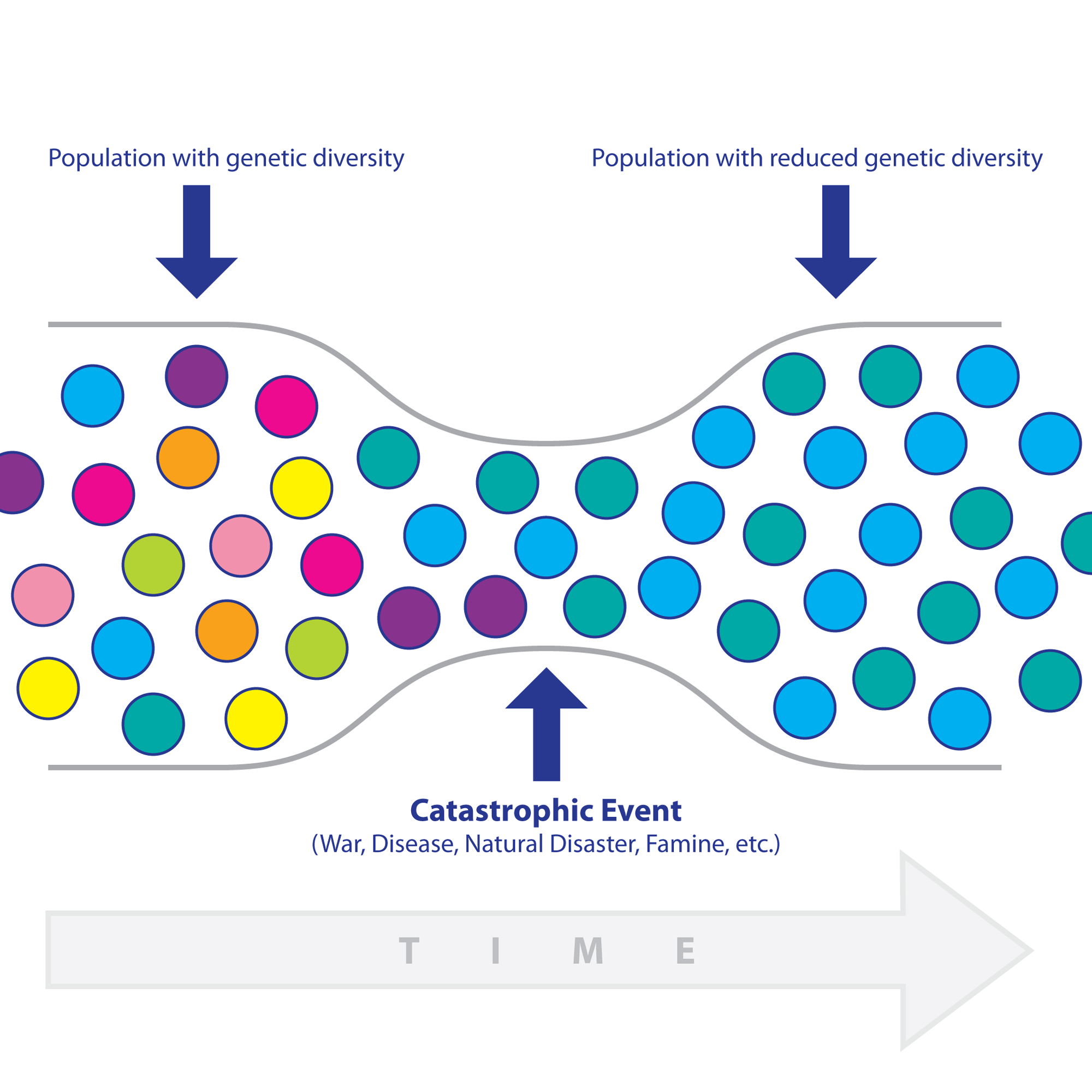
A drastic reduction in the size of a population that can change allele frequencies is called
the bottleneck effect
the founder effect
the gene flow effect
the Thanos effect
The Amish have a higher frequency of polydactyly (extra fingers) in their community than the general population. This is due to the allele for extra fingers being present in the group that started the Amish community.
The difference in allele frequency is due to genetic flow.
The difference in allele frequency is due to the founder effect.
The difference in allele frequency is due to a bottleneck.
The difference in allele frequency is due to speciation.
If a population of lizards is isolated on an island, with no new immigrants over many years, any new genetic variations are most likely to come from
recessive alleles
natural selection
mutations
speciation
Small populations are more prone to genetic drift than large populations.
True
False
The movement of alleles from one population to another is called
genetic drift
the bottleneck effect
the founder effect
gene flow
Select ALL of the following that violate the Hardy-Weinberg assumptions and would lead to a change in allele frequencies in a population.
natural selection
large population
no mutations
nonrandom mating
no migration
When allele frequencies remain constant, a population is evolving.
True
False

A forest fire ignites in the Sam Houston State Forest and kills many members of a population of pigmy rattlesnakes.
Gene Flow
Genetic Drift

Select the best answer based on the image.
Gene Flow
Genetic Drift
Genetic diversity is decreased through this process.
Gene Flow
Genetic Drift

Select the best answer based on the image.
Gene Flow
Genetic Drift

Select the best answer based on the image.
Gene Flow
Genetic Drift

A population of flowers on one side of a river transports pollen to flowers on the other side of the river
Gene Flow
Genetic Drift
Mutations are important because they bring about
death of the organism in which they develop
genetic variation needed for a population to evolve
benefits for the individual, not for the population
changes in genotype, but not phenotype

Label the natural selection graphs correctly...
1 Stabilizing, 2 Directional, 3 Disruptive
1 Disruptive, 2 Stabilizing, 3 Directional
1 Directional, 2 Stabilizing, 3 Disruptive

Starlings produce an average of five eggs. If there are more than five the parents cannot adequately feed the young. Fewer than five and predators may destroy them. As a result, five eggs becomes the most common number.
Stabilizing
Directional
Disruptive

Seed cracker birds have either large beaks or small beaks. They do not have medium sized beaks because medium sized beaks do not allow for adequate cracking of seeds.
Stabilizing
Directional
Disruptive

A scientist measures the circumference of acorns in a population of oak trees and discovers that the most common circumference is 2 cm. There are very few acorns with circumferences of 3 cm or circumferences of 1 cm. Only the 2 cm circumference acorns survive.
Stabilizing
Directional
Disruptive

A population of Madagascar hissing cockroaches lives in a woodpile. The cockroaches are eaten by lizards. Because the lizards have small heads, the lizards are unable to eat the very largest adult cockroaches, and instead prey upon small and medium sized adults. Over time, only the large headed lizards survive.
Stabilizing
Directional
Disruptive

A population of birds with various size beaks eats seeds. Small seeds can be eaten by birds with small beaks. Larger, thicker seeds can only be eaten by birds with larger, thicker beaks. During a drought, only large thick seeds exist so only the large, thick-beaked birds survive.
Stabilizing
Directional
Disruptive

Black rabbits (BB) and white rabbits (bb) are both able to survive because they can camouflage into the white and black rocks in their environment. However, the intermediate gray rabbits (Bb) do not survive. This results in only white and black rabbits.
Stabilizing
Directional
Disruptive

