wayground logo

Free Printable Worksheets

Font size

S
M
L
XL
Worksheets

DNA Replication & Protein Synthesis

Total questions: 45

Worksheet time: 47mins

Name
Class
Date
1.
Which of the following best describes a DNA molecule?
a)
double helix
b)
contains ribose
c)
made of amino acids
d)
contains Uracil
2.
Which of the following units are repeatedly joined together to form a strand of DNA? (This is the MONOMER of DNA.) 
a)
amino acids
b)
nucleotides
c)
fatty acids
d)
polysaccharides
3.
Adenine bonds with ______________.
a)
Guanine
b)
Thymine
c)
Cytosine
d)
Adenine
4.

What are the 4 nitrogen bases of DNA?

a)

adenine, thymine, cytoplasm, and guanine

b)

adenine, thymine cytosine, and guanine

c)

adenine, thymine, cytosine, and gylcerol

d)

adenine, thymine, cytosine, and glucose
5.
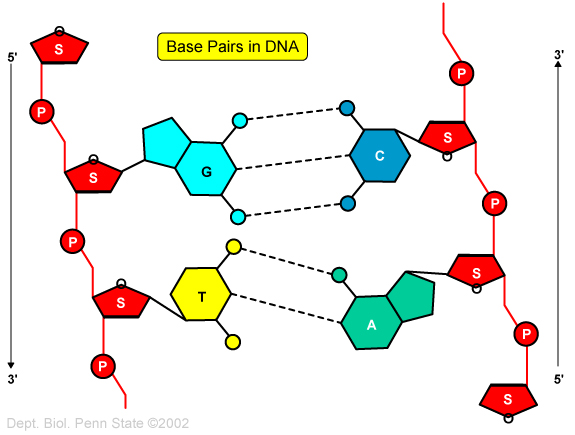
Which 2 molecules forms the sides (backbone) of the DNA ladder?
a)
deoxyribose and adenine
b)
deoxyribose and a hydrogen bond
c)
sugar and the nucleus
d)
deoxyribose (sugar) and phosphate
6.
Nitrogenous bases are joined by which type of bond?
a)
polar bonds
b)
ionic bonds
c)
covalent bonds
d)
hydrogen bonds
7.
The concept that DNA is made of two strands running in opposite directions is called:
a)
Antiparallel
b)
Isomerism
c)
Enantiomerism
d)
S/R Chirality
8.
What determines the code, or information, of a DNA molecule?
a)
the shape (structure) of the nitrogen bases
b)
the order (sequence) of the nitrogen bases
c)
the color of the nitrogen bases
d)
the frequency (number) of nitrogen bases
9.
A process in which DNA has the unique ability to make an exact copy of itself.
a)
Replication
b)
Translation
c)
Transcription
10.
Why does DNA replicate?
a)
To create another copy for the new cell
b)
To create a duplicate copy in case the original gets damaged
c)
To create a new copy to replace the damaged original
11.

DNA replication results in

a)

2 completely new DNA molecules

b)

2 DNA molecules that each contain one new strand and old daughter strand

c)

1 new DNA molecule and 1 old

d)

1 new molecule of DNA

12.

The picture below shows the steps of DNA replication beginning with step one and ending with step three.


​Because you are reusing the old, or parent, DNA strand DNA replication is said to be

a)

Semi- Conservative

b)

Semi-discontinuous

c)

Continuous

d)

Fully-Conserveative

13.

What are the steps of DNA Replication? (in order)

a)

Unwind, Unzip, Complementary Base Pairing

b)

Unzip, Unwind,

Complementary Base Pairing

c)

Transcription & Translation

d)

Translation & Transcription

14.
Which enzyme is responsible for adding nucleotides?
a)
Topoisomerase
b)
DNA Polymerase
c)
Ligase
d)
Primase
15.

Which enzyme is responsible for unzipping or the DNA molecule when replication begins?

a)

Helicase

b)

DNA breakase

c)

Primase

d)

DNA polymerase

16.
Based on the diagram, the enzyme (represented in gray) is most likely...
a)
DNA polymerase
b)
DNA Ligase
c)
Nuclease
d)
Helicase
17.
Replicate the following strand of DNA: 
AATCATGGA
a)
AATCATGGA
b)
TTAGTACCT
c)
UUAGUACCU
d)
GGATAUCUA
18.
Which of the following best defines a gene?
a)
A diploid cell containing two sets of chromosomes
b)
A unit made up of chromosomes that control for a specific trait
c)
A segment of DNA that codes for a particular protein
d)
All the other answers are correct.
19.

Which correctly outlined the "central dogma" of Protein Synthesis?

a)

DNA --> mRNA --> rRNA

b)

DNA --> tRNA --> protein

c)

DNA --> mRNA --> protein

d)

DNA --> amino acid --> protein

20.
In eukaryotes, molecule 1 is found in
a)
ribosomes
b)
chloroplasts
c)
cytoplasm
d)
the nucleus
21.
Which of the following statements is true?
a)
DNA is single-stranded
b)
RNA is single-stranded
c)
DNA contains uracil
d)
RNA contains deoxyribose
22.

In RNA the base T is replaced with

a)

U

b)

G

c)

C

d)

A

23.

The Process of creating RNA from DNA

a)

Transcription

b)

Translation

c)

Replication

24.
Which type of RNA takes the instructions from the nucleus to the cytoplasm?
a)
mRNA
b)
tRNA
c)
rRNA
d)
RNA polymerase
25.
What process is occurring in this photo?
a)
Transcription
b)
Translation
c)
mRNA is matching with amino acids
d)
tRNA is transcribing the DNA
26.
If a DNA strand reads ATT CGT CTA, what would the mRNA strand read?
a)
TAA GCA GAT
b)
CGA TGA GUT
c)
UAA GCA GAU
d)
TAA GCA GUT
27.

Why must transcription occur in the nucleus?

a)

because DNA can't leave the nucleus

b)

because ribosomes are in the nucleus

c)

because DNA polymerase is found there

d)

because helicase unzips the DNA

28.
Where does translation take place?
a)
in the nucleus
b)
at a ribosome in the cytoplasm
c)
at a mitochondria
d)
at a lysosome
29.

How many nucleotides make up a codon?

a)

1

b)

3

c)

5

d)

15

30.

What type of RNA is shown in this image?

a)

rRNA

b)

mRNA

c)

tRNA

31.
The anti-codon 
a)
contains a sequence the same as the codon
b)
contains a sequence complementary to the codon 
c)
contains the base thymine
32.
_______ is made during transcription and ________ is made during translation.
a)
mRNA / a protein
b)
a protein / mRNA
c)
Ribosome / Nucleus
d)
mRNA / tRNA
33.
What process is going on in this photo? 
a)
Transcription 
b)
Translation 
c)
Replication 
d)
All the above 
34.

When using your codon chart, what sequence can you use to find the correct amino acid?

a)

DNA

b)

mRNA

c)

tRNA

d)

Any of these will do

35.

A mutation is defined as:

a)

A change in the cell's structure

b)

Anything that changes in an embryo

c)

Any change in the physical features of a human

d)

A change in the DNA sequence

36.
What causes mutations?
a)
Mistakes in replication or environmental substances
b)
The amino acids
c)
Passed down by genetics
d)
It's how your born
37.

A mutation in which only one nucleotide is altered is called a:

a)

Frameshift Mutation

b)

Deletion Mutation

c)

Point Mutation

d)

Insertion Mutation

38.

Another name for a point mutation is:

a)

Substitution

b)

Frameshift

c)

Insertion

d)

Deletion

39.

Which type of mutation occurs when there is an addition or removal of a base?

a)

missense mutation

b)

nonsense mutation

c)

frameshift mutation

d)

point mutation

40.

What type of mutation is shown in the diagram?

a)

Point mutation - missense

b)

Frameshift Mutation - deletion

c)

Frameshift Mutation - addition

d)

Point mutation - nonsense

41.

What type of mutation is this?

a)

Nonsense mutation

b)

Missense mutation

c)

Silent mutation

d)

Frameshift mutation

42.

Occurs when the DNA change does not alter the amino acid sequence of the polypeptide.

a)

Frameshift Mutation

b)

Insertion

c)

Missense mutation

d)

Silent Mutation

43.

Genetic mutations can be...

a)

beneficial, harmful, or neutral

b)

beneficial only

c)

harmful only

d)

neutral only

44.
A type of substitution in which one amino acid changes is called 
a)
Nonsense
b)
Missense
c)
Silent
d)
all of the above
45.
A frameshift mutation can occur with either _________ or __________ mutations.
a)
Addition, division
b)
Deletion, substitution
c)
Addition, substitution
d)
Addition, deletion