
 Worksheets
Evidence for Evolution (Unit 7 Standard D)
Total questions: 12
Worksheet time: 18mins

Students analyzed several photosynthetic eukaryotic organisms in the laboratory to determine their phylogenetic relationships. The organisms were Spirogyra (a green alga), a moss, a spruce tree, and an apple tree. Table 1 compares several characteristics in the organisms ( + indicates the trait is present, − indicates the trait is absent). Which of the following rows of data listed in table 1 best supports the possibility of a common ancestor for the organisms listed there?
Vascular tissue
Seeds enclosed in fruit
Cell wall composed of cellulose
Flagellated sperm cells

Researchers studying the evolutionary relationships of three species of snails collected the data shown in Table 1. Which of the following data sets is most likely to provide reliable information about the evolutionary relationships among these three snail species?
Shell composition and shell orientation
Trophic level and DNA analysis
Location of fossils and shell orientation
Shell composition and location of fossils

Hemoglobin is a highly conserved protein used by all mammals to transport oxygen. Table 1 was constructed by comparing the amino acid sequence in the hemoglobin molecules from five different mammal species. Which of the following best describes the importance of the number of amino acid differences indicated in Table 1 ?
They reflect the different environments where the organisms were captured.
They reflect the number of base pair changes in the DNA .
They reflect random changes due to translation errors.
They reflect the number of oxygen molecules each hemoglobin molecule carries.

Researchers observed selected internal structures of four different microscopic organisms as part of a larger study on the divergence between eukaryotes and prokaryotes. Their observations are recorded in Figure 1. Which organism would the researchers most likely predict to be the most distantly related to eukaryotes?
Organism I
Organism II
Organism III
Organism IV

Figure 1 illustrates a process that occurs in a certain group of organisms. Which of the following best predicts the importance of this process?
This process is common to all members of Eukarya and allows noncoding regions of RNA to be removed so that proteins with the correct amino acid sequence are produced.
This process is common to all members of Archaea and allows these organisms to survive harsh environments.
This process is common to all organisms and is a conserved DNA repair mechanism.
This process is common to vertebrates and allows the production of large and complicated proteins.
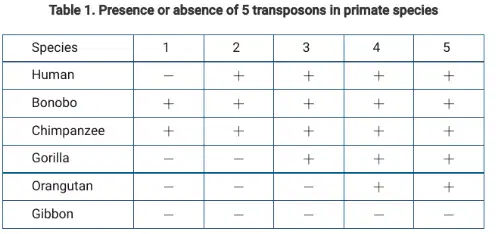
Transposable elements are significant features in the genomes of almost all eukaryotic organisms. The accumulation of these elements in various species can help determine their relatedness. Table 1 indicates the presence ( + ) or absence ( − ) of 5 segments of DNA that have been moved by transposition (transposons) in 6 primate species. Which of the following best predicts how phylogenetic relationships might be revised if transposon 1 was not found in chimpanzees?
Bonobos would be more closely related to humans than to chimpanzees.
Chimpanzees would be more closely related to humans than to bonobos.
Orangutans would be more closely related to humans than to chimpanzees.
Chimpanzees would be more closely related to gibbons than to gorillas.
Researchers examined the ability of cultures of the bacterium Pseudomonas aeruginosa to adapt to the antibiotics ceftazidime and avibactam when they are administered together. The researchers grew four replicate cultures in growth medium with no antibiotics added (control) and four additional replicate cultures in the same growth medium with added ceftazidime and avibactam. At the conclusion of the experiment, samples of the replicates exposed to the antibiotics were removed and their genomes were sequenced. All of the antibiotic-resistant mutants were missing three genes ( hmgA , galU , mexXY ). It is known that one of these three genes makes wild-type P. aeruginosa susceptible to the two antibiotics. However, the researchers do not know which gene it is. Which of the following experiments would specifically determine which gene is responsible for ceftazidime-avibactam sensitivity in P. aeruginosa ?
Clone the three deleted genes from a wild-type P. aeruginosa strain, and insert these sequences into the mutant bacterial strains to restore sensitivity to ceftazidime-avibactam.
Delete genes that are homologous to the three deleted genes in other bacterial species, and determine if doing so also confers ceftazidime-avibactam resistance in those bacteria.
Perform gene knockout (targeted mutation) of either the hmgA , galU , or mexXY gene on separate cultures of the wild-type P. aeruginosa. For each individual mutant, determine whether or not ceftazidime-avibactam resistance has occurred.
Perform gene knockout (targeted mutation) of both the hmgA and galU genes of the wild-type P. aeruginosa in a single culture, and then determine if ceftazidime-avibactam resistance has occurred in the mutant strain.
Low doses of antibiotics are often added to livestock feed to increase production. Studies have shown that bacterial populations constantly exposed to the sublethal doses can evolve resistance to the antibiotics. A research group claimed that when a population of bacteria are constantly exposed to sublethal doses of streptomycin, their fitness declines due to the increased energy requirements for survival in the presence of the antibiotic. For subsequent studies, the researchers wish to determine whether adding a low, sublethal dose of an additional antibiotic causes further decline in the fitness of the bacteria.
Which of the following best represents the next step the researchers should take with respect to experimental design?
Group 1: high dose of streptomycin + low dose of additional antibiotic
Group 2: low dose of streptomycin + high dose of additional antibiotic
Group 1: low dose of streptomycin + no dose of additional antibiotic
Group 2: low dose of streptomycin + low dose of additional antibiotic
Group 1: no dose of streptomycin + no dose of additional antibiotic
Group 2: low dose of streptomycin + low dose of additional antibiotic
Group 1: low dose of streptomycin + low dose of additional antibiotic
Group 2: high dose of streptomycin + high dose of additional antibiotic
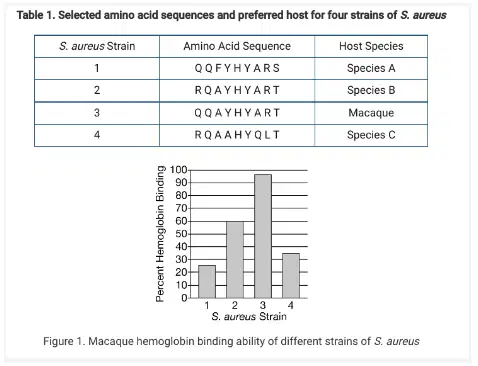
Staphylococcus aureus is a pathogenic bacterium that can infect a wide range of host species, including humans. S. aureus has a particular protein that binds with hemoglobin from the host organism. Hemoglobin is the iron-containing protein used to transport oxygen in the blood. Since iron is important for growth, S. aureus have evolved the ability to absorb the iron from the host's hemoglobin.
Different S. aureus strains preferentially infect different hosts and have different amino acid sequences at their hemoglobin-binding domains (Table 1; letters indicate different amino acids). In an experiment, different S. aureus strains were mixed with hemoglobin from macaque monkeys and their binding ability was measured (Figure 1). The differences in amino acid sequences contributed to the differential binding abilities observed. Which of the following experiments would be most appropriate to determine whether populations of S. aureus are continuously adapting in order to obtain iron from hosts more effectively?
Grow S. aureus in media with macaque hemoglobin and abundant free iron. Record bacterial growth over time and compare it to growth of the original population.
Culture S. aureus bacteria with hemoglobin from a mixture of host species. Then transfer the bacteria to media with a known effective antibiotic and record bacterial growth.
Sequence the genes of different S. aureus strains and construct a cladogram representing their relatedness.
Culture S. aureus bacteria with hemoglobin from a novel host species as the only source of iron for many generations, then compare protein structure from bacteria in this culture with bacteria from the original culture.
A scientist is attempting to provide support for the hypothesis that RNA was the first genetic material. Which of the following would be a workable alternate hypothesis?
RNA , like DNA , is a carrier of genetic information and contains the nitrogen bases adenine, guanine, and cytosine.
RNA can be observed to self-replicate without the assistance of proteins, while DNA always requires protein-based enzymes to replicate.
RNA exists in both single-stranded and double-stranded configurations; however, it is less stable compared with DNA .
Transfer RNA and ribosomal RNA are products of transcription, but they are not translated as is mRNA .
Dr. Robert Hazen has worked to develop a hypothesis that explains the origin of life on Earth. His work has focused on hydrothermal vents, which are cracks in the ocean floor. Water heated by molten rock beneath the crust escapes from these vents at very high temperatures, producing hot, high‑pressure environments at the vents on the ocean floor.
In order to provide evidence that these vents may be areas where life originated, which of the following states a null hypothesis Hazen might have used to begin his research?
Organic molecules were transported to the hydrothermal vents via a meteorite, thereby seeding them with precursors for more complex molecules.
The temperatures and pressures found in hydrothermal vents resemble conditions described in currently accepted origins of life hypotheses.
Organic waste sinking to the ocean floor would have used the unique hot water environment as an energy source to begin manufacturing food.
Chemosynthetic organisms can best develop in the hydrothermal environment, manufacturing nutrients for other living things to feed on.
Many scientists claim that the synthesis of the first organic molecules from inorganic precursors was possible because of the highly reducing atmosphere found on primitive Earth.
Which of the following is an appropriate null hypothesis that could be used when investigating the claim?
The level of atmospheric oxygen on modern Earth is significantly higher than on primitive Earth.
Organic molecules were transported to primitive Earth by a meteorite or other celestial event.
The synthesis of organic molecules from inorganic molecules is possible under current atmospheric oxygen levels as well as those found on primitive Earth.

