
 Worksheets
IGCSE Rates of Reaction
Total questions: 15
Worksheet time: 9mins
Why does a higher temperature increase the rate of a reaction?
it increases both the frequency and energy of particle collisions
it only increases the frequency of particle collisions
it only increases the energy of particle collisions
it reduces the activation energy of the reaction
Grinding a effervescent tablet into powder increases the rate of reaction due to increased
concentration
surface area
temperature
reactants
Adding a catalyst ___________ the activation energy.
Raises
Lowers
Doesn't affect
Inreases
The minimum amount of energy needed for colliding particles to react is called
Chemical Energy
Kinetic Energy
Activation Energy
Potential Energy
Why does a higher concentration increase the rate of reaction?
it increases the amount of reactants
it lowers the activation energy
it increases the energy of particle collisions
it increases the frequency of particle collisions
Why does a higher temperature increase the rate of a reaction?
it increases both the frequency and energy of particle collisions
it only increases the frequency of particle collisions
it only increases the energy of particle collisions
it reduces the activation energy of the reaction
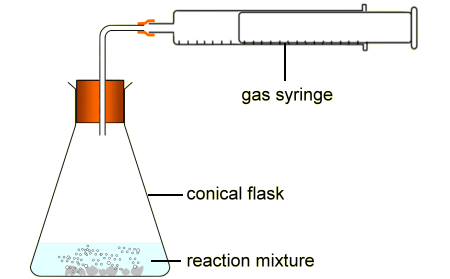
How is this equipment being used to measure the rate of reaction?
The gas syringe measures how much gas is produced in a certain time
The reaction mixture will increase in volume in a certain time

The rates of some chemical reactions can be measured by using the apparatus shown. For which reaction is this apparatus suitable?
MgCO3 + 2HCl -> MgCl2 + CO2 + H2O
Mg + ZnCl2 -> MgCl2 + Zn
MgCl2 + 2NaOH -> Mg(OH)2 + 2NaCl
MgO + 2HCl -> MgCl2 + H2O
When you react sodium thiosulfate and hydrochloric acid, the solution turns cloudy. This is because...
a sodium precipitate is produced
a sulfur precipitate is produced

Which solution show a higher concentration (left or right)?
left
right
both the same
The more concentrated the sodium thiosulfate solution, the less time is taken for the cross to become no longer visible. Give two reasons why.
Particles are more spread out
Particles collide more frequently
Particles have more energy
Particles move more quickly
There are more particles in a fixed volume

