wayground logo

Free Printable Worksheets

NEW

Font size

S
M
L
XL
Worksheets

Absolute Monarchy in England

Total questions: 33

Worksheet time: 20mins

Name
Class
Date
1.

English civil war took place between

a)

Charles I and Parliament

b)

James I and Parliament

c)

Charles 1 and James 1

d)

England and Ireland

2.

Bloodless Revolution is also known as

a)

Glorious Revolution

b)

socialist revolution

c)

communist revolution

d)

none of these

3.

Why did parliament fear the restoration of James II?

a)

He vowed to persecute all Protestants

b)

He had a male heir who would rule as a Catholic after him

c)

He was young and promised to reign for several decades

d)

He had a large, personal army

4.
What religion was King James II?
a)
Protestant
b)
Catholic
c)
Mormon
d)
Buddhist
5.
What did William and Mary  agree to sign that placed limits on their power as King and Queen?
a)
English Bill of Rights
b)
Petition of Rights
c)
Magna Carta
d)
Declaration of Indpendence
6.
What is the result of the signing of the English Bill of Rights?
a)
The monarch had to share power with Parliament
b)
Monarchs began ruling by divine right
c)
English citizens had fewer individual rights
d)
England became an unlimited government
7.
What is the significance of the English Bill of Rights?
a)
England became a constitutional monarchy
b)
England became a dictatorship
c)
William and Mary were publicly executed
d)
James II returned to England and reclaimed the throne
8.
What is the Glorious Revolution?
a)
The overthrow of James II
b)
Members of Parliament limiting the power of the king
c)
Charles I arresting members of Parliament
d)
The coronation of Mary and William
9.
What is a constitutional monarchy?
a)
A government in which a king or queen are limited by the law
b)
A government in which the king or queen has full and absolute power 
c)
A government in which all citizens are allowed to vote for representives
d)
A government in which all citizens are allowed to vote directly on issues
10.
Who ascended to throne during the Glorious Revolution?
a)
Louis XIV
b)
Charles I
c)
James II
d)
William and Mary
11.
What is the correct chronological order of events in English history?
a)
The Glorious Revolution-The Restoration- The English Civil War
b)
The English Civil War- The Glorious Revolution-The Restoration
c)
The English Civil War-The Restoration-The Glorious Revolution
d)
The Restoration-The English Civil War- The Glorious Revolution
12.
Which of the following would best describe the rule of Oliver Cromwell after the English Civil War?
a)
He was extremely popular with the majority of the people.
b)
He established a multitude of reforms that gave Parliament almost unlimited power.
c)
Many of his limits on freedoms were greatly disliked and he led as a military dictator.
d)
He gave Parliament almost unlimited power.
13.

What did the document known as the Petition of Right try to do to the king's power?

a)

Give the king total power

b)

Give the king NO power

c)

Limit the king of England's power

d)

Let the king decide how to rule

14.

Why was is called The Glorious Revolution?

a)

only soldiers die, not civilians.

b)

it was a political upheaval in which the ruling class is removed from power by the common people

c)

it was a transfer of power between rulers without a war and deaths

d)

King James II was a bloodthirsty king who was removed quietly

15.

Parliament forced Charles I to sign __________________ but he would not honor it.

a)

Petition of Reason

b)

Bill of Rights

c)

Petition of Right

d)

Triennial Act

16.

What charge was laid against Charles I at his trail

a)

Adultery

b)

Blasphemy

c)

Treason

d)

Bribery

17.
This unpopular monarch was the reason for the English Civil War
a)
Edward I
b)
Charles I
c)
Charles II
d)
James I
18.

After King Charles I is beheaded, who becomes the dictator of England?

a)

Oliver Cromwell

b)

William & Mary

c)

Charles I

d)

Peter the Great

19.

Who takes the throne during the Glorious Revolution?

a)

Maximilian Robespierre

b)

James II

c)

Prince Henry

d)

William & Mary

20.
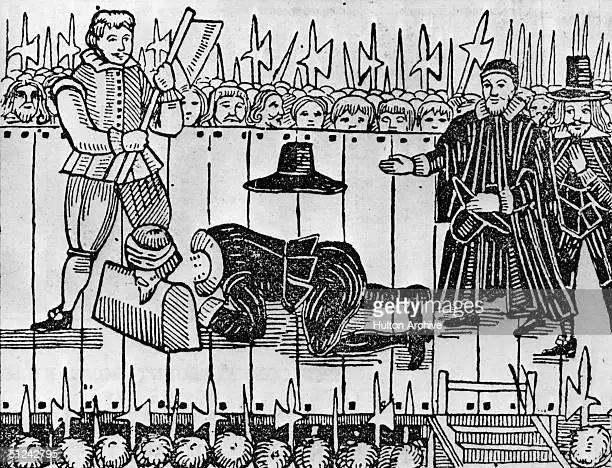
What happened to King Charles I after the English Civil War?
a)
He was put on trial, found guilty and executed
b)
He was punished by a  citizen army
c)
He was sentenced to house arrest for the remainder of his life
d)
He was exiled to an island off the coast of Spain.
21.

The period of Charles II's rule over England, after the collapse of Oliver Cromwell's government is known as the

a)

Restoration

b)

Thirty Years' War

c)

Renaissance

d)

Cabinet

22.

Who succeeded Elizabeth I?

a)

James I

b)

Charles I

c)

Mary I

23.

James I was ruling England and

a)

Wales

b)

Scotland

24.

Oliver Cromwell persecuted

a)

Irish

b)

Scots

25.

Oliver Cromwell took title of

a)

Lord Protector

b)

Lord Dictator

26.

Petition of Rights banned quartering of soldiers in private houses.

a)

yes

b)

no

27.

Charles II signed

a)

Petition of Rights

b)

Bill of Rights

c)

Habeas Corpus

28.

Royalists were supporters of

a)

Charles I

b)

Oliver Cromwell

29.

Who tried to force Scots to convert into Anglicanism?

a)

James I

b)

Charles I

c)

Charles II

30.

The right to be found guilty only by decision of court is

a)

Perpetua mobile

b)

habeas corpus

31.
a)

Charles I

b)

Charles II

32.

Members of Parliament who opposed king

a)

Puritans

b)

Pilgrims

33.

Petition of Rights gave power to levy taxes to

a)

king

b)

Parliament