Wayground logo

Free Printable Worksheets

Font size

S
M
L
XL
Worksheets

Grade 8 - Diversity of Life

Total questions: 38

Worksheet time: 32mins

Name
Class
Date
1.

Which is an input for cellular respiration?

a)

Oxygen

b)

Light

c)

Energy

d)

Carbon dioxide

2.

6CO2 + 6H2O ® C6H12O6 + 6O2

This chemical equation describes:

a)

Cellular respiration

b)

Glycolysis

c)

Photosynthesis

d)

Photolysis

e)

Electron Transport Chain

3.

Photosynthesis is to chloroplasts as cellular respiration is to

a)

chloroplast

b)

cytoplasm

c)

mitochondria

d)

nucleus

4.

Which process uses sunlight?

a)

cellular respiration

b)

photosynthesis

5.

Which process makes glucose?

a)

cellular respiration

b)

photosynthesis

6.

Cellular respiration occurs in both animal and plant cells.

a)

true

b)

false

7.

What role does sunlight play in photosynthesis?

a)

evaporation

b)

energy

c)

does not play a role

d)

warmth

8.

What are the inputs (reactants) of photosynthesis?

a)

carbon dioxide, water, sunlight

b)

oxygen and glucose

c)

soil and nutrients

d)

sugar and yeast

9.

Which of the following is the best description of the process photosynthesis?

a)

Water, oxygen, and light are inputs while carbon dioxide and glucose are outputs

b)

Water, oxygen, carbon dioxide, and light are inputs and glucose is the output.

c)

Water, carbon dioxide, and light are inputs while oxygen and glucose are outputs.

d)

Glucose, oxygen, and light are inputs while carbon dioxide and water are outputs.

10.
The process by which sugar is converted into energy (ATP) by living organisms is called
a)
photosynthesis
b)
cellular respiration
11.
The products of cellular respiration are
a)
carbon dioxide, water, energy
b)
oxygen and sugar (glucose)
12.
The products of photosynthesis are
a)
carbon dioxide, water, energy
b)
sugar (glucose), oxygen, water
13.
The green pigment in plants is called
a)
melanin
b)
chlorophyll
14.

In which cell organelle does PHOTOSYNTHESIS take place?

a)

The chloroplast

b)

The mitochondria

c)

The cytoplasm

d)

The golgi apparatus

15.

Where in the cell does cellular respiration take place?

a)

The chloroplasts

b)

The golgi apparatus

c)

The mitochondria

d)

The cell wall

16.

True of False, Plants can perform Cellular Respiration and Photosynthesis

a)

False

b)

True

17.

Which of the following statements about chromosomes is correct?

a)

Chromosomes are long, thread-like structures

b)

Chromosomes are found in the nucleus of all cells in the human body

c)

Chromosomes contain DNA

d)

All of the above

18.

How many chromosomes are found in each cell of your body (excluding gametes)?

a)

46

b)

23

c)

40

d)

36

19.
What is the relationship between DNA and chromosomes?
a)
Chromosomes are made of DNA
b)
DNA is made of chromosomes
c)
DNA and chromosomes are the same thing.
d)
All of the above are correct
20.
A __________ is a segment of DNA that codes for a particular protein, which leads to a particular trait.
a)
Gene
b)
Allele
c)
Codon
d)
Nucleotide
21.

Why are your chromosomes arranged in pairs?

a)

Because DNA is double stranded.

b)

Because paired chromosome can divide easier.

c)

Because you get one from your mom and one from your dad.

d)

None of the above

22.
In which case would a cell most likely shrink?
a)
when placed in a solution containing a high salt concentration
b)
when placed in a isotonic solution
c)
when placed in a solution containing a low pH
d)
when placed in a solution containing distilled water
23.
A student noticed that placing wilted lettuce in a bowl of cool water caused the lettuce to become more crisp and firm. What is the best explanation for his observation?
a)
Water moved into the lettuce cells by active transport.
b)
Water moved into the lettuce cells by osmosis.
c)
Salt moved into the lettuce cells by diffusion.
d)
Water moved out of the lettuce cells by osmosis.
24.
Where will the water go?
a)
Into the cell
b)
Out of the cell
c)
Equally in & out - it's isotonic
d)
There is no water
25.
What is diffusion?
a)
when molecules move from a low concentration to a high concentration 
b)
when molecules move from a high concentration to a low concentration.
c)
no movement 
d)
molecules move everywhere
26.
Where is there a high concentration of bbq smoke?
a)
In the bbq pit
b)
In the house
c)
Two streets over
d)
In the atmosphere
27.
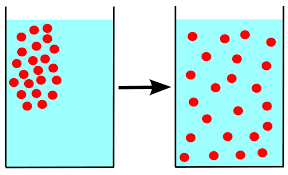
The picture below is an example of _________________.
a)
osmosis
b)
isotonic
c)
diffusion
d)
active transport
28.
Osmosis is the movement of _____ across a membrane.
a)
food
b)
energy
c)
oxygen
d)
water
29.
Equilibrium?
a)
a large  amount of substance on  side of the cell and a small amount on the other side
b)
a small  amount of substance on  side of the cell and a large amount on the otherside
c)
equal amount of substance on either side of the membrane  
d)
no particles on either side of the a cell membrane
30.
Which way will the water molecules move during osmosis?
a)
Out of the cell, so the cell shrinks.
b)
Out of the cell, so the cell swells.
c)
Into the cell, so the cell shrinks.
d)
Into the cell, so the cell swells.
31.
Ideally, your cells should be in a(n) _______ solution
a)
isotonic
b)
hypertonic
c)
hypotonic
d)
isometric
32.
Why can't you drink salt water?
a)
It's hypertonic to your cells
b)
It's hypotonic to your cells
c)
It's isotonic to your cells
d)
It's paratonic to your cells
33.
What type of solution is this cell in?
a)
Isotonic
b)
Hypertonic
c)
Hypotonic
d)
diffused
34.
What type of solution is this cell in?
a)
Isotonic
b)
Hypertonic
c)
Hypotonic
d)
diffused
35.
What type of solution is this cell in?
a)
Isotonic
b)
Hypertonic
c)
Hypotonic
d)
diffused
36.

A cell has 80% water 20% solute, the surrounding solution has 60% water and 40% solute. What type of solution is this?

a)

Hypertonic

b)

Isotonic

c)

Hypotonic

d)

Equilibrium

37.
You put a cell into a solution, the cell grows. Is the solution hypotonic or hypertonic to the cell? 
a)
hypertonic
b)
hypotonic
c)
isotonic
d)
not enough information
38.
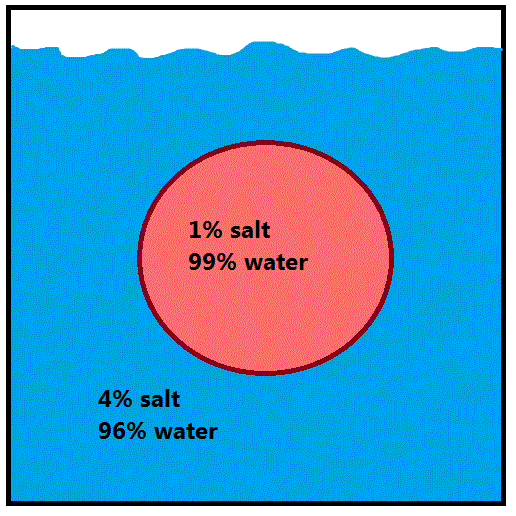
The cell below is in a _____________ solution.
a)
Hypertonic
b)
Hypotonic
c)
Isotonic