
 Worksheets
AP HuG Chapter 8 Political Geography
Total questions: 95
Worksheet time: 48mins
The world's largest state is
China.
Canada.
Russia.
Alaska.
India.
Extremely small island-states in the world, many of which are former European colonies, are called
island nations.
macrostates.
microstates.
small nation-states.
island-colonies.
The world's smallest state is
Monaco.
Bahrain.
Andorra.
Vatican City.
Tuvalu.
An area organized into an independent political unit is a
colony.
nationality.
nation.
state.
territory.
The best example of a state among the following is
an island with a long history of self-rule and a homogeneous ethnic identity, although the island has been under the control of a colonial power for the last 30 years.
a group of islands inhabited by a homogeneous ethnicity, although the westernmost islands pertain to the territory of one country whereas the easternmost islands pertain to another country.
a mountainous region inhabited by heterogeneous ethnicities and divided up administratively among various independent countries.
a mountainous region inhabited by heterogeneous ethnicities which share responsibility for maintaining an independent government and a standing army
a mountainous region inhabited by a mixture of peoples but recently colonized by a European nation-state.
This country has built a sand wall around the disputed Sahrawi Republic.
Mauritania
Mali
Malawi
Mozambique
Morocco
The Senkaku/Diaoyu Islands represent the contested sovereignty of these three nations.
The Philippines, Indonesia, Australia
Japan, Russia, The People's Republic of China
The People's Republic of China, the Republic of China (Taiwan), Japan
The People's Republic of China, the Republic of China (Taiwan), Australia
The People's Republic of China, the Republic of China (Taiwan), Russia
These two countries are committed to unifying the nation but face disagreement as to which will be the dominant political and economic ideology.
North and South Vietnam
Moldova and Romania
Lesotho and the Republic of South Africa
Morocco and Sahrawi Republic
North and South Korea
Korea is a good example of a(n)
sovereign state.
nation-state existing in a unified condition.
ethnicity divided between more than one state.
colony divided between more than one ethnicity.
patron-state.
A state with control over its internal affairs has
centripetal forces.
nationality.
suffrage.
sovereignty.
ethnicity.
) This is a sovereign state that comprises an urban area and the surrounding countryside.
rural-state
nation-state
city-state
primate-state
homogeneous state
The Fertile Crescent
followed the Nile and Euphrates rivers.
was the key to the Roman Empire in classical times.
was the location of the first city-states in the Middle East and the first large-scale agricultural projects of Sub-Saharan Africa.
is sometimes considered to have extended from the Nile Valley to the Atlas Mountains.
extended from the Persian Gulf to the Mediterranean Sea and was the location of the first city-states in the Middle East.
The first states in ancient Mesopotamia were
city-states, which incorporated cities as well as their countryside.
colonies, which incorporated cities as well as their countryside.
empires, which incorporated dozens of unified colonies.
nation-states, which incorporated city-states, colonies, and empires.
patron-states ruled by sheiks.
Political unity in the ancient Mediterranean world reached its height in
the Fertile Crescent.
Egypt.
the Roman Empire.
the Alexandrian Empire.
Western Europe.
The first widespread use of the nation-state concept came in
Mesopotamia.
the Roman Empire.
Western Europe.
the United States.
Southeast Asia.
Examples of major nation-states are
Germany and Denmark.
Australia and New Zealand.
Russia and the United States.
Mexico and Russia.
Mexico and Germany.
The concept that ethnicities have the right to govern themselves is known as
centripetal determination.
nationalism.
universal suffrage.
self determination.
sovereignty.
Among the world's largest multinational states are
Russia and the United States.
Australia and New Zealand.
Japan and Denmark.
Mexico and Russia.
Mexico and Japan.
A(n) ________ is a state that contains more than one ethnicity with traditions of selfdetermination and self-government. A) B) C) D) E) Answer: B
multinational state
anocracy
city-state
fragile state
multi-linguistic state
This European country was divided post-World War II into a Democratic Republic and a Federal Republic.
the United Kingdom
Czechoslovakia
Yugoslavia
Germany
Poland
This country is recognized as one of the most ethnically homogeneous in the world.
Japan
China
India
Bangladesh
Taiwan
The republics of the former Soviet Union were established based on
economic contributions.
national resources.
ethnic lines.
religious values.
linguistic lines.
The dissolution of the Soviet Union in 1991 resulted in five groups of independent states, Russia and all but which of the following?
Baltic States (Estonia, Latvia, Lithuania)
Russia's western European states (Belarus, Moldova, and Ukraine)
Russia's central European States (Czechoslovakia, Hungary, and Romania)
Central Asian states (Kazakhstan, Kyrgyzstan, Tajikistan, Uzbekistan, Turkmenistan)
Caucasus states (Azerbaijan, Armenia, Georgia)
) Russia, today, recognizes ________ different ethnicities within its political borders.
100
79
50
39
19
Which of the following is NOT true about Russia's multiethnic state?
Nineteen percent of its population is made up of 39 different ethnicities.
Many ethnic groups are located along the borders such as those with Mongolia and the Caucasus states.
Uralic speaking ethnicities are concentrated in the region between the Ural Mountains and the Volga River.
Russia's constitution grants autonomy in local governance to the majority of its ethnic population.
Russia prohibits secondary official languages to ensure Russian remains pure.
The conflict in the Ukraine started as a result of
Russia's interest in Ukraine's coal deposits.
Russia's interest in Ukraine's Black Sea tourist industry.
ignoring early signs of the Chernobyl disaster in the 1980s
the Russian minority declaring they were endangered in Ukraine.
Russia's interest in Crimea's oil deposits.
Moldova, after it became an autonomous republic sought ethnic reunification with
Bulgaria.
Hungary.
Austria.
Romania.
Slovenia.
The Trans-Dniestria
a bridge spanning the Dniester River linking Moldova and Russia.
a manufacturing region Russia controls.
a Free Trade Zone operated by the Ukraine.
a sliver of land on the east bank of the Dniester River in Moldova occupied largely by Russians and Ukrainians.
a Belarussian plain.
Which of the following is NOT true about the Baltic States?
Lithuanians are largely Roman Catholic.
Latvians are largely Lutheran with a significant minority Roman Catholic.
Most Estonians are Protestant.
In all three states, Russian has remained the official language.
Balto-Slavic and Uralic languages are the official languages in these states.
Which country has experienced the most extreme "balkanization" since the dissolution of the Soviet Union?
Armenia
Georgia
Azerbaijan
Moldova
Belarus
Which of the following countries has suffered in the twenty-first century from ethnic cleansing?
Kazakhstan
Uzbekistan
Tajikistan
Kyrgyzstan
Turkmenistan
Which country suffered from genocide in the early twentieth century by the Turks?
Azerbaijan
Armenia
Georgia
Nagorno-Karabakh
South Ossetia
Nagorno-Karabakh is an ethnic enclave of ________ in ________.
Georgia; Russia
Moldova; Romania
Armenia; Azerbaijan
Azerbaijan; Georgia
Armenia; Georgia
A territory tied to a state rather than being completely independent is a
nation.
state.
nation-state.
colony.
patron-state.
The attempt by one country to impose political control over another territory is
colonialism.
constitutionality.
self-determination.
sovereignty.
suffrage.
The motives of European states in establishing colonies can be summarized as all but which of the following?
God
glory
guilt
gold
power
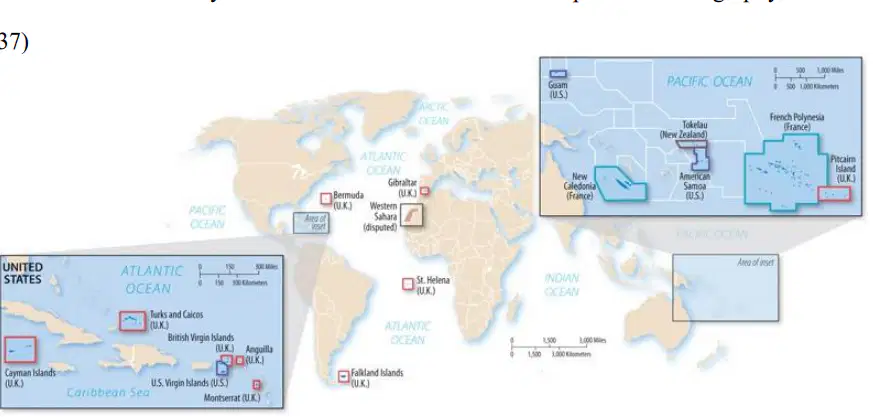
Using the above map, which of the following is a small British colony in the Pacific Ocean?
Hong Kong
Pitcairn
Puerto Rico
San Marino
St. Lucia
The least populated remaining colony is ruled by
the United States.
the United Kingdom.
France.
China.
the Netherlands.
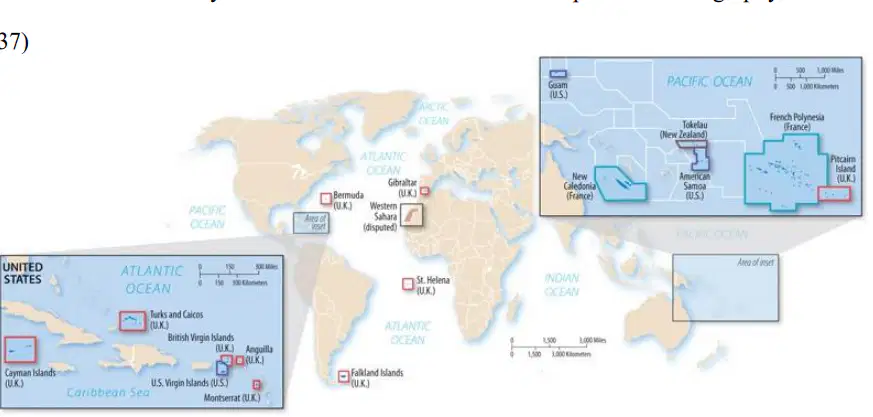
Using the above map, the U.S. colony located east of the Philippines is
Palmyra.
Guam.
Jarvis Island.
Puerto Rico.
the U.S. Virgin Islands.
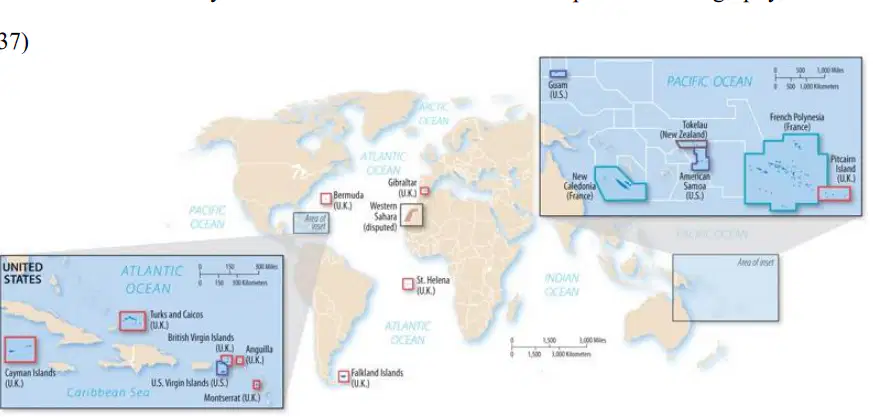
Using the above map, the U.S. colony located west of the British Virgin Islands is
Palmyra
Guam.
Jarvis Island.
Puerto Rico.
the U.S. Virgin Islands.
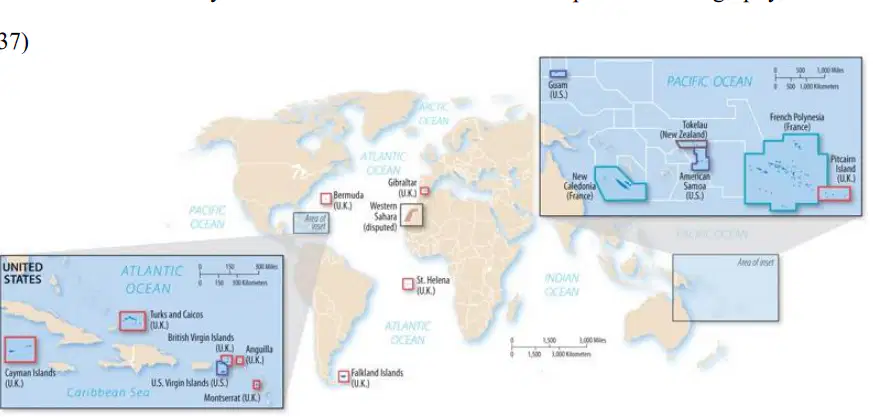
Using the above map, the British colony to the west of Angola is
Anguila.
the Falkland Islands.
Gibraltar.
Saint Helena.
the British Virgin Islands.
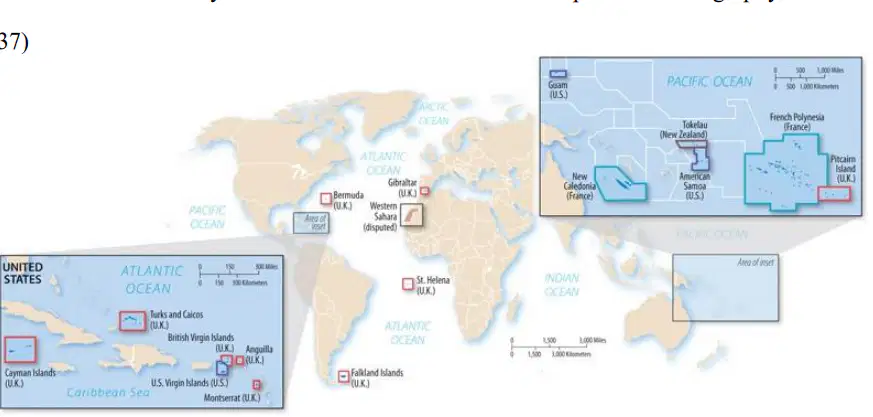
Using the above map, the British colony east of Argentina is
Gibraltar.
Saint Helena.
the British Virgin Islands.
the Falkland Islands.
Anguila.
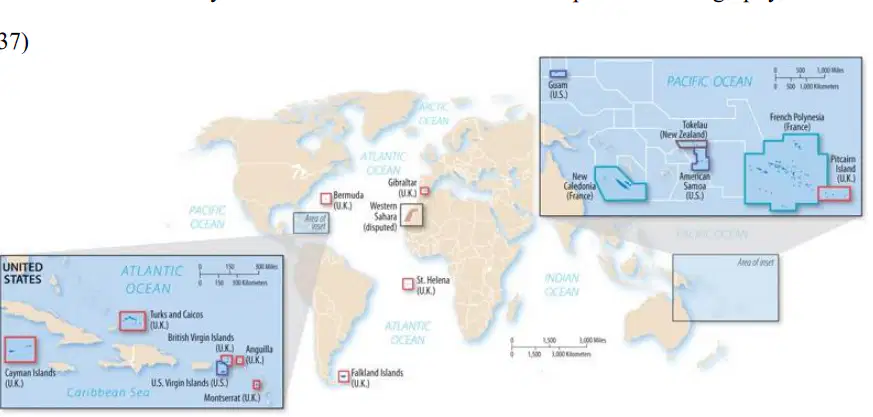
Using the above map, the French colony northwest of the Pitcairn Islands is
Aruba.
the Cook Islands.
Kingman Reef.
French Polynesia.
Clipperton Island.
A frontier, in contrast to a boundary,
separates two states.
is an area rather than a line.
has become a more common means to separate states.
is a region of ethnic conflict.
is the westernmost part of a state.
Cultural boundaries include all but which of the following?
ethnic
geometric
religious
linguistic
geomorphic
The difference between a frontier and a boundary is
a frontier is a tangible geographic area where a boundary is an infinitely thin line.
a frontier is uninhabited and a boundary is densely populated.
a frontier is controlled by state coalitions while a boundary is controlled by one state.
a frontier marks the ends of a territory while a boundary is dynamic in its representation of territory.
most boundaries have been replaced by frontier zones.
This type of boundary coincides with significant features of the landscape.
geometric
cultural
physical
relic
linguistic
What was an important cultural characteristic of boundaries in nineteenth century France, Spain, and Portugal?
religion
economics
kingdoms
language
mountains
This island's capital is the only capital city in the world divided by an international ethnic boundary.
Crete
Sardinia
Sicily
Cyprus
Ireland
Cyprus
is not a member of the European Union.
allows for easy integration of Greeks and Turks.
has a northern section that is recognized by the UN as the Turkish Republic of Northern Cyprus.
has a non-Greek, non-Turkish official language.
has a UN Peacekeeping force patrolling the buffer zone.
The problems experienced by Cyprus during the past four decades include all but which of the following?
a Greek-inspired military coup
a Turkish army invasion
a partition of the island by the British as part of independence
an increasing spatial segregation of Greeks and Turks
division of the capital city by a buffer zone patrolled by UN soldiers
The only large land mass NOT part of a sovereign state is
Antarctica.
the Arctic.
Greenland.
Siberia.
Borneo.
What might be the contemporary basis for conflicting claims to the Arctic?
potential for energy resources
old Cold War grudges
colonial expansion
shifting sea ice formations
the proximity of South American and African countries
The U.S.-Canadian border was established
in its entirety by the Oregon Treaty of 1846.
in its entirety along the 45th parallel.
s an isogloss demarcating speech variations between Canada and the United States.
without longitudinal geometric borders.
through a series of treaties between the United States and the United Kingdom.
The boundary between the United States and Canada is best described by which of the following?
geometric only
linguistic and religious
water and linguistic
mountain and water
water and geometric

The conflict over the Aozou Strip involved
centripetal forces acting in the absence of any centrifugal forces.
a disputed border and Egypt's claims of sovereignty over the zone.
a disagreement regarding suffrage and a disputed border.
a disputed border and Libya's claims of sovereignty over the zone.
Aozou attempts to join the United Nations as a sovereign nation-state.
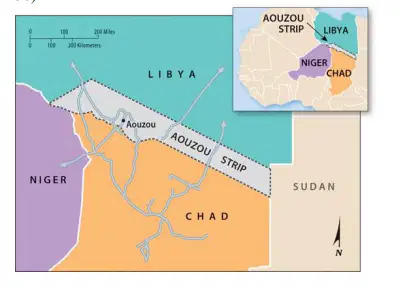
Using the above map, observe that the Aozou Strip
is a zone of conflict between Russia and its neighbors in the Caucasus region.
exists because of Egypt's past invasions of the Sinai Peninsula.
disappeared when the disputed border between Egypt and Libya was overrun.
is a disputed zone that abuts Niger on the west and Sudan on the east.
forms an elongated strip of disputed land between Chad and Egypt.
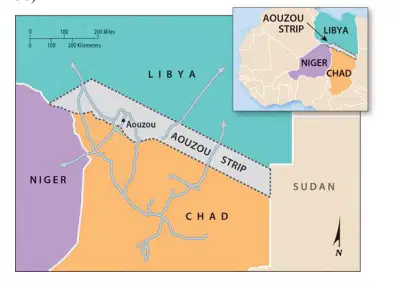
Using the above map, observe that the shape and size of the Aozou Strip make it an example of a
prorupted boundary.
physical boundary.
geometric boundary.
mathematical frontier.
perforated frontier.
A feature of the physical environment commonly used to separate states includes all but which of the following?
deserts
geometry
mountains
lakes
rivers
The boundary between Argentina and Chile is an example of a
prorupted boundary.
geometric boundary.
physical boundary.
cultural frontier.
perforated frontier.
The eastern part of the border between the United States and Mexico is delineated by
the Rio Grande.
the Gulf of Mexico.
the Mojave desert.
the Mississippi River.
the Rocky Mountains.
The role of the International Boundary and Water Commission run by the U.S. and Mexican governments is to
restore the original border agreement intent by physically altering the flow of the Rio Grande.
replace physical boundaries with geometric boundaries to simplify immigration processes.
build a wall between the two countries.
ensure pollution controls and water sustainability.
renegotiate borders after the Rio Grande changes course.
Which is NOT true about the Law of the Sea?
It identifies territorial waters up to 12 nautical miles as under state control.
It identifies international waters as having no single state control.
It identifies internal shoreline waters as international to ensure free trade.
It identifies the exclusive economic zone as a zone of state exploitation of resources such as fish and oil.
It identifies a contiguous zone in which a state may enforce pollution controls and levy taxes for its use.
) The Germans established the ________ known as the Caprivi Strip in present-day Namibia to access resources in central Africa, including the Zambezi River.
causeway
disruption zone
railroad
protraction
proruption
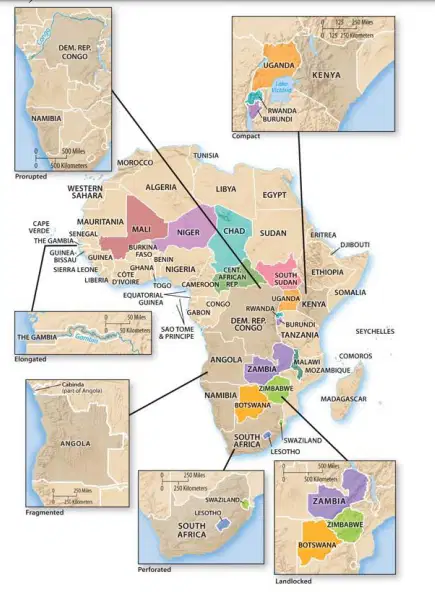
Using the above map, which African country has an elongated shape?
Central African Republic
Algeria
Malawi
Sudan
Libya
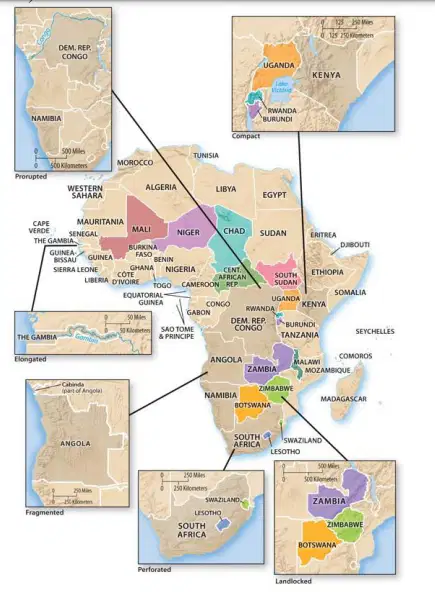
Using the above map, which African country has a prorupted shape?
Algeria
Lesotho
Democratic Republic of Congo
the Gambia
São Tome and Principe
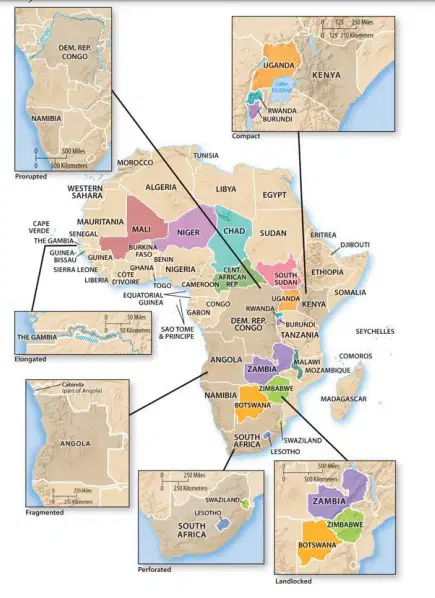
Using the above map, which African country has an elongated shape?
the Gambia
Ethiopia
Zambia
Niger
Kenya
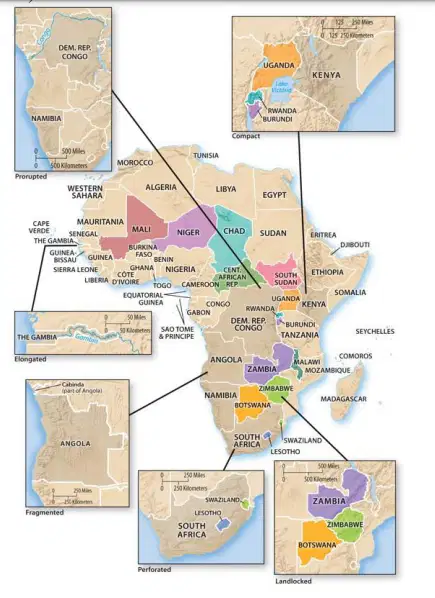
Using the above map, Swaziland makes ________ into a perforated state.
Madagascar
Mozambique
South Sudan
South Africa
Zimbabwe

Using the above map, which African country is the most fragmented state?
Namibia
Tanzania
Somalia
Madagascar
Gabon
) Elongated states may suffer from poor internal communication and difficulty defending borders. Which of the following is NOT an elongated state?
Malawi
Gambia
Botswana
Chile
Italy
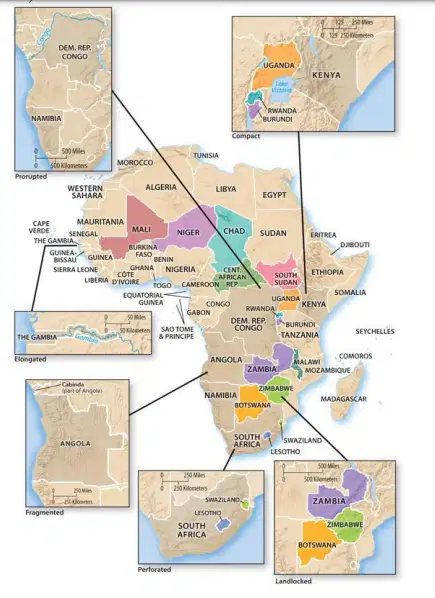
Using the above map, which African country is a NOT a fragmented state?
South Africa
Comoros
Equatorial Guinea
Tanzania
Zambia
Which shape most easily fosters the establishment of effective internal communications for a smaller state?
compact
elongated
fragmented
prorupted
prolonged
) Democracies and autocracies differ in three essential ways; they are
longevity of regime, citizen participation, and adoption of free market economies.
selection of leaders, citizen participation, and checks and balances.
longevity of regime, selection of leaders, and checks and balances.
selection of leaders, adoption of free market economies, checks and balances.
longevity of regime, checks and balances, membership in the United Nations.
Sub-Saharan Africa's fragile states' status may be attributed to all but which of the following?
high population growth and poor health
extreme poverty
alignment with the Soviet Union during the Cold War
ethnic tensions and ethnic cleansing
problematic shapes

Using the above map, what do South Sudan, Libya, and the Central Africa Republic have in common?
They are landlocked.
They are poor nations.
They are recently independent nations.
They are fragile states.
They have experienced repercussions of U.S. Cold War involvement.
Which of the following democracies represents a unitary state in which power is concentrated in the hands of the central government?
India
France
South Africa
Russia
the United States
Which of the following countries represents a federal state in which power is allocated to local governments?
Rwanda
France
Kenya
China
Brazil
A state which places most power in the hands of a central government is a(n)
federal state.
anocratic state.
fragmented state.
unitary state.
compact state.
A country that is not fully autocratic or democratic is defined as a(n)
bureaucracy.
totalitarian state.
kleptocracy.
plutocracy.
anocracy.
Which of the following democracies represents a unitary state in which power is concentrated in the hands of the central government?
India
France
South Africa
Russia
the United States
) An increasing number of states have adopted a federal form of government primarily to
grant different ethnicities or nationalities more effective representation.
encourage the breakup of the superpower alliances.
govern compact states more effectively.
deploy scarce resources efficiently.
accommodate rightwing political parties and their demands for more representation in national elections.
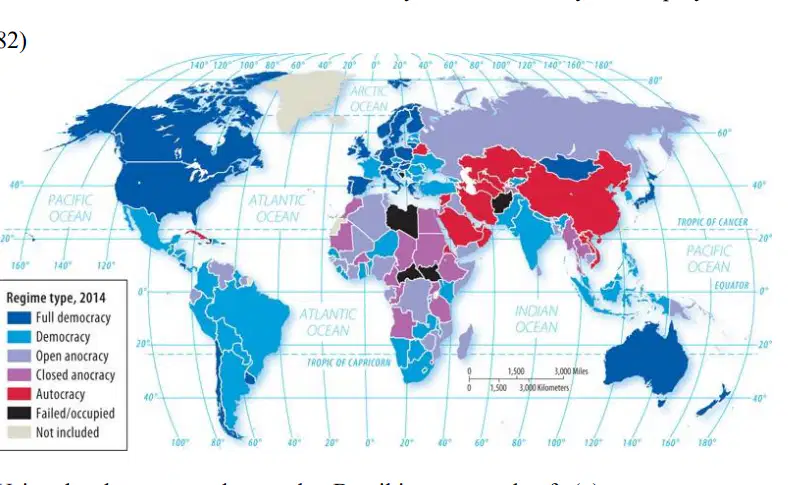
Using the above map, observe that Brazil is an example of a(n)
full democracy.
democracy.
open anocracy.
closed anocracy.
autocracy

Using the above map, observe that Spain is an example of a(n)
full democracy.
democracy.
open anocracy.
closed anocracy.
autocracy.
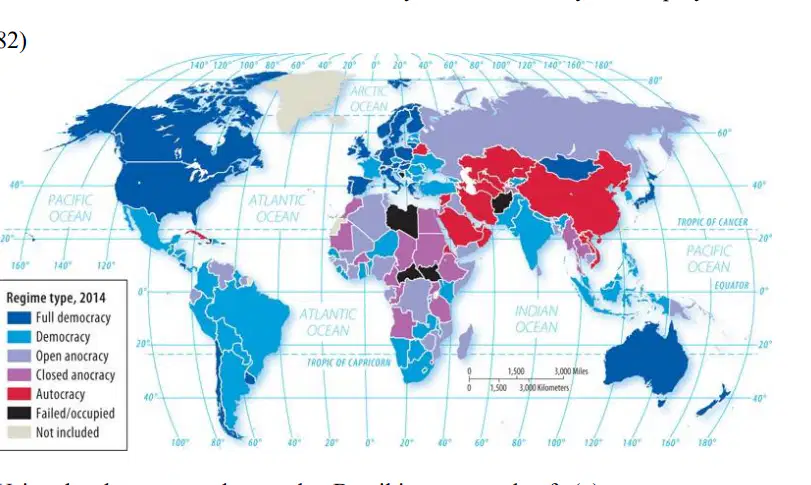
Using the above map, observe that Chile is now an example of a(n)
full democracy.
democracy.
open anocracy.
closed anocracy.
autocracy.
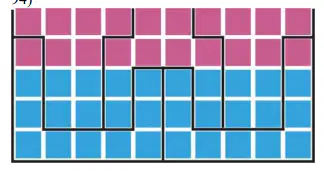
Using the above example, observe that the form of gerrymandering is
wasted vote.
stacked vote.
excess vote.
brokered vote.
contested vote.
State support for terrorism is seen to include all but one of the following.
providing sanctuary for wanted terrorists
assisting in planning terrorist attacks
supplying arms and materiel for terrorist attacks
supplying both money and intelligence to terrorist groups
establishing a political party representing terrorist grievances
Examples of state-sponsored terrorism by this country include the explosion of Pan Am Flight 103 over Lockerbie, Scotland.
Iran
Iraq
Libya
the Sudan
North Korea
Which of the following is NOT true about the U.S. attacks on Iraq in 1991 and 2003?
The 2003 war with Iraq was not supported by the UN membership.
The United States asserted Iraq had WMDs (Weapons of Mass Destruction) as well as close links with al-Qaeda as its justification to invade Iraq.
Kuwait's oil was a critical component to Iraq's justification for invading and the U.S. counterinvasion in 1991.
The hostility between the United States and Iraq dates back to the 1979 Shi'ite fundamentalist uprising which deposed the U.S.-friendly leadership.
Desert Storm (1991) was supported by nearly every country in the United Nations based on Iraq's unjustified invasion of Kuwait.
Which pairing of terms and definitions is INCORRECT?
Fatwa - Religious decree
Jihad - Suicide
Boko Haram - Western education is forbidden
al-Qaeda - The Foundation
Taliban - Religious Students
Boko Haram seeks to turn which African country into an Islamic State?
Mali
Nigeria
Algeria
Somalia
Mauritania
Terrorist activities
are restricted to foreigners instigating violence in another country.
are only associated with al-Qaeda.
hold every citizen responsible and view them as culpable for the actions they oppose and therefore view citizens as legitimate targets.
ended with the death of Osama bin Laden.
have been reduced in frequency due to drone attacks.
Terrorism is NOT
a systematic use of violence by a group to create fear or coerce a government into actions it would not have taken.
a government imposing economic sanctions followed by a bombing strategy to coerce another government into behaving differently.
an attempt to reach objectives of the group through bombing, kidnapping, hijacking, or assassinations.
viewing violence as means to publicizing grievances.
attacks largely aimed at ordinary people rather than military targets.
Terrorism differs from assassinations and other acts of political violence because
attacks are never well coordinated.
attacks are aimed at military targets or political leaders.
attacks are aimed at ordinary people.
attacks use only personal and improvised weapons.
attacks are typically made without regard for political goals.
The Commonwealth is primarily
an economic and cultural alliance of states once part of the British Empire.
an organization of culturally homogenous nations that opposed the Warsaw Pact.
organized to increase availability of mineral resources in perforated states that are NATO allies.
a religious entity that sends missionaries to Africa from the United Kingdom.
an association of countries that were once members of COMECON and the Warsaw Pact.
Economic and political cooperation in the European Union takes the form of all but which of the following?
Subsidies are provided to economically depressed areas.
Transfer of finished products between countries is simplified.
With few exceptions, citizens may live in one country but work in another without political difficulty.
Every member country must adopt the Euro currency.
A European Parliament is elected by member states.

