
 Worksheets
2023 AP1 Equation/Concept/Term Review
Total questions: 25
Worksheet time: 18mins

This term stands for...
The acceleration of gravity
The universal gravitational contant
Newton's first law
gravitational field strength

100 cm equals
1 m
10,000 km
10 mm
0.01 m

x represents...
position
velocity
acceleration
mass
a represents...
displacement
velocity
acceleration
mass
In the expression, a = v2 / r
r is displacement
a represents linear acceleration, and r represents radius
a represents centripetal acceleration, and r represents radial distance
v is the average velocity per revolution

p in the top equation is...
momentum
potential energy
force
the same as the P in the bottom equation.
When we add a triangle (delta) to the p in the top equation is...
it represents the change in momentum - called "impulse"
it is equal to force
it always equals zero
it is circular

The forth equation has two vertical lines between the F and d. This just means that for work to be done...
the parts of the force and distance used have to parallel.
the parts of the force and distance used have to perpendicular.
the force has to be sinusodial.
the force and distance have to be less than 1.

A change of energy is...
Work
power
force
acceleration

Spinnear motion equations operate just like linear motion equations, except they use radians instead of meters. The "linear" version of the top equation is...


b is the
adjacent side
opposite side
hypotenuse
For the top three equations, pick all that apply:
Changing "x" to "y" means they are being used in the y direction.
You can change "v" to "a" to create new equations.
The value of "a" should always be 10 m/s/s
Setting x0 to 0 (or ignoring it), just means you are starting at the origin.
When we add a triangle (delta) to the p in the top equation we get the second equation. This means...
F (delta) t = m (delta) v
F (delta) t = mv
F (delta) t = 0
F (delta) t = m / v

The "k" stands for...
kick
the spring constant
gravity
the energy constant
kinetic energy

As a spring oscillates side to side on a frictionless surface, the spring potential energy (bottom equation) changes into kinetic energy and back to spring potential. Kinetic energy equation, K =
(1/2) m v2
mgh
kx
0

The units for this physical constant
m/s2
N m2/kg2
N/kg
m/s
Slope of a position time graph gives you:
change in position
velocity
acceleration
y=mx+b!!!
Select all that are correct: In free fall, if I drop an object
the initial velocity is 0 m/s
the final velocity is 0 m/s
the acceleration is 10 m/s2
it speeds up as it falls
The rotational equivalent to x (position), v (velocity) and a (acceleration) are?
m, m/s, m/s2
θ, ω, α
x, x/t, α
μ, Σ, τ
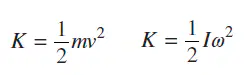
Select all that apply to these equations
They are both kinetic energy equations
The first is linear, the second is spinnear
You can always set them equal to one another
The first is spinnear, the second is linear
They are both measured in Joules
The SI units (the ones you use in physics equations to have them work out correctly every time) for mass are
kilograms
grams
Newtons
pounds
Weight and force of gravity are interchangeable terms
True
False
μ Select all that apply to this letter in physics
it is the coefficient of friction
it is unitless
it is the force of friction
it has units of N/m
You can use the kinematic equations...
for constant acceleration scenarios
for projectile motion
for pendulums
for springs
for constant force scenarios
In a closed system, when two objects collide...
momentum of the two objects is ALWAYS conserved
kinetic energy of the two objects is ALWAYS conserved
momentum of the two objects is only conserved in perfectly elastic collisions
kinetic energy of the two objects is only conserved in perfectly elastic collisions

