
 Worksheets
Spring Benchmark Review #3
Total questions: 25
Worksheet time: 18mins
Which of the following does NOT have an effect on a region's climate?
Large bodies of water
Latitude
Mountains
Longitude
Why does the area around the equator have a consistent temperature all year?
The equator rotates slower than the poles.
The equator remains the same distance from the sun.
The equator receives the most direct sunlight year round.
The equator has 18 hour days.
Throughout the year, the Earth receives varying intensities of sunlight. Listed below are three of the four seasons. Place each season in order from the MOST INTENSE sunlight to LEAST INTENSE sunlight.
Summer
Spring
Winter
Why do regions on Earth experience different amounts of daylight throughout the year? (You will select TWO answers.)
The Earth rotates on its axis.
The Earth's axis is tilted.
The Earth revolves around the Sun.
The Earth's rotation slows during the winter.
What does unequal heating of the earth cause?
wind
earthquakes
volcanoes
lightning
Match the following terms to their definitions.
dry
arid
moist
humid
mild
temperate
Match the prevailing wind to its definition.
Trade Winds
Prevailing winds that blow from east to west 30 degrees latitude to the equator in both hemispheres
Westerlies
Prevailing winds that blow from west to east 30-60 degrees latitude in both hemispheres
Polar Easterlies
Prevailing winds that blow from east to west 60-90 degrees latitude in both hemispheres

What season is the Northern Hemisphere experiencing in the diagram?
Fall
Spring
Summer
Winter

The arrows on the diagrams represent what type of thermal energy transfer?
radiation
convection
conduction
Skylar notices some erosion taking place on the hillside next to her home. What could she do to prevent further erosion?
She could add moisture to the ground by installing a sprinkler system.
She could plant trees. The roots will help hold the soil and rocks in place.
She could build a road. The asphalt will hold the soil and rocks in place.
She could build a ditch going down the mountain to add more water to the hillside.

Which of the following biomes is the largest and most diverse?
Marine
Taiga
Tropical Rainforest
Temperate Deciduous
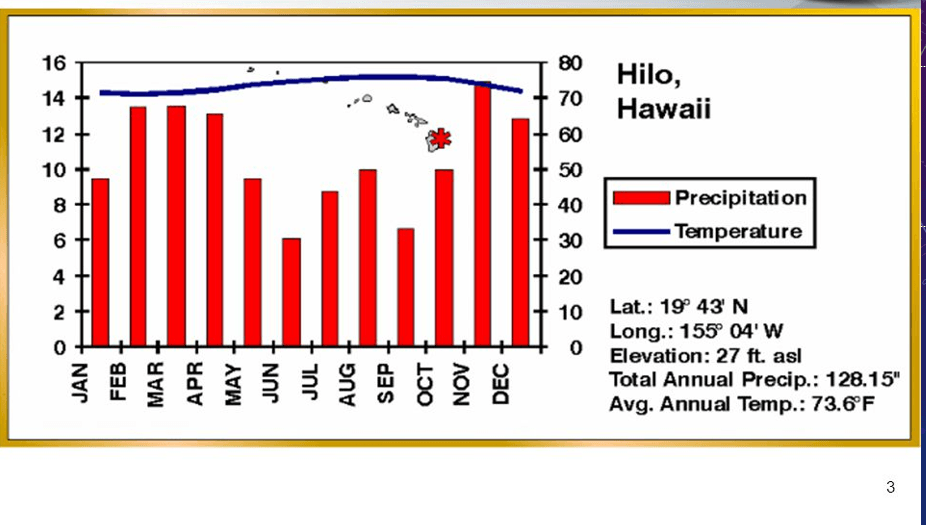
The diagram shows the climate for Hilo, Hawaii. This area is a tropical rainforest. How would this graph change if this were a desert climate?
The precipitation would be much lower.
The temperature would be much lower.
The precipitation would be much higher.
There is no difference between a tropical rainforest and a desert.
Which substance has a lower specific heat?
Hint: This means it changes temperature quickly.
Land
Water
Cannon sets up an experiment to measure how quickly water and land heat up and cool off. He sets up two beakers under a heat lamp. One beaker is full of water; the other beaker is full of sand (to represent land). After 10 minutes, he turns off the lamp and measures the temperature for another 10 minutes. Which beaker will be the warmest at the end of the second 10-minute interval?
Land
Water

Which season is taking place in the Northern Hemisphere in Position 1?

Which season is taking place in the Northern Hemisphere in Position 3?
Gases
Nutrients
Heat Energy
All of these
The sun heats up the surface of the Earth
(a) due to the Earth's (b) .

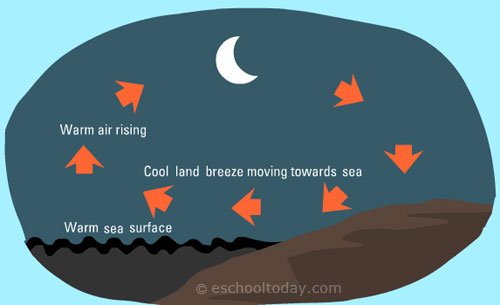
What kind of breeze is being shown in this image?
Sea breeze
Land breeze
Air moves areas of (a) pressure to areas of (b) pressure.
Which of the following is the main cause of surface ocean currents?
The Coriolis Effect
Pluto
Salinity
Wind

