
NEW
Font size
 Worksheets
Life Sciences TCAP Review
Total questions: 45
Worksheet time: 34mins
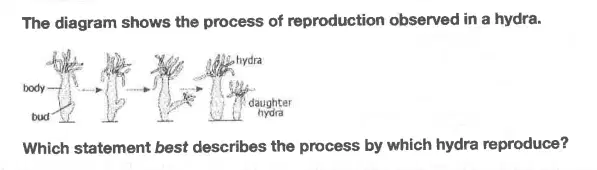
A single parent produces a genetically identical offspring by sexual reproduction.
A single parent produces a genetically identical offspring by asexual reproduction.
A single parent produces an egg and sperm that combine to develop into an offspring.
A single parent produces an egg that develps into an offspring without being fertilized.
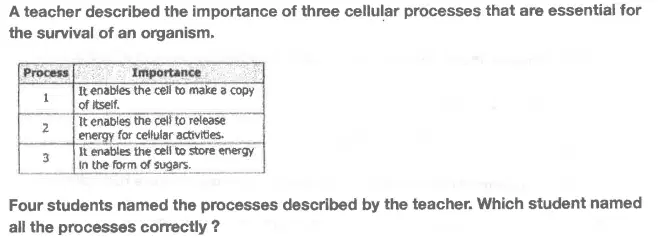


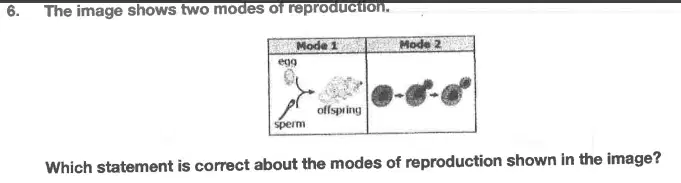
Mode 1 can produce offspring more rapidly than Mode 2.
Mode 1 produces offspring identical to their parents.
Mode 2 produes offspring identical to their parents.
Mode 2 produces a zygote through the process of fertilization.
Which diagram shows the four stages of mitosis labeled correctly?


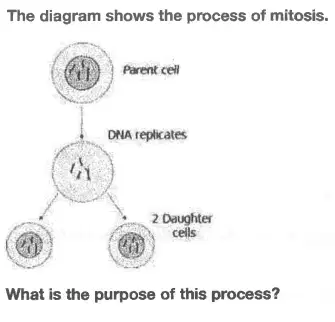
It helps the cell function efficiently.
It helps the cell from energy molecules.
It helps the cell make an exact copy of itself.
It helps the cell increase its genetic material.
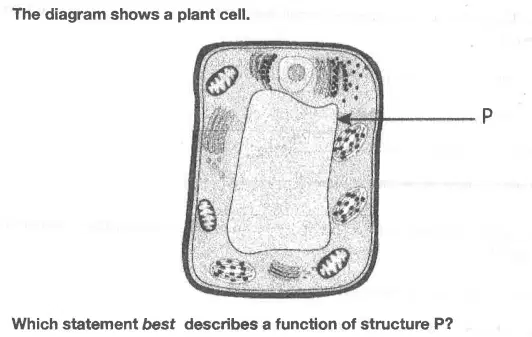
It stores chloroplasts which make food for the cell.
It stores oxygen which is needed for cellular respiration.
It stores water which is needed for cell processes.
It stores cytoplasm which allows the organelles to move around in it.
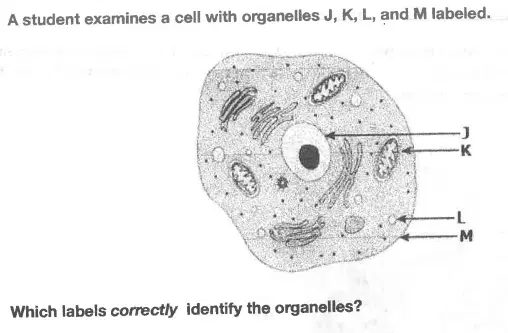
J: nucleus; K: cell membrane; L: vacuole; M: mitochondrion
J: cell membrane; K: nucleus; L: mitochondrion; M: vacuole
J: nucleus; K: mitochondrion; L: vacuole; M: cell membrane
J: mitochondrion; K: nucleus; L: cell membrane; M: vacuole
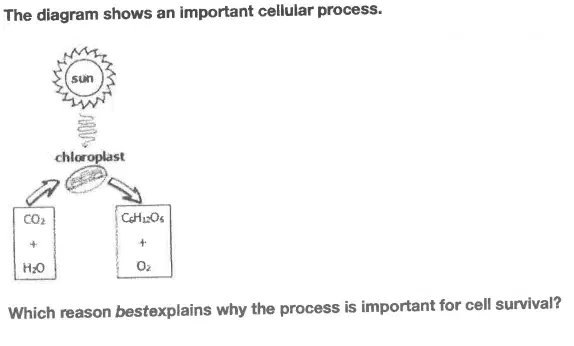
It enables the cell to reproduce.
It breaks down sugar to release energy and water.
It prevents toxic waste accumulation.
It produces sugar for the cell to use or store.
Which diagram most accurately displays the process of simple diffusion across a cell membrane?


Why does water (H20) cross the cell membrane without help, but sugar (C6H1206) requires special structures to cross the membrane?
Sugar molecules are too large to enter by diffusion.
Sugar molecules are too large to enter by osmosis.
Water molecules are too small to enter by diffusion.
Water molecules are too small to enter by osmosis.
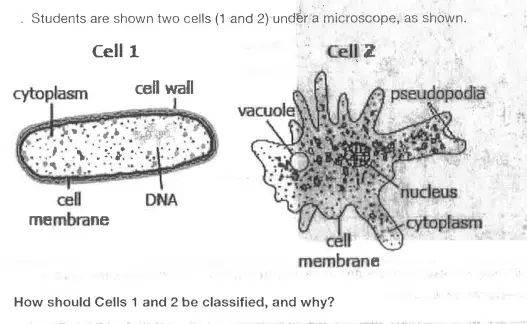


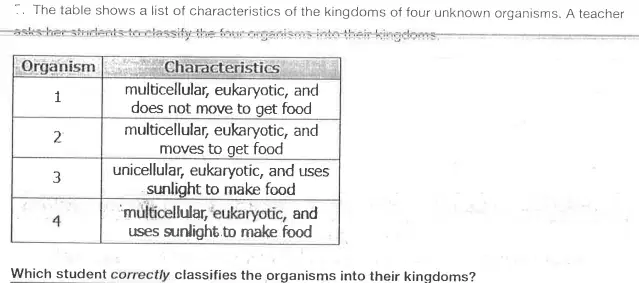


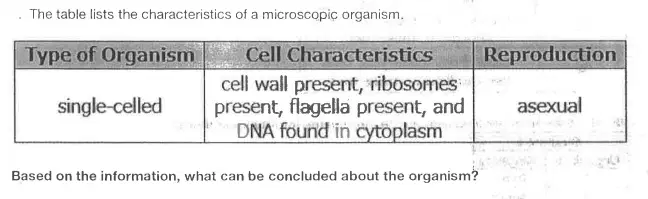
It is a photosynthetic eukaryote.
It is a photosynthetic prokaryote.
It is a non-photosynthetic eukaryote.
It is a non-photosynthetic prokaryote.
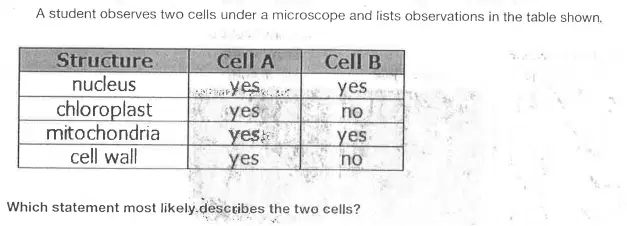
Both Cells A and B are plant cells.
Both Cells A and B are animal cells.
Cell A is a plant cell; Cell B is an animal cell.
Cell A is an animal cell; Cell B is a plant cell.
Prokaryotes and eukaryotes are the two basic categories of cells. Which cell is a eukaryote?


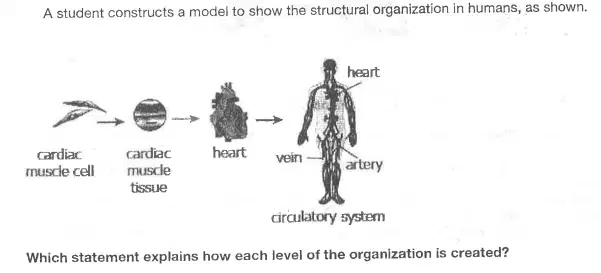
Two or more types of muscle tissues working together make an organ.
Two or more types of organs working together make a cell.
Two or more types of organ systems working togther make a tissue.
Two or more types of muscle tissues working together make a cell.
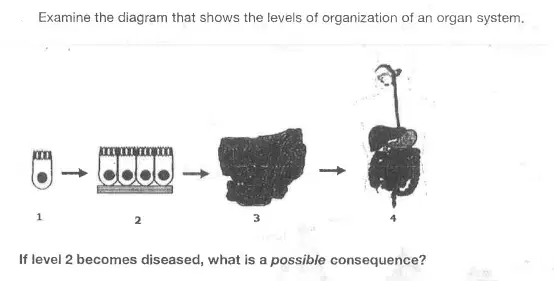
The organ system will generate more cells to create a new organ to replace the diseased component.
The organ will fail to function properly, affecting the organ system and consequently the organism.
The cells will bypass creating tissues, creating the organ directly to limit the spread of the disease to the organism.
The organ will temporarily shut down until the disease is repaired with the replication of new cells.
The human body has many levels of organization. Which diagram shows the correct order of these levels?


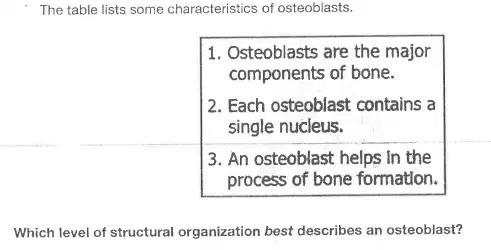
cell
organ
system
tissue

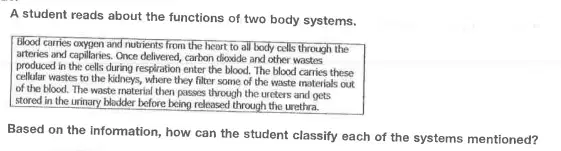
digestive system
excretory system
nervous system
respiratory system
How does the muscular system help the respiratory system?
It monitors and controls the breathing rate.
It helps absorb carbon dioxide supplied by the blood.
It moistens and warms the air taken in from the nose.
It helps in the movement of organs invovled in breathing.
Malaria is caused by a protist that spreads through a mosquito bite. The parasite passes from the bloodstream to the liver where it reproduces and re-enters the bloodstream. As the infection spreads throughout the body, the person experiences a high fever and chils.
Which system of the body reacts to cause the fever and chills?
digestive
excretory
immune
respiratory


Bears hibernate during part or all of the winter months. Before they do so, bears must each much more food than normal in order to store the excess food in the body in the form of fats.
Which statement best explains how fats sustain the bears during hibernation?
The fats provide the energy to sustain their warmer than normal body temperature and fast heart rates.
The fats provide the energy to sustain their colder than normal body temperatures and slower heart rates.
The fats provide the energy to sustain their warmer than normal body temperatures and slower heart rates.
The fats provide the energy to sustain their colder than normal body temperatures and faster heart rates.
The bombardier beetle produces a large popping sound when releasing a chemcial from its abdomen. This chemical has a foul oder and is as hot as boiling water.
What explains this behavior?
The helps the beetle stay warm.
It helps the beetle catch its prey.
It helps the beetle attract a mate.
It helps the beetle protect itself from the predators.
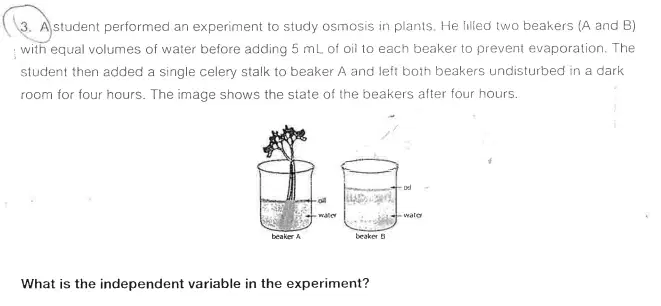
amount of water in the two beakers
the type of beakers used in the experiment
duration of the experiment
presence or absence of the celery stalk in the beakers
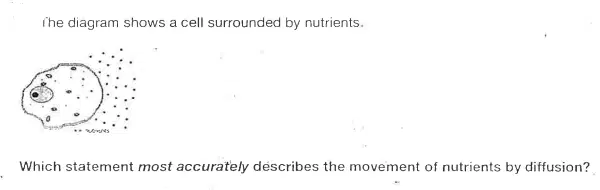
The nutrients will move into the cell across the cell membrane.
The nutrients will move out of the cell across the cell membrane.
The nutrients will move farther away from the cell.
The nutrients will remain in their current position.
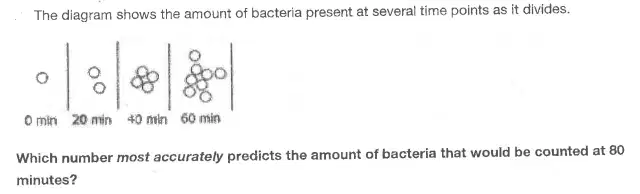
4
8
16
32
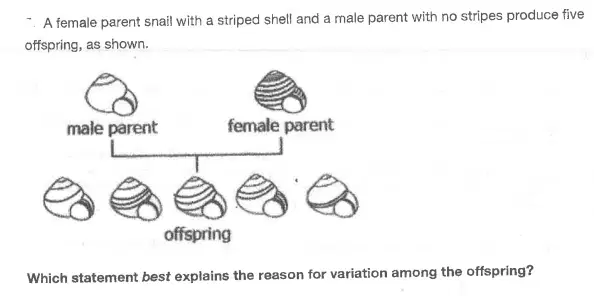
In sexual reproduction, only the male parent passess genes to the offspring.
In sexual reproduction, only the female parent passes genes to the offspring.
In sexual reproduction, offspring inherit genes from both parents, and each offspring has a new combination of traits.
In sexual reproduction, the male parent passes its genes to male offspring, and the female parent passes its genes to female offspring.
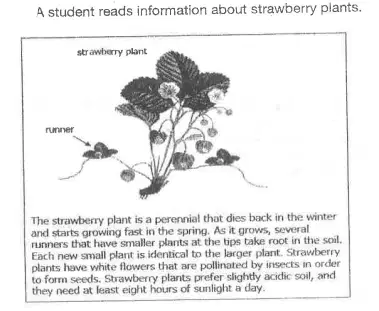
What can be concluded about strawberry plants?
Strawberry plants reproduce only by asexual reproduction.
Strawberry plants reproduce only by sexual reproduction.
Strawberry plants reproduce both by asexual and sexual reproduction.
Strawberry plants reproduce neither by asexual nor sexual reproduction.
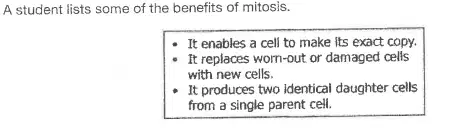
Which other benefit can the student include in the list?
It helps in the release of oxygen.
It helps in the generation of energy.
It helps in the asexual reproduction of an organism.
It helps in the removal of waste from the cell.

Mitosis helps in the growth of the plant parts.
Plant cells undergo mitosis at high temperatures.
Root tips switch from meiosis to mitosis when cut.
Water stops the process of mitosis in garlic root tips.
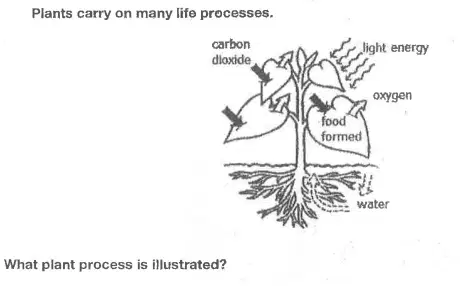
germination
photosynthesis
respiration
transpiration
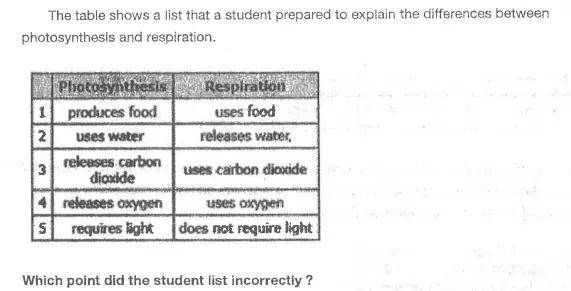
2
3
4
5
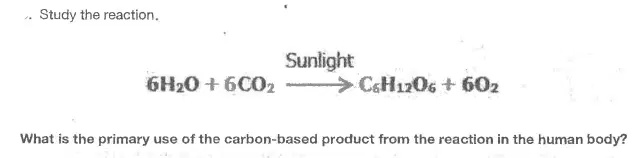
to be broken down by our cells during photosynthesis
to be combined with lipids to produce proteins in the body
to be converted into ATP for the body's energy needs
to be divided evenly into daughter cells during mitosis

arrows indicating the intake of carbon dioxide gas and the release of oxygen gas becuase the farmer respires
arrows indicating the intake of carbon dioxide and the release of oxygen gas becuase the farmer photosynthesizes
arrows indicating the intake of oxygen gas and the release of carbon dioxide gas becuase the farmer respires
arrows indicating the intake of oxygen gas and the release of carbon dioxide gas becuase the farmer photosynthesizes

The grass and the tree produce carbon dioxide for use by the elephant, and the elephant exhales oxygen for use by the grass and the tree.
The grass the tree produce oxygen for use by the elephant, and the elephant exhales nitrogen for use by the grass and the tree.
The grass and the tree produce nitrogen for use by the elephant, and the elephant exhales carbon dioxide for use by the grass and the tree.
The grass and the tree produce oxygen for use by the elephant, and the elephant exhales carbon dioxide for use by the grass and the tree.

Sex cells have one-fourth the number of chromosomes as the parent cell.
Sex cells have one-half the number of chromosomes as the parent cell.
Sex cells have the same number of chromosomes as the parent cell.
Sex cells have double the number of chromosomes as the parent cell.

meiosis
metabolism
mitosis
mutation


In a plant, the trait for purple leaves (B) is dominant over the trait for green leaves (b). Which cross will result in maximum offspring with the purple leaf trait?
bb x Bb
bb x bb
BB x bb
Bb x Bb

2 and 5
3 and 4
1, 2, and 3
3, 4, and 5
In pea plants, the allele for purple flowers (P) is dominant over the allele for white flowers (p). What percentage of the offspring is expected to be purebred from the cross of Pp x Pp?
25%
50%
75%
100%
In tomato plants, red skin (R) is dominant over yellow skin (r). A hybrid tomato plant is crossed with a yellow tomato plant.
As a result of this cross, what percentage of the offspring are predicted to have yellow skin?
25%
50%
75%
100%
The trait for dark-colored hair (D) is dominant over the trait for light-colored hair (d) in mice. Which statement correctly represents an example of a phenotype and a genotype for these traits.
Genotypes dd and Dd result in the light-colored hair phenotype.
Genotypes dd and DD result in the dark-colored hair phenotype.
Genotypes Dd and DD result in the dark-colored hair phenotype.
Genotypes DD and dd result in the light-colored hair phenotype.

