

wayground logo

Free Printable Worksheets

Font size

S
M
L
XL
Worksheets

Middle Ages

Total questions: 82

Worksheet time: 43mins
Name
Class
Date
1.
Middle Ages
a)
A Renaissance intellectual movement in which thinkers studied classical texts and focused on human potential and achievements
b)
The Turkish Muslim that defeated the Crusaders in the 2nd crusade
c)
The medieval period in Europe from 500-1500 CE
d)
Mounted horsemen who pledged to defend their lords' land
2.
Secular
a)
The person who receives a fief
b)
The Duke of Normandy that invaded and conquered England
c)
(732 CE) European victory over Muslims. It halted Muslim movement into Western Europe.
d)
Worldly, or not connected to the church
3.
Franks
a)
Germanic group located in the former Roman province of Gaul
b)
The teenager that fought for France because she had seen a vision from God
c)
(732 CE) European victory over Muslims. It halted Muslim movement into Western Europe.
d)
"rebirth"; following the Middle Ages, a movement that centered on the revival of interest in the classical learning of Greece and Rome
4.
Charlemagne
a)
The first Holy Roman Emperor, Charles the Great
b)
The lord's estate
c)
the practice of lending money at really high rates
d)
Mounted horsemen who pledged to defend their lords' land
5.
Monasteries
a)
A legal system based on custom and court rulings that applies to everyone
b)
Germanic group located in the former Roman province of Gaul
c)
Religious community where monks and nuns lived
d)
Mounted horsemen who pledged to defend their lords' land
6.
Vassal
a)
An assembly of representatives from all three of the estates, or social classes, in France.
b)
The person who receives a fief
c)
(732 CE) European victory over Muslims. It halted Muslim movement into Western Europe.
d)
The English King that made a truce with Saladin in the Third Crusade
7.
Knights
a)
Mounted horsemen who pledged to defend their lords' land
b)
The first Holy Roman Emperor, Charles the Great
c)
led by William the conquerer, the Normand's invaded and conquered England
d)
The medieval period in Europe from 500-1500 CE
8.
Manor
a)
A legal system based on custom and court rulings that applies to everyone
b)
a machine for printing text or pictures from type or plates.
c)
The first Holy Roman Emperor, Charles the Great
d)
The lord's estate
9.
Lord
a)
The Turkish Muslim that defeated the Crusaders in the 2nd crusade
b)
Landowner who granted land
c)
This group of invaders originated in Scandinavia. While they are well-known for being fierce warriors, they were also very impressive seafarers. They were the first to reach the Americas
d)
During the late 15th century, they became King and Queen of a united Spain after centuries of Islamic domination. Together, they made Spain a strong Christian nation and also provided funding to overseas exploration, notably Christopher Columbus.
10.
Fief
a)
Church law
b)
A medieval organization of crafts workers or trades people.
c)
a Germanic tribe that conquered present-day France and neighboring lands in the 400s
d)
A piece of land
11.
Serf
a)
the appointment of religious officials by kings or nobles
b)
People who could not lawfully leave the place where they were born, so they worked the land
c)
(732 CE) European victory over Muslims. It halted Muslim movement into Western Europe.
d)
"rebirth"; following the Middle Ages, a movement that centered on the revival of interest in the classical learning of Greece and Rome
12.
Holy Roman Empire
a)
First called the Roman Empire of the German Nation, it was a large empire of Western Europe
b)
Landowner who granted land
c)
Holy War
d)
These people eventually settled in England
13.
Saladin
a)
The Turkish Muslim that defeated the Crusaders in the 2nd crusade
b)
the selling or buying of a position in a Christian church
c)
The first Holy Roman Emperor, Charles the Great
d)
led by William the conquerer, the Normand's invaded and conquered England
14.
Richard the Lionheart
a)
The English King that made a truce with Saladin in the Third Crusade
b)
led by William the conquerer, the Normand's invaded and conquered England
c)
the practice of lending money at really high rates
d)
The Great Charter that King John of England was forced to sign, which guaranteed basic political rights
15.
Pope Urban II
a)
a system of farming developed in medieval Europe, in which farm land was divided into three fields of equal size and each of these was successively planted with a winter crop, planted with a spring crop, and left unplanted.
b)
the selling or buying of a position in a Christian church
c)
First called the Roman Empire of the German Nation, it was a large empire of Western Europe
d)
Pope that called for a Holy War
16.
Crusade
a)
Church law
b)
Holy War
c)
First called the Roman Empire of the German Nation, it was a large empire of Western Europe
d)
the practice of lending money at really high rates
17.
Reconquista
a)
This group of invaders originated in Scandinavia. While they are well-known for being fierce warriors, they were also very impressive seafarers. They were the first to reach the Americas
b)
Spanish effort to drive the Muslims out of Spain
c)
These people eventually settled in England
d)
People who could not lawfully leave the place where they were born, so they worked the land
18.
Inquisition
a)
An effort in Spain to rid the Church of heresy
b)
the practice of lending money at really high rates
c)
The teenager that fought for France because she had seen a vision from God
d)
led by William the conquerer, the Normand's invaded and conquered England
19.
Bubonic Plague
a)
A legal system based on custom and court rulings that applies to everyone
b)
Disease that killed about 1/3 of Europe's population
c)
King of France elected in 987 and founding the Capetian dynasty (940-996)
d)
Holy War
20.
William the Conqueror
a)
Germanic group located in the former Roman province of Gaul
b)
The war between England and France that was fought over who would become the king of France
c)
a machine for printing text or pictures from type or plates.
d)
The Duke of Normandy that invaded and conquered England
21.
Parliament
a)
The legislative group in England
b)
A piece of land
c)
a system of farming developed in medieval Europe, in which farm land was divided into three fields of equal size and each of these was successively planted with a winter crop, planted with a spring crop, and left unplanted.
d)
(732 CE) European victory over Muslims. It halted Muslim movement into Western Europe.
22.
Magna Carta
a)
a machine for printing text or pictures from type or plates.
b)
The Great Charter that King John of England was forced to sign, which guaranteed basic political rights
c)
The lord's estate
d)
An effort in Spain to rid the Church of heresy
23.
100 Year War
a)
(732 CE) European victory over Muslims. It halted Muslim movement into Western Europe.
b)
The medieval period in Europe from 500-1500 CE
c)
Disease that killed about 1/3 of Europe's population
d)
The war between England and France that was fought over who would become the king of France
24.
Joan of Arc
a)
King of France elected in 987 and founding the Capetian dynasty (940-996)
b)
The teenager that fought for France because she had seen a vision from God
c)
(732 CE) European victory over Muslims. It halted Muslim movement into Western Europe.
d)
The medieval period in Europe from 500-1500 CE
25.
Vikings
a)
An effort in Spain to rid the Church of heresy
b)
a machine for printing text or pictures from type or plates.
c)
First called the Roman Empire of the German Nation, it was a large empire of Western Europe
d)
This group of invaders originated in Scandinavia. While they are well-known for being fierce warriors, they were also very impressive seafarers. They were the first to reach the Americas
26.
Anglo-Saxon
a)
The Great Charter that King John of England was forced to sign, which guaranteed basic political rights
b)
Germanic group located in the former Roman province of Gaul
c)
These people eventually settled in England
d)
Pope that called for a Holy War
27.
Hugh Capet
a)
Germanic group located in the former Roman province of Gaul
b)
soldiers on horseback
c)
The war between England and France that was fought over who would become the king of France
d)
King of France elected in 987 and founding the Capetian dynasty (940-996)
28.
Franks
a)
a Germanic tribe that conquered present-day France and neighboring lands in the 400s
b)
People who could not lawfully leave the place where they were born, so they worked the land
c)
A dramatic change in the economy of Europe at the end of the Middle Ages. It is characterized by an increase in towns and trade, the use of banks and credit, and the establishment of guilds to regulate quality and price.
d)
Holy War
29.
Battle of Hastings (1066)
a)
the selling or buying of a position in a Christian church
b)
The legislative group in England
c)
led by William the conquerer, the Normand's invaded and conquered England
d)
The Duke of Normandy that invaded and conquered England
30.
Calvary
a)
soldiers on horseback
b)
Landowner who granted land
c)
The lord's estate
d)
Spanish effort to drive the Muslims out of Spain
31.
Magyars
a)
King of France elected in 987 and founding the Capetian dynasty (940-996)
b)
The teenager that fought for France because she had seen a vision from God
c)
An effort in Spain to rid the Church of heresy
d)
Muslims who attacked Europe and converted to Christianity and established Hungary
32.
Battle of Tours
a)
The Great Charter that King John of England was forced to sign, which guaranteed basic political rights
b)
The legislative group in England
c)
Spanish effort to drive the Muslims out of Spain
d)
(732 CE) European victory over Muslims. It halted Muslim movement into Western Europe.
33.
Ferdinand and Isabella
a)
During the late 15th century, they became King and Queen of a united Spain after centuries of Islamic domination. Together, they made Spain a strong Christian nation and also provided funding to overseas exploration, notably Christopher Columbus.
b)
The medieval period in Europe from 500-1500 CE
c)
Pope that called for a Holy War
d)
A family's payment of one-tenth of its income to a church
34.
three-field system
a)
Holy War
b)
The first Holy Roman Emperor, Charles the Great
c)
a system of farming developed in medieval Europe, in which farm land was divided into three fields of equal size and each of these was successively planted with a winter crop, planted with a spring crop, and left unplanted.
d)
A dramatic change in the economy of Europe at the end of the Middle Ages. It is characterized by an increase in towns and trade, the use of banks and credit, and the establishment of guilds to regulate quality and price.
35.
Guild
a)
The war between England and France that was fought over who would become the king of France
b)
Church law
c)
First called the Roman Empire of the German Nation, it was a large empire of Western Europe
d)
A medieval organization of crafts workers or trades people.
36.
Estates General
a)
Holy War
b)
An effort in Spain to rid the Church of heresy
c)
An assembly of representatives from all three of the estates, or social classes, in France.
d)
A piece of land
37.
Commercial Revolution
a)
Worldly, or not connected to the church
b)
A legal system based on custom and court rulings that applies to everyone
c)
A dramatic change in the economy of Europe at the end of the Middle Ages. It is characterized by an increase in towns and trade, the use of banks and credit, and the establishment of guilds to regulate quality and price.
d)
"rebirth"; following the Middle Ages, a movement that centered on the revival of interest in the classical learning of Greece and Rome
38.
Johann Gutenberg
a)
the practice of lending money at really high rates
b)
Invented the printing press which could create many books quickly
c)
The war between England and France that was fought over who would become the king of France
d)
a system of farming developed in medieval Europe, in which farm land was divided into three fields of equal size and each of these was successively planted with a winter crop, planted with a spring crop, and left unplanted.
39.
Printing Press
a)
The war between England and France that was fought over who would become the king of France
b)
Mounted horsemen who pledged to defend their lords' land
c)
soldiers on horseback
d)
a machine for printing text or pictures from type or plates.
40.
Renaissance
a)
An effort in Spain to rid the Church of heresy
b)
A piece of land
c)
"rebirth"; following the Middle Ages, a movement that centered on the revival of interest in the classical learning of Greece and Rome
d)
the selling or buying of a position in a Christian church
41.
Humanism
a)
People who could not lawfully leave the place where they were born, so they worked the land
b)
Worldly, or not connected to the church
c)
A Renaissance intellectual movement in which thinkers studied classical texts and focused on human potential and achievements
d)
The first Holy Roman Emperor, Charles the Great
42.
Tithe
a)
A family's payment of one-tenth of its income to a church
b)
a Germanic tribe that conquered present-day France and neighboring lands in the 400s
c)
"rebirth"; following the Middle Ages, a movement that centered on the revival of interest in the classical learning of Greece and Rome
d)
A Renaissance intellectual movement in which thinkers studied classical texts and focused on human potential and achievements
43.
Clergy
a)
Church officials such as a priest
b)
soldiers on horseback
c)
These people eventually settled in England
d)
The English King that made a truce with Saladin in the Third Crusade
44.
Simony
a)
The Duke of Normandy that invaded and conquered England
b)
the selling or buying of a position in a Christian church
c)
Pope that called for a Holy War
d)
During the late 15th century, they became King and Queen of a united Spain after centuries of Islamic domination. Together, they made Spain a strong Christian nation and also provided funding to overseas exploration, notably Christopher Columbus.
45.
lay investiture
a)
The English King that made a truce with Saladin in the Third Crusade
b)
A dramatic change in the economy of Europe at the end of the Middle Ages. It is characterized by an increase in towns and trade, the use of banks and credit, and the establishment of guilds to regulate quality and price.
c)
the appointment of religious officials by kings or nobles
d)
a Germanic tribe that conquered present-day France and neighboring lands in the 400s
46.
Usury
a)
People who could not lawfully leave the place where they were born, so they worked the land
b)
the practice of lending money at really high rates
c)
The war between England and France that was fought over who would become the king of France
d)
Church officials such as a priest
47.
Canon Law
a)
These people eventually settled in England
b)
Church law
c)
Disease that killed about 1/3 of Europe's population
d)
The Turkish Muslim that defeated the Crusaders in the 2nd crusade
48.
Common Law
a)
Muslims who attacked Europe and converted to Christianity and established Hungary
b)
a machine for printing text or pictures from type or plates.
c)
Germanic group located in the former Roman province of Gaul
d)
A legal system based on custom and court rulings that applies to everyone
49.
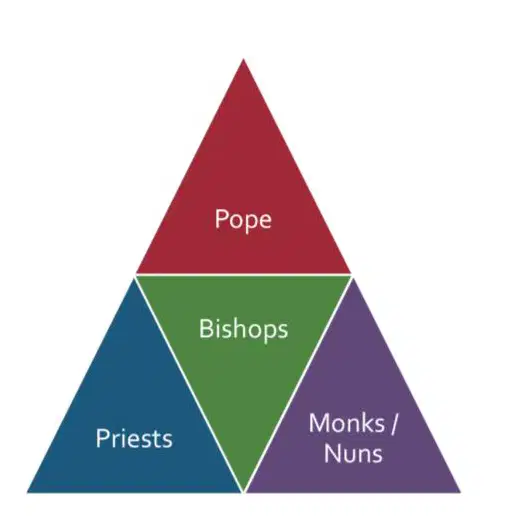
Question Image

Match each member of the clergy with their description

a)

Head of the church:  speaks directly from God

1.

Pope

b)

Common church men who work directly with the people

2.

Priests

c)

Former priests who now govern over the conduct of many churches

3.

Bishops

d)

Isolated men who take

 a vow to live

 only for God

4.

Monks

e)

Isolated women who take

 a vow to live

 only for God

5.

Nuns

50.

Match each person below to the correct achievement

a)

Beat the Muslims at the Battle of Tours

1.

Charles Martel

b)

First Frankish King to convert to Christianity

2.

Clovis

c)

First Holy Roman Emperor, expanded to take over most of Western Europe

3.

Charlemagne

d)

Crowned the Holy Roman Emperor

4.

Pope Leo III

51.

From which area did the Vikings spread?

52.

Who was the first king of the Franks?

a)

Charlemagne

b)

Clovis

c)

Charles Martel

d)

Charles the Great

53.

Who was the first Holy Roman Emperor?

a)

Charlemagne

b)

Clovis

c)

Pope Leo III

d)

Charles Martel

54.

Who defeated the Muslims at the Battle of Tours?

a)

Charles Martel

b)

Charlemagne

c)

Clovis

d)

Leo

55.

What was the unifying force in Western Europe after the fall of the Roman Empire?

a)

the Roman Catholic Church

b)

the Islamic Empire

c)

the Roman Empire

d)

The Mongols

56.

Who lived and worked in Monasteries?

a)

Monks

b)

Peasants

c)

Lords

d)

Priests

57.

Banishment from the Church is ...

a)

Excommunication

b)

Serfdom

c)

Feudalism

d)

Unifying Power

58.

The strongest Germanic tribe in the Early Middle Ages in Western Europe was the ...

a)

Franks

b)

Goths

c)

Visigoths

d)

Gauls

59.

Which area was taken over by the Magyars?

60.

From which area did the Muslims spread?

61.

England

62.

The Baltic Sea

63.

Russia

64.

Constantinople

65.

The Caspian Sea

66.

Rome

67.

Which of these is the largest?

a)

England

b)

Constantinople

c)

Jerusalem

d)

Russia

e)

The Baltic Sea

68.

_______ is a peninsula in Northen Europe.

a)

England

b)

Constantinople

c)

Jerusalem

d)

Russia

e)

Scandinavia

69.

Which of these is an island?

a)

England

b)

Constantinople

c)

Jerusalem

d)

Russia

e)

Scandinavia

70.

Which of these is now called Istanbul?

a)

England

b)

Constantinople

c)

Jerusalem

d)

Russia

e)

Scandinavia

71.
Who is the first king of England?
a)
William the Conquerer
b)
John
c)
Hugh Capet
d)
Henry II
72.
Who is the first king of France?
a)
Hugh Capet
b)
John
c)
William the Conquerer
d)
Joan of Arc
73.
What law was based on prior judgements and applied to everyone?
a)
Common Law
b)
Parliament
c)
House of Commons
d)
Simony
74.
The Hundred Years War gave England and France ...
a)
a sense of nationalism
b)
a reason to hate each other
c)
lots of money
d)
fame
75.
Which document limited the power of the King in England?
a)
Magna Carta
b)
Declaration of Independence
c)
Papal Curia
d)
Common Law
76.
The black plague killed what percentage of people in Europe?
a)
0.3
b)
1
c)
0.75
77.
During the Middle Ages the climate became
a)
warmer, with a longer growing season
b)
colder, with a longer growing season
c)
warmer, with a shorter growing period
d)
colder, with a shorter growing period
78.
In the three field system, they plant crops in two fields. What do they do with the third piece of land?
a)
left it fallow
b)
planted corn
c)
planted beans
d)
sold it off
79.
Instead of using oxen to plant, peasants began using which animal?
a)
Horses
b)
Cows
c)
Giraffes
d)
Dogs
80.
After the crusades, Europeans had access to a lot of ________ goods and technology.
a)
Islamic
b)
Indian
c)
Byzantine
d)
Chinese
81.
After the crusades, who had the most power?
a)
Monarchs
b)
Pope
c)
Bishops
d)
Nobles
82.
A way to avoid carrying gold after the crusades was ...
a)
Credit
b)
Dollars
c)
Pesos
d)
Bonds
