
 Worksheets
Classification corrections
Total questions: 37
Worksheet time: 23mins
The 3 domains are Eukarya, Archaea, and
Fungi
Plantae
Animalia
Bacteria
What two levels make up a scientific name?
genus and order
genus and species
domain and kingdom
family and genus
What level comes after order?
genus
kingdom
family
species
What is the study of classification?
taxonomy
biology
botany
microbiology
What type of organism makes its own food?
Autotroph
Heterotroph

The taxonomic level that would include the MOST number of species
class
kingdom
phylum
genus
Which of the following is the CORRECT form of a scientific name?
canis lupus
Canis Lupus
Canis lupus
canis lupus
What would the scientific name of this organism be?
Kingdom: Animalia
Phylum: Chordata
Class: Aves
Order: Charadriiformes
Family: Laridae
Genus: Thalasseus
species: maximus
thalassues maximus
Anamalia maximus
Aves chordata
Thalassues maximus
What is the purpose of a cladogram?
To map the ancestral relationships and shared traits of different organisms.
To trace the inherited traits of a single species over time.
To check the likelihood of an offspring having a particular trait.
To monitor mutations that arise among different populations.
A “family tree” made by scientists to show relationships of ancestry and similar traits between organisms.
Cladogram
Scientific Family Tree
Pedigree
DNA Test

What characteristics do all of these animals have in common?
Vertebrate
Lungs
Endothermic
Mammal
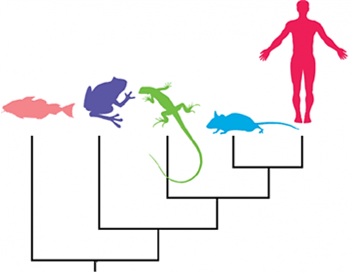
What is the human most closely related to?
Fish
mouse
Salamander
Human

Which group of animals on this tree are most closely related to birds?
Saurischian dinosaurs
Ornithischian dinosaurs
Crocodiles
None of these are related to birds

Which organism is LEAST closely related to a human?
Fruit Fly
Chimpanzee
Rhesus Monkey
Cow
Which kingdom contains bacteria that live in extreme places - hot, salty, or acidic places where no other cells can survive?
Archaebacteria
Eubacteria
Animalia
Protista
Which kingdom has organisms whose cells contain Chitin?
Fungi
Protista
Animalia
Plantae

According to this chart, which two organisms are most closely related?
Snail and triceratops
Human and snail
Human and triceratops
None are related to each other

According to this chart, which two organisms are most closely related?
Cat and Wolf
Cat and Fly
Wolf and Fly

Students examine images of a certain species of bat commonly found in Texas. Using the bat dichotomous Key, they conclude that the bat species is a Mexican free-tailed bat due to its large, round ears.
Based on the dichotomous key, in addition to the shape of the bat's ears, which other set of features should the students look for to confirm the identity of the bat?
Solitary with a wingspan greater than 35cm
Solitary with a wingspan less than 35cm
Colonial with a wingspan greated than 35cm
Colonial with a wingspan less than 35cm
A researcher determines an organism to be eukaryotic, unicellular and autotrophic. In which taxonomic group should this organism be classified?
bacteria
protista
archaea
animalia
The gray squirrel, Eastern fox squirrel, and red squirrel are all different species of squirrels. Why is having a scientific name for each species of an organism important?
To prevent existing named organisms from having their names changed as they become extinct
To keep the classification system from being altered as new organisms are discovered
To allow organisms to be placed in many classification levels at the same time
To standardize the naming and organization of organisms to avoid confusion

Organisms are classified today using the Linnaean system, and the following table shows the taxonomic classification of two marine organisms living along the Pacific Coast.
Taxonomic classification is important to marine biologists because it provides a way to -
prove that marine evolution occurs
discover and name every marine organism on Earth
designate Latin as the universal language of marine biology
identify marine organisms and find evolutionary relationships between them
Many tree frog populations are threatened due to habitat loss. In an effort to promote conservation, tree frogs may be bred in captivity. A zoo acquired male and female tree frogs from two different populations. In the zoo, the tree frogs were able to successfully mate within their own population, but breeding attempts between the two populations were unsuccessful.
Based on this information, which statement correctly describes the relationship between the two populations of tree frogs.
They are in the same species but different kingdoms.
They are in the same class but different phyla.
They are in the same family but different orders.
They are in the same genus but different species.
Which list correctly identifies characteristics that protists share with animals?


Five general characteristics of organisms in kingdoms Plantae or Fungi are listed in the box.
Which table correctly lists the characteristics of the organisms in the two kingdoms?


The standardized name differentiates mountain lions from pumas
The standardized name is less descriptive of the animal that has been observed
Communication with other scientists about mountain lions will be reduced
All scientists will be using the same name for mountain lions

Stemmiulida is more closely related to Merocheta than Penicillata is to Merocheta
Spirostreptida is more closely related to Glomerida than Sphaerotheriida is to Glomerida
Polizoniida is more closely related to Glomeridesmida than Sphaerotheriida is to Glomeridesmida.
Merocheta is more closely related to Glomeridesmida than Glomerida is to Glomeridesmida

Anthropoda
Annelida
Mollusca
Platyhelminthes
Theory that all organisms descended from a mutual species
Evolution
Natural Slection
Common Ancestry
Fossil Record
Single celled organisms that do not contain a nucleus are referred to as
eukaryotes
prokaryotes
Multi-celled organisms that contain a nucleus are referred to as
eukaryotes
prokaryotes
Bacteria are
unicellular
multicellular
Some bacteria are motile which means
they are very big
they can move
they are multicellular
they are eukaryotes

