
Font size
 Worksheets
CP Synoptic Yr 10
Total questions: 164
Worksheet time: 2hrs 56mins
The total force that results from two or more forces acting upon a single object.
resultant force
vector force
scalar force
total force
When the forces in opposite directions on an object are the same size so that there is a zero resultant force.
balanced forces
action-reaction forces
equal forces
forces of equilibrium
A force that causes objects to follow a circular path. The force acts towards the centre of the circle
centrifugal force
central force
centripetal force
circular force
When a situation is not changing because all the forces affecting it balance out.
balanced
equilibrium
centred
equal
The mass of an object multiplied by its velocity.
It is a vector quantity, with units kilogram metres per second (kg m/s).
acceleration
force
momentum
weight
The total distance in which a car stops, which is the sum of the thinking and braking distances.
stopping distance
braking distance
stopping time
thinking distance
A vehicle safety device in which part of the vehicle is designed to crumple in a crash, reducing the force of the impact.
air bag
seat belt
bumper
crumple zone
Pairs of forces on interacting objects.
These forces are always the same size, in opposite directions, and act on different objects.
balanced forces
action-reaction forces
equilibrium forces
force pairs
A measure of how strong the force of gravity is somewhere. It is the force on a 1 kilogram mass, so the units are newtons per kilogram (N/kg).
weight
gravitational field strength
GPE
gravitational potential energy
The distance travelled by a car during the time taken for the drive to react.
stopping distance
braking distance
thinking distance
reaction distance
distance travelled =
speed / time taken
speed - time taken
time taken / speed
speed x time taken
acceleration =
u-v x t
speed x time
change in velocity ÷ time
change in velocity x time
force =
mass / acceleration
mass x acceleration
mass- acceleration
acceleration / mass
weight =
mass
m/g
mass x gravitational field strength
mass2 x gravitational field strength
kinetic energy =
mass x velocity2
mass / velocity2
0.5 x mass x velocity2
0.5 x mass x velocity
momentum =
mass x velocity
mass x velocity2
mass / velocity
gravity x mass / velocity
Work done = ?
Force / Distance
Force x Distance
Energy / Power
Energy / Time
Force =
change in momentum ÷ time
change in momentum x time
time ÷ change in momentum
change in momentum + time
Which of these is the correct equation for working out acceleration?
a = 2 x(v2 − u2)
a=2xv − u
a = 2(v2 − u2)
a = 2x(v−u)2
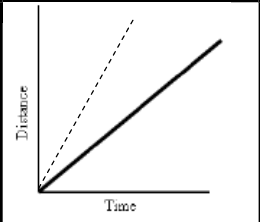

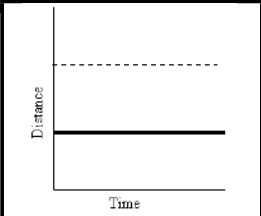


Match the description to the graph:
"The car is stopped."


Select the description of motion from A - B.
Slowing down away from the origin
Speeding up away from the origin
Constant velocity away from the origin
Constant velocity towards the origin

What segment of the graph shows no motion, or standing still?
A - B
B - C
C - D
None

The rate that a car's velocity changes is its
speed
force
gravity
acceleration

A roller coaster accelerates from an initial speed of 6.0 m/s to a final speed of 70 m/s over 4 seconds. What's the acceleration?
24 m/s2
18 m/s2
16 m/s2
16 m/s

What is Acceleration?
How long it takes me to win at fortnite
The direction of an object
A change in Motion
How fast something is moving
What does speed x time equal?
velocity
Distance travelled
acceleration
stopping distance
Choose the correct equation for acceleration (2 apply)
acceleration = change in velocity / time
acceleration = change in velocity x time
acceleration = force / mass
acceleration = force x mass


What type of energy decreased when you hit the brakes?
What is energy transfer?
Movement of energy from one store to another
Loosing energy
Useful energy
Heat
A stretched spring has what type of energy store?
Kinetic energy store
Gravitatioanl potential energy store
Elastic potential energy store
Thermal energy store
When a bungee jumper is about to jump, where is the energy stored?
Kinetic energy store
Gravitatioanl potential energy store
Elastic potential energy store
Disipated to the enviroment
At the bottom of the bungee jumper's first bounce, where is the energy stored?
Kinetic energy store
Gravitatioanl potential energy store
Elastic potential energy store
Disipated to the enviroment
When the bungee jumper finishes bouncing where is the energy stored
Kinetic energy store
Gravitatioanl potential energy store
Elastic potential energy store
Disipated to the enviroment

Earth’s nearest star (our Sun) radiates this type of energy.
Solar
Coal
Propane
Oil



The time taken for one wave to pass a given point.
period
wavelength
frequency
amplitude
The maximum displacement of a point on a wave from it's rest position.
wavelength
frequency
amplitude
period
The number of vibrations (or the number of waves) per second.
period
frequency
amplitude
wavelength
The distance between a point on one wave and the same point on the next wave
period
amplitude
frequency
wavelength
A wave where the particles vibrate in the same direction as the wave is travelling.
transverse
longitudinal
water
electromagnetic
A wave where the vibrations are at right angles to the direction the wave is travelling.
longitudinal
transverse
sound
seismic
Any substance through which something travels.
medium
large
small
x large
The boundary between two materials.
interface
medium
border
normal
The change in direction when waves go from one medium to another.
reflection
dispersion
refraction
diffraction
An imaginary line at right angles to a surface where a ray of light hits it.
interface
normal
incidence
gradient
What type of wave is light?
transverse
longitudinal
neither
What type of wave is sound?
transverse
longitudinal
neither
What type of wave is ultrasound?
transverse
longitudinal
neither
What type of wave are radiowaves?
transverse
longitudinal
neither
Which of the following travel as transverse waves? (more than one answer)
light
radiowaves
water
sound
wavespeed = ?
frequency x wavelength
frequency ÷ wavelength
wavelength ÷ frequency
wavespeed = ?
distance x time
distance ÷ time
time ÷ distance

Which letter represents the amplitude of this wave?
A
B
C
D
Which letter represents the wavelength of this wave?
A
B
C
D
Which of the following does NOT show a transverse wave?


Which of the following does NOT show a longitudinal wave?


What is the Order of visible light in the Electromagnetic System?
Red,Yellow,Orange,Green,Blue,Indigo,Violet
Red,Orange,Yellow,Green,Blue,Indigo,Violet
Violet,Indigo,Green,Blue,Red,Orange,Yellow
Violet,Blue,Red,Orange,yellow,green,Indigo
Longest Wavelengths and Lowest Frequencies?
Visible Light
Microwaves
X-Rays
Radio Waves
Shorter Waves have ____Energy,Longer Waves___Energy?
Lower,Higher
Higher,Lower
Shortest Wavelength and a Higher Frequency on the Electromagnetic System?
X-rays
Infrared
Visible Lights
Gamma Rays
Order Of the Electromagnetic System?
Radio Waves,Microwaves,Infrared,Visible Light,X-rays,Ultra Violet,Gamma.
Radio Waves,Microwaves,Infrared,Visible Light,Ultra Violet,X-rays,Gamma.
What is the Electromagnetic Spectrum?
A Group of Energy Waves That are Visible to the human Eye.
The name Given to a Group of Waves that mostly are Invisible and can travel through empty Or outer Space.
Example Of A Radio Waves?
Cellphone's,Remote Control.
Heat Lamps.
Microwaves,Satellites
Visible Light?
Human Eyes Can't Detect and Have Higher Frequency than Infrared.
Human Eyes Can detect and are Have a Higher frequency than Infrared.
Human Eyes Can't Detect and Have lower Frequency than Infrared
Human Can detect and have higher Frequency than Radio waves.
Ultra Violet?
Can carry more Energy than Visible light and Longer wavelengths, Lowest frequency.
Can Carry more Energy than X-rays
Can Carry more Energy than Visible Light and Shorter Wavelengths,Higher Frequency than Visible Light.
Can Carry more Energy than Gamma rays.
Radio Waves?
Longest Wavelength and Lowest frequency in the Electromagnetic Spectrum.
Shortest Wavelength and Highest frequency in the Electromagnetic System.
Longest Wavelength, Highest Frequency in Electromagnetic System.
Microwaves ?
Shorter Wavelength than X-rays and lower Frequency than X-ray.
Longer Wavelength than Radio Waves and Higher Frequency than Radio waves.
Shorter Wavelength than Radio Waves, Higher Frequency than Radio Waves.
X-Rays?
Have shorter wavelengths and Higher Frequency than Gamma Rays.
Have longer wavelengths and Higher Frequency than Ultra Violet.
Have shorter wavelengths and Higher Frequency than Ultra Violet.
Gamma Rays?
Higher Frequency and shortest wavelengths in the whole Electromagnetic Spectrum.
Lowest Frequency and longest wavelength in the Electromagnetic System.
Infrared?
Higher Frequency and longest wavelength than Radio waves.
Lowest frequency and higher frequency than radio waves.
Higher Frequency and shortest wavelength than Microwaves .
Visible Light Humans eyes Can't detect?
True .
False.
Can too Much Ultra Violet Light can Cause Cancer
True.
False.
Gamma Rays Highest Frequency in the Electromagnetic system.
False.
True.
You can Not detect Infrared waves with special Goggles.
True
False
Longest wavelength=______
Red
Purple
Violet
Shortest Wavelength=_____
Green
Red
Violet


This type of electromagnetic wave can be used to see inside luggage at an airport or in hospitals to see your bones.
Gamma Rays
Visible Light
X Rays
Infrared Rays
This type of electromagnetic wave has the most energy and therefore can be very dangerous.
Microwaves
Radio Waves
X Rays
Gamma Rays

Ionizing radiation has the ability to cause biological damage to our tissues. True or False
True
False
This is the name for the type of radiation that naturally occurs in the environment and is generally safe.
background radiation
environmental radiation
ionizing radiation
acceptable radiation
Which of the following are examples of ionising radiation?
Gamma Rays
Alpha particles
Beta particles
Why are some elements radioactive and some aren't?
Because they are light
Because they are heavy
Because they are unstable
Because they are stable
Which best describes gamma radiation?
A helium nucleus.
A fast moving electron.
High frequency electromagnetic wave.
Cosmic radiation comes from ....
Nuclear bombs
Nuclear Power stations
Space
Earth's core
Isotopes in objects
Flying in a plane increases your exposure to cosmic radiation
true
false
Select the dangers associated with gamma rays.
cancer
mutating DNA
heating of internal organs
sun burn



Electrons have a ________.
positive charge
neutral charge (no charge)
negative charge

Protons have a _____.
positive charge
neutral charge (no charge)
negative charge

Neutrons have a _______.
positive charge
neutral charge (no charge)
negative charge

